The official publication date is still October 1, but more and more book sites are noting that The Mammoth Book of Hockey Trivia is now in stock. If you don’t have one yet, you can order it here, or get it at any place you like to buy your books. And if you do have it, and like it, feel free to give it an online review.
I didn’t get a lot of guidance from the publisher when I started working on this book. The key thing was, “give us lots!” So, I did. I think the manuscript I submitted was 125,000 words, and more was added to bulk it up. But, in the end, we had to cut some things too. The book still comes in at 496 pages, so there’s lots to read. Some of the cuts included a short chapter on NHL Captains, and since I’ve still got all the information and I’ve got this web site, I figured I’d post some of it here…
RULE 6
Rule 6 in the NHL rule book is about captains and alternate captains. One Captain shall be appointed by each team, and he alone shall have the privilege of discussing with the Referee any questions relating to interpretation of rules which may arise during the progress of a game. Either one Captain and no more than two Alternate Captains (we always referred to them as assistant captains), or no Captain and no more than three Alternate Captains are permitted. The designated players shall wear the letter “C” or “A” approximately three inches (3”) in height and in contrasting color, in a conspicuous position on the front of his sweater. No co-Captains are permitted.
C IS FOR CAPTAIN
It was for the 1947–48 season that the NHL rule book was updated to say a team captain shall wear the letter “C” on the front of his sweater. Captains in hockey pre-date the NHL in 1917, and have likely been part of the game since the beginning, but prior to 1947, there was no requirement for a public display of who was a team’s captain. Some NHL captains had already been wearing the letter previously, as can be seen in some team pictures and newspaper photos from the 1946–47 season. It’s said that the practice evolved from soccer, in which captains wear armbands.
GOALIE CAPTAINS
JOHN ROSS ROACH
John Ross Roach was the first of six goalies in NHL history to officially serve as team captain. Roach was captain of the Toronto St. Patricks for the 1924–25 season. According to The Toronto Daily Star on November 18, 1924, Roach had been the unanimous choice of his teammates at their first practice of the season the day before.
THREE IN 1932–33
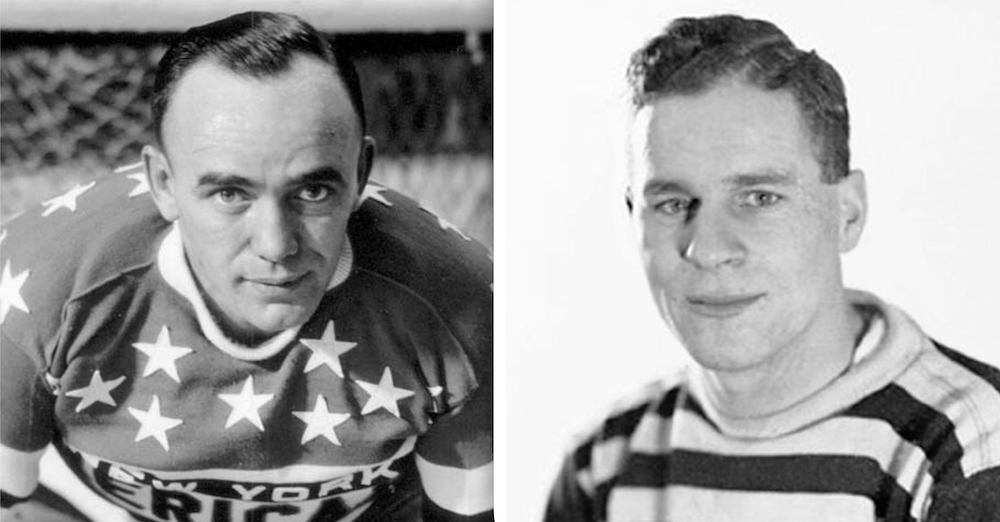
On October 31, 1932, at an NHL meeting in Toronto, the league added a rule compelling teams to have a captain on the ice at all times. If the regular captain was on the bench, a pro-tem leader would be named and the referee advised. In order to comply with the rule, three teams named their goalie to be their captain for the 1932–33 season. Alec Connell of the Ottawa Senators was identified as team captain in The Ottawa Citizen on November 3, 1932. Montreal Canadiens manager Leo Dandurand named George Hainsworth as captain on November 9, 1932. Roy Worters of the New York Americans also served as team captain that season.
CHARLIE GARDINER
On November 7, 1933, newspapers reported goalie Charlie Gardiner had been elected captain of the Chicago Black Hawks for the 1933–34 season. “If Major Frederic McLaughlin’s promise was all they needed,” the papers said, “Chicago Black Hawks would be just as good as in possession of the Stanley Cup right now. After seeing Charlie Gardiner elected captain yesterday, the Major, owner of the Chicago club, predicted this year’s edition of the Hawks would bring Chicago its first world championship.”
Charlie Gardiner became a bright spot on a weak Chicago team when he broke in with the Black Hawks in their second season of 1927–28. In 1930–31, he helped lead Chicago to the Stanley Cup Final and was named to the First Team the first time an NHL All-Star Team was selected. Gardiner won the Vezina Trophy and was also a First-Team All-Star in 1931–32. As team captain in 1933–34, he earned those honors again and led Chicago to the Stanley Cup as Major McLaughlin had predicted. Gardiner is the only goalie in NHL history to have his name engraved on the Stanley Cup as team captain.
Tragically, barely two months after leading his team to the Stanley Cup over the Detroit Red Wings on April 10, 1934, Charlie Gardiner was dead at the age of 29. He had played the entire 1932–33 season while suffering from tonsillitis and was never quite able to beat the disease despite repeated hospital visits. The infection grew steadily and spread to his kidneys. His health problems flared up throughout the 1933–34 season, often leaving him in severe pain, yet he played through it. Gardiner passed away on June 13, 1934, in Winnipeg, the city he had grown up in after coming to Canada from Scotland with his parents as a boy. The attending physician attributed Gardiner’s brain hemorrhage to the tonsil and kidney infections. He ruled out any link to hockey injuries.
BILL DURNAN
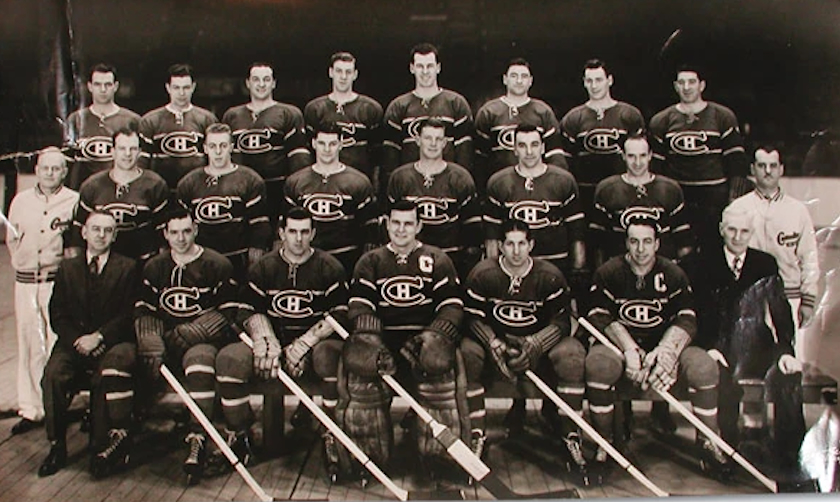
The records of both the Montreal Canadiens and the NHL have long noted that Bill Durnan shared the captaincy of the Montreal Canadiens with Toe Blake in 1947–48. However, Durnan and Blake first shared the captaincy a year before, in 1946–47. A team picture long identified as being from the 1947–48 season shows both Blake and Durnan with a C on their sweater, but the photograph was actually taken in 1946–47. (The picture includes both Buddy O’Connor and Frank Eddols, who had both played for the Canadiens for several seasons but were traded to the New York Rangers on August 19, 1947.) Analysis done by author Pat Laprade and Carl Lavigne, former manager of research for the Canadiens, shows that Blake and Durnan often shared the captaincy throughout the 1946–47 season. In checking the game sheets for 54 of the 60 games played during the 1946–47 season, Durnan and Blake both have the C next to their names 36 times. In total, Durnan was listed as captain on the game sheets 47 times and Blake 43 times. Further checks were made in newspapers from the time and it was often seen that for the same game there was a photo of Durnan and another of Blake both wearing the C.
Toe Blake was first named captain of the Canadiens for the 1940–41 season. After sharing the duties with Bill Durnan in 1946–47, Blake resumed the captaincy alone for the 1947–48 season. Of the 32 games Blake played that year before suffering a career-ending broken right ankle in a game against the New York Rangers on January 10, 1948, a check of the game sheets for 26 of them revealed Blake as the captain every time. After Blake was injured, Murph Chamberlain initially replaced him as captain, but Durnan soon took over — although the C was sometimes exchanged between them. In 13 game sheets that were checked after Blake’s injury, Durnan was shown as captain nine times compared to four for Murph Chamberlain. When Durnan is listed as captain, Chamberlain is the alternate captain and vice versa.
THE DURNAN RULE
Bill Durnan was the top goaltender of his day, starring with the Canadiens from 1943–44 through 1949–50. He won the Vezina Trophy in each of his first four seasons in the NHL and in his last two seasons as well. He was also named to the First All-Star Team in each of those six seasons and helped the Canadiens win the Stanley Cup in 1944 and 1946. As captain, it’s long been said that when Durnan left his crease to discuss calls with the referee — as was his right as team captain — other teams protested that he was slowing the pace of the game and giving the Canadiens unscheduled time outs. On June 8, 1948, some Canadian newspapers reported on a recent meeting in Montreal between the NHL, the minor professional American Hockey League, United States Hockey League and Pacific Coast Hockey League, plus the Canadian Amateur Hockey Association. Among the new rules agreed to was that a goalkeeper would be penalized if he left his net to argue a decision with a referee. In amateur leagues, goalies would receive a minor penalty, while in the pro leagues a goalie would be fined $50. The newspaper stories noted, “Even if he is captain or alternate captain he will not be allowed to wander about the ice protesting.” However, the NHL would add a new provision to its rules about captains in the rule book in 1948–49. “No goalkeeper shall be entitled to exercise the privileges of Captain or Alternate Captain on the ice.” This new regulation is sometimes referred to as the Durnan rule. The current NHL rule book states: “No playing Coach or playing Manager or goalkeeper shall be permitted to act as Captain or Alternate Captain.”
ROBERTO LUONGO
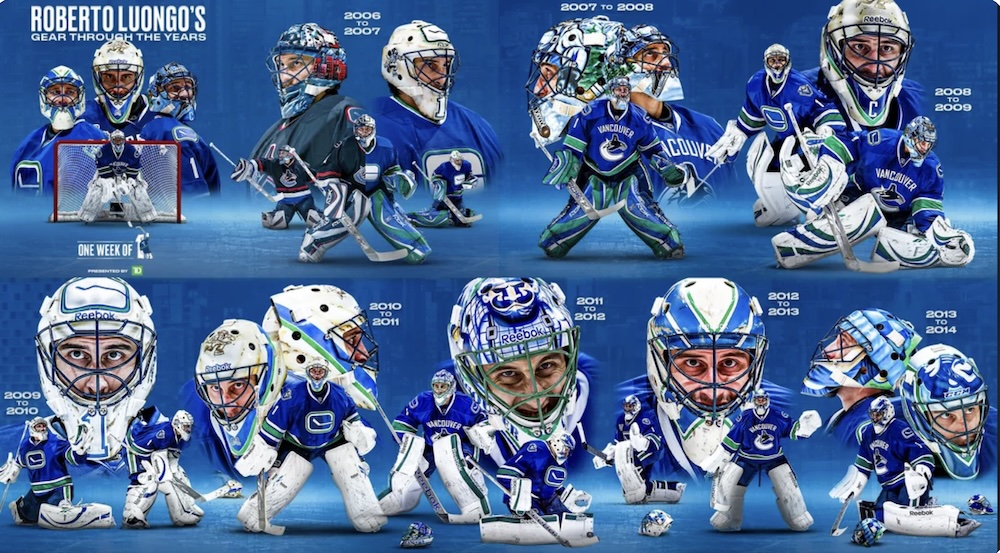
No NHL goalie had served as his team’s captain since Bill Durnan with the Montreal Canadiens in 1947–48 until Roberto Luongo was named captain of the Vancouver Canucks in 2008–09. Luongo was captain though the 2009–10 season. Henrik Sedin took over as captain after Luongo stepped down before the 2010–11 season. “He should be proud of himself,” Sedin said. “He did a good job for us. If this is going to help him be a better goalie, I think we like that as a team.” On the ice, Luongo’s role as captain was mainly symbolic since NHL rules forbid goalies to wear a C and to engage with the referees. Luongo had a C painted on the chin of his mask and defenseman Willie Mitchell served as the liaison with officials.


