All posts by Eric Zweig

Early Men Behind the Mask

It’s been 42 years now since I last went back to school, and pretty much 20 since I even had a child going back to school. And for pretty much 22 years from 1996 to 2018, summer was my busiest work time of the year. Even so, I still find the days after Labour Day to be pretty depressing. And yet, after a summer of inactivity on my web site, here I am back at it again…

I pretty much refrain from turning my own sporting interests from baseball to hockey until early October at best and usually not until after the World Series — especially since the Blue Jays have climbed back into wild card contention and are proving fans with “meaningful games in September” — but I do have a hockey book coming out soon, so hockey it is today.

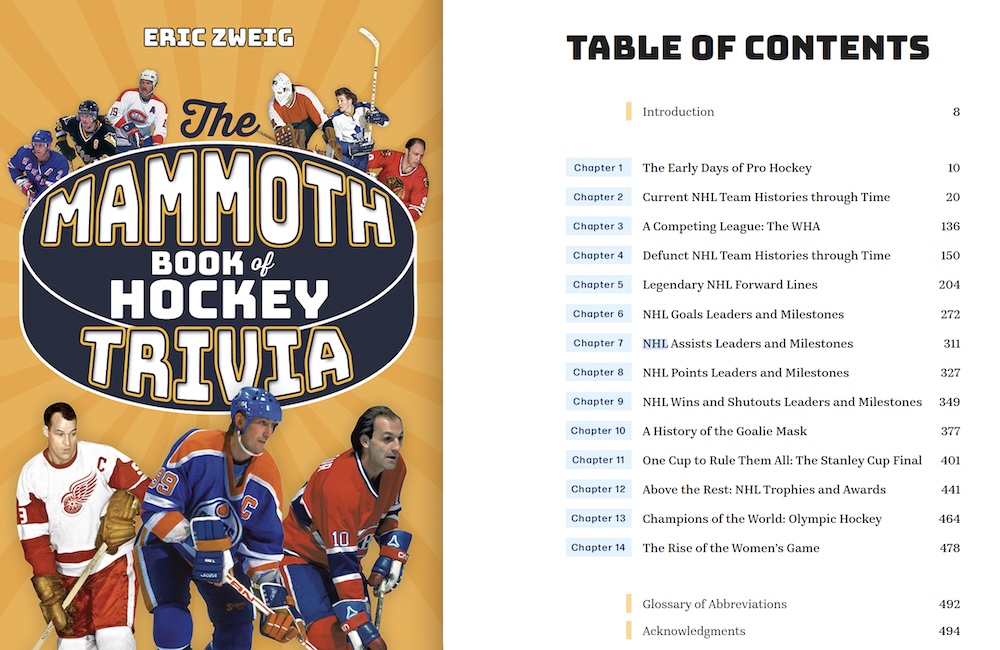
As I mentioned in some of my last posts in the spring (May 22 and June 4), The Mammoth Book of Hockey Trivia is out this fall. Book releases aren’t as exact as movie releases. The true date really depends on how quickly books are delivered from the printer to the publisher’s warehouse, and then how quickly they are sent from the warehouse to various booksellers, and then how quickly the booksellers actually start selling them. The official release date is still October 1, but I know of at least one friend who pre-ordered the book in July and has received his copy already. So, feel free to order your own copy right now!

My newest book is coming soon…

The book is a trivia book in the dictionary definition of the word in that it’s full of facts and figures, not questions and answers. But at 496 pages, it is pretty mammoth. And today, I’m featuring a few stories from Chapter 10 about the history of the goalie mask (which I had to fight a little bit to make sure was included in the book when all was said and done). It’s a topic I’ve covered on my web site in years past (December 2, 2020 and March 11, 2015), though I was surprised how many years past! These stories today are from the early 1920s — which I still have trouble wrapping my brain around being more than 100 years ago! Two of them basically occurred within a few days of each other.

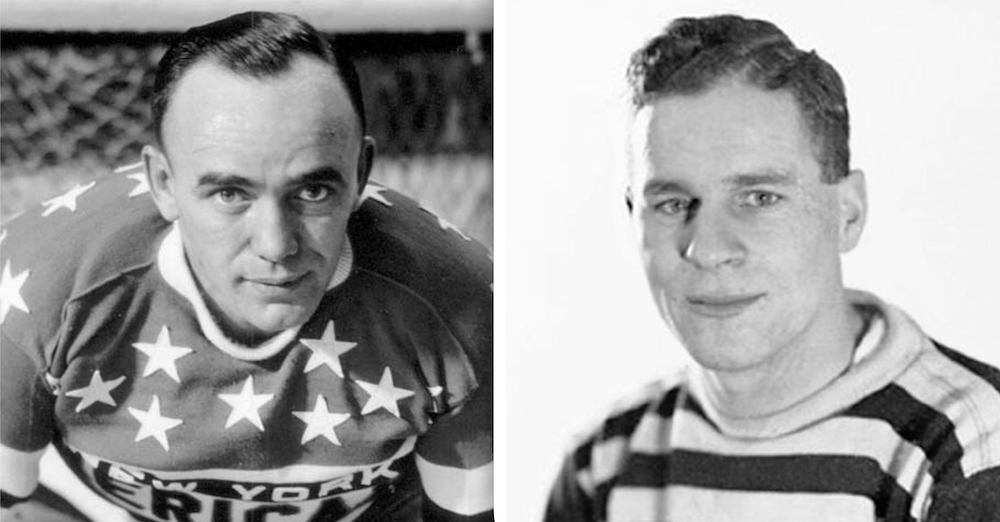
Herbert Lyons was a goalie with a team called the Greys in Montreal. He was pictured in The Montreal Star on February 4, 1922, wearing a full catcher’s mask and with a caption saying, “Unique apparition which will appear during the matches of the Mount Royal Hockey League in the Arena tomorrow afternoon.” The newspaper notes Lyons “had his nose split some time ago,” and would be wearing the mask to protect his injury. Lyons’ story was also reported on that same day in The Calgary Herald and his masked picture appeared in The Daily Province in Vancouver on February 14. Only The Montreal Star followed up with a report of the Saturday game in its Tuesday edition on February 7 … and it turns out he didn’t go through with wearing it. “Lyons, Grey’s goaler, appearing on the ice with his mask could not stand the teasing from spectators and discarded it at the beginning of the game.”

At almost the same time Herbert Lyons wasn’t wearing his mask in Montreal, Iver Anderson of the Duluth Hornets was wearing one in a United States Amateur Hockey Association game against the Cleveland Indians in Duluth, Minnesota on February 7, 1922. The previous night, also against Cleveland, Anderson was hit in the mouth one minute in to the third period on a shot by future NHL star Nels Stewart and had four teeth knocked out. The Cleveland coach offered Duluth their substitute goalie, but Anderson refused to leave the game. Duluth was losing 3–2 at the time, and Anderson allowed another goal a few minute later “while still in a groggy condition,” according to the game report in The Duluth News Tribune, but his team rallied for a 6–4 win.

Newspaper coverage of Herbert Lyons and Iver Anderson.

Other Duluth players had been banged up as well in the game that night, and the team was beaten 5–0 by the Indians in their February 7 game. “[T]here is no use in saying that Anderson was not in fit condition to play,” reported the News Tribune. “Everyone who saw him knew that much. Spending a sleepless night in a hospital; passing all afternoon in a dentist’s chair Anderson returned to the game last night. He wore a baseball catcher’s mask and this did not help him in keeping his eyes on the puck.”

Two nights later, Iver Anderson was back in action in Winnipeg for the Duluth American Legion team when they were defeated 11–7 by the Manitoba all-stars. “Anderson of Duluth wore a baseball catchers’ mask and had difficulty in keeping his eye on the puck,” read a report from Winnipeg that ran in The Duluth News Tribune on February 10. Whether or not he wore a mask for the rest of the season, Anderson would put one on again early the next season on the night of December 30, 1922. Prior to a Duluth legion game with a team from the Canadian Soo (Sault Ste. Marie, Ontario), he was hit in the face with a practice shot. “Anderson received a bad cut over his left eye,” said the News Tribune in its story on December 31, “but returned to the game with a baseball mask and football headgear.” He played well that night in a 2–1 loss.

Iver Anderson is an interesting story. The Duluth News Tribune said of him on November 1, 1922, that he was “the first player to use a baseball mitt during actual play in the net,” and the accompanying picture makes it clear he was wearing one. After he left Duluth to play with the St. Louis Flyers of the American Hockey Association for the 1928–29 season, The St. Louis Star and Times shed more light on Anderson’s baseball background. A story in that St. Louis newspaper on December 12, 1928, claims Anderson had been a baseball catcher and knew little about hockey until he was pressed into action by a hockey team whose goalie was out with the flu.

The story from St. Louis and the Duluth picture clearly showing a baseball glove.

“To say Anderson made a hit in his first appearance is so mild it’s actually libelious,” says the story. “He was a wow, a panic. He played a good game, but that wasn’t what knocked the customers out of their chairs. He scored on his interpretation of what the well-dressed goalie should wear. His left hand was buried in his old catcher’s mitt. In his right he carried a hockey stick half the regulation size, which he explained was less cumbersome and far more sensible than that usually carried.” Though it gets some of the details wrong, the St. Louis paper also gives a brief outline of Anderson wearing his baseball mask in his Duluth days.

Unfortunately, Iver Anderson was no longer wearing a mask on February 1, 1929, when he was playing for St. Louis while back in his hometown of Duluth. Early in the second period, Anderson was hit in the face again and injured badly. Anderson returned to action for the Flyers’ final home game of the season in St. Louis on March 1, 1929. It was already known that he would retire at the end of the season, and he gave up 12 goals in a 12–2 loss to the Tulsa Oilers. He did not play on the season-ending four-game road trip to Tulsa, and though there were reports in November of 1929 that St. Louis wanted him at least as a back-up goalie, Anderson never played again.

Back in 1921, better protection for goalies had been on the agenda when the Ontario Hockey Association met for its annual convention on Saturday, December 3. OHA executives did not vote in favor of the goal crease, which had already been adopted in an earlier meeting of the Canadian Amateur Hockey Association, but they did agree to let goalies wear a mask if they chose to. Rule 15 in the OHA rule book dealt with goalies. Previously, when it came to equipment, the rule for many years had stated, “He may wear pads, but must not wear a garment such as would give him undue assistance in keeping goal.” Now, a sentence was added saying, “He may wear a mask to protect his face and head if he so desires.”

Picture from the Toronto Star in 1919 and Belleville headlines from 1923.

Still, no OHA goalie was known to wear a mask until Len Crook of Belleville in 1923. Crook played goal for four different Toronto teams in the senior division of the Ontario Hockey Association from 1916 through 1922, but his off-ice job as an employee of the Canadian Bank of Commerce took him to Belleville in the spring of 1922. The Daily Intelligencer in Belleville would repeatedly misspell his name as Crooks, and in the newspaper’s story on January 11, 1923, of the team’s 8–3 win over Brockville the night before, it was reported “Crooks stopped a nasty shot from the corner which struck him in the mouth splitting both lips and loosening his teeth.” Crook was unable to continue, but returned for the next game when Belleville beat Queen’s University 4–1 on January 15. Just over a year after the OHA had passed its rule allowing goalies to wear masks, Crook became the first one known to do so. He played at least one more time with a mask in Belleville’s next game on January 26.

After the 1922–23 season in Belleville, Len Crook returned to Toronto for a new job with the Bank of Nova Scotia and retired from hockey. There is never a specific description of the type of mask he wore, but the The Toronto Star on January 11, 1924, notes Crook had finished the 1922–23 season with a headgear and mask and that he believed the Canadian Amateur Hockey Association should make such gear compulsory for every goalie. “The way players drive that puck nowadays makes it dangerous,” said Crook. “Some day someone will stop one with his temple and you know flowers are dear in the wintertime.”

Still, it was not until the 1958–59 season that the NHL added a line to its rule book stating: “Protective masks of a design approved by the Rules Committee may be worn by goalkeepers.” Jacques Plante began wearing a mask in games the very next season although it would not be until the 1974–75 season that every goalie in the NHL wore one. As late as 2009–10, the NHL rule book only said masks “may” be worn by goalkeepers. The wording wasn’t changed to “must be worn” until 2010–11.

******************************************************************************************

If you’re looking for a different kind of hockey book, here are two interesting ones people contacted me about this summer.

For Toronto Maple Leafs fan interested in some light-hearted though factually accurate relief from the team’s Stanley Cup struggles since 1967, there’s 60 Years of Disappointment by Richard Spiegel.

And, if you’ve got a young reader on your shopping list, there’s That’s Mein Boy: The Alex Levinsky story by Rabbi Ron Isaacs. Ron is a long-time New Jersey rabbi who was born in Toronto and has numerous books — mainly about Judaism — to his credit. (As some of you may recall, I wrote about Levinsky on my site back in 2024.)

It’s Coming Around Again

There’s certainly a lot going on in sports these days. So, let’s start with congratulations to the Carolina Hurricanes … a team that, admittedly, I’ve never paid much attention to. Obviously a team without a lot of top stars, but a team that (and this is not an original thought of mine) definitely resembles their coach Rod Brind’Amour and plays a stifling brand of team-first hockey. Their first championship in 20 years, and the neat thing about Brind’Amour is he’s just the fourth man in NHL history to both captain (2006) and coach (2026) the same team to the Stanley Cup. He joins Hall of Famers Cooney Weiland (Boston), Hap Day (Toronto) and Toe Blake (Montreal) in that little club.

In Toronto, the Maple Leafs farm team the Toronto Marlies seems well on their way to the American Hockey League Calder Cup championship, which they won previously in 2018. Hardly seems like a boatload of their players will suddenly turn the Leafs into Stanley Cup contenders, though. I’m sure Easton Cowan has gotten some useful experience, and perhaps goalie Artur Akhtyamov has vaulted himself up the pecking order … especially with the recent trade of Joseph Woll. But it’s not like the Marlies’ 2018 champions did much to bolster Maple Leaf playoff pursuits in recent years. And who the heck is Jim Hiller? I mean, I guess I must have known who he was when the was a Maple Leafs assistant coach under Mike Babcock and I was still working on the NHL Guide & Record Book. And I may have been vaguely aware of his being fired by the LA Kings this season … but I feel like when the Leafs hired him on Wednesday that was the first I’d ever hear of him!

Then there was the news on Tuesday that Hockey Night in Canada will no longer air on the CBC. It’s a blow to history and tradition (and an evil triumph of money above everything else), but really, it hasn’t been Hockey Night in Canada since Sportsnet took over in 2013 (or maybe dating back to 2008, when CBC dropped the theme song!) even if Saturday night and playoff games still aired on the CBC until a few days ago. Funny thing is, you can watch hockey on some channel (mostly a Sportsnet channel) every night of the week, but I don’t watch nearly as much as I did when we got one Wednesday night Leafs game and Hockey Night in Canada on Saturdays during my youth. But I feel bad for anyone who doesn’t have a cable package that includes Sportsnet and will either have to pay more or stop watching.

And of course, in Toronto and Vancouver, and in a host of other American and Mexican cities, (and cross most of the globe) the big news in sports is the World Cup. Never been much into soccer myself. I get that it’s a big deal all around the world. And I know my brothers and my nephews are into it. I don’t want to discourage anyone who’s enjoying it now … and I’m sure I’ll tune in later today when Canada faces Qatar. Because, you know, Qatar. Who doesn’t want to watch Canada versus Qatar? Playing soccer…

But interestingly to me at least, the recent sports news I’ve found myself thinking about the most is the New York Knicks’ NBA championship. I’m the furthest thing from a basketball fan these days, but I guess there’s something about the first title since 1973 that’s appealing to even a don’t-live-and-die-with-’em Maple Leafs fan. It was sort of fun watching the New York-born celebrities getting so excited about it. But I had my own odd sort of personal connection.

I used to watch basketball more than the almost none I watch now. I remember the commercials for NBA games on the American channels of my TV childhood — “Buffalo, home of the Braves!” And, of course, I knew of their star, Bob McAdoo (whose distant cousin Charles is currently with the Blue Jays). I never saw the Braves play at Maple Leaf Gardens when they’d occasionally play home games there in the early 1970s, but I did see the Harlem Globetrotters!

I first got into basketball in 1979 when we were skiing in Colorado at March break and the news on TV was hyping the NCAA championship featuring Larry Bird of Indiana State and Magic Johnson of Michigan State. I continued to follow those two during their NBA rivalry with the Celtics and Lakers. Their basketball heyday coincided with my basketball heyday when I worked with Digital Media, a small “electronic newsroom” in Toronto from 1986 to 1990. We watched, and wrote about, a ton of NBA and NCAA basketball in those days … and that’s where my tiny Knicks connection comes from.

I knew (though I don’t remember how or why) about Willis Reed’s heroic turn on a badly injured leg in Game 7 versus the Lakers inspiring the Knicks to their first championship in 1970. And about he and Walt Frazier leading them to another in 1973. And about the team’s run of mediocrity after that, which was already seeming to be a pretty long one by 1988–89 when they were suddenly a contender again. We at Digital Media had access to satellite channels in those days that no one I knew had at home, and I guess we were sometimes watching Knicks games on MSG (Madison Square Garden) Network or something like it. And I remember this commercial. As I recall, it was full of 1970 and 1973 Knicks footage interspersed with highlights of the current team with a Carly Simon song playing under it:

I know nothing stays the same.
But if you’re willing to play the game.
It’s coming around again.

I’ve been trying to find it with Google and YouTube searches for a while now with no success. But, I’m pretty sure it was a real thing! I’ve certainly thought of it a lot over the years.

I thought about it in 2015, when the Jays suddenly got red hot down the stretch to win the American League East for the first time since the World Series years of 1992 and 1993.


I thought about it a lot last year when the Jays finally made it back to the World Series

I thought about it on behalf of Knicks fans as their team got red hot in the playoffs.

I don’t like change … but I do know nothing stays the same. And, I guess, sometimes, if you’re willing to play the game, it really might come around again.

So, hang on Leafs fans. I’m not sure about the new management yet. But, maybe…!

Playoff Beards

As I mentioned in my previous post on May 22, I have a new book coming out in the fall. It’s called The Mammoth Book of Hockey Trivia. (Feel free to pre-order a copy now.) I didn’t receive a lot of direction for the book, but my key takeaway was “give us lots!” And I did. So much so that about 50 pages had to be cut in order to get it to the printer on time. (It’s still pretty “Mammoth” at just under 500 pages.) I figured some of the text that got cut might prove useful for future posts, and as I was watching Game 1 of the Stanley Cup Final on Tuesday, I thought the cut segment on playoff beards would work well now…

The tradition of players growing their facial hair during the playoffs is said to have started with the New York Islanders’ Stanley Cup dynasty of the 1980s. Wikipedia posits a theory put forward by hockey author and historian Andrew Podnieks that because the Islanders of that era featured Swedish players Stefan Persson and Anders Kallur, the playoff beard may have been inspired by tennis sensation Bjorn Borg of Sweden who let his beard grow during Wimbledon when he won five-straight championships from 1976 through 1980. Wikipedia also references an article by Ryan Kennedy in The Hockey News from 2006 in which Mike Bossy thought it was Butch Goring who started the trend.

Vegas players on Tuesday night display facial hair of varying lengths.

An article by Ian Walker of Postmedia News, appearing in several newspapers in April of 2011, tried to determine the origin of the playoff beard. In it, Butch Goring deflects any credit for inspiring the tradition during his time with the Islanders. “It was well on its way by the time I came on board in 1980,” Goring says, “but I don’t think any of us gave a second thought about whether it would become such a big rallying point for everybody like it is today.”

Islanders captain Denis Potvin agreed. “I don’t know if we can take full credit,” says Potvin, “and I wish I had a great story for you, but it was just one of those things. Back then, we’d play four games in five nights in the opening round and it was just something that kind of happened. It certainly wasn’t choreographed or planned. I really don’t recall a moment where everyone said ‘Ah-ha, we’re going to go ahead and do this.”

Ken Morrow was bearded before he joined the Islanders after the 1980 Miracle on Ice.

Rob Rossi of The Athletic had a story about playoff beards on June 17, 2025. In it, Denis Potvin said, “We were too tired to shave. Then we just didn’t. That’s part of it, you know? To win the Stanley Cup is a miserable two months. The beard is a reminder of how much you have to put into it.”

Ken Morrow was a bearded member of the first Islanders championship team in 1980, but he’d brought his beard with him when he entered the NHL in February after winning a gold medal with the “Miracle on Ice” U.S. Olympic team. “The first person I remember putting us with the beards was Stan Fischler,” Morrow told Rossi. Fischler, the longtime NHL writer and broadcaster (and New York-area teams historian), wrote a story about the Islanders and their beards “at some point during our run,” said Morrow. Morrow added that though he couldn’t point to a specific teammate who led the playoff beard charge in 1980, he remembers everybody being on board entering the 1981 playoffs. “Don’t mess with what’s working.”

Wikipedia credits the phrase “playoff beard” to an unusual source, saying the birth of the term relates to the Detroit Red Wings during the regular season of 1984–85, when players on the team agreed not to shave until they won four games in a row. An article in the Detroit Free Press by Bernie Czarniecki on February 3, 1985, credits the idea to Ivan Boldirev and Danny Gare and says Brad Park called his new facial hair his “playoff beard.” But the term is actually older than that.

Kevin Maxwell from the 1981 Minnesota Tribune and Brad Park with Detroit.


On April 26, 1983, the News of Paterson, New Jersey, refers to John Tonelli of the Islanders and his “lucky playoff beard.” Two years earlier, the Minneapolis Tribune on May 11, 1981, on the eve of the North Stars facing the Islanders in the Stanley Cup Final, has a photo of a shaggy Kevin Maxwell of Minnesota showing his “Stanley Cup Playoffs beard,” which may well have been inspired by the Islanders from the season before. 


Nearly three weeks before that, on April 23, 1981, the Minneapolis Star referred to North Stars rookie goalie Don Beaupre having “sprouted a very respectable playoff beard.” On May 10, 1981, James F. Clarity in the New York Times writes that the North Stars, during their first-round series with the Boston Bruins, “decided to grow beards as long as they lasted in the playoffs,” without referencing anything about the Islanders of 1980. But certainly many Islanders, including Potvin, Goring, Morrow and Clark Gillies, are sporting full beards in photographs at the end of the 1980 Stanley Cup Final when they had defeated the Philadelphia Flyers.

Ed Westfall was an original Islander from 1972 through 1979 who became a team broadcaster in 1979–80. In Rob Rossi’s 2025 story for The Athletic, he writes of Westfall saying that he and Bryan Trottier have often debated whether the 1980 Islanders truly pioneered playoff beards. “Both men said their Islanders teams in the mid-to-late 1970s also had players who didn’t shave during the playoffs,” wrote Rossi. “But, as the saying goes, winners write history, and … ‘Those teams didn’t win the Cup,’ Westfall said, laughing. ‘When you win and the players have beards, well, there you go — it’s a tradition, I guess.’” (Apparently, a handful of New York Rangers were growing playoff beards in the mid-1970s, but the Rangers never had much playoff success.)

The beard of Pittsburgh Jordan Staal this playoff season is among the bushiest.

In photographs and videos of the Islanders and the Stanley Cup from 1980 through 1983, only a handful of players are ever fully bearded. And the concept of the playoff beard didn’t catch on immediately after the Islanders’ dynasty. The Edmonton Oilers of 1984 through 1990 were mostly clean-shaven during their five Cup victories in those years. Ian Walker in his Postmedia story of 2011 wonders if the Oilers were just too young to successfully grow beards, or if it was a way to distance themselves from a hated rival.

Ian Walker attributes the comeback of the playoff beard to the New Jersey Devils of 1988. The Devils clinched their first playoff spot since moving from Colorado in 1982 on the last day of the 1987–88 season and then advanced all the way to the Eastern Conference Final. “Part of it was respect for the tradition the Islanders had started and part of it was superstition,” said Ken Daneyko, who was a rookie at the time and would go on to win the Cup in New Jersey in 1995, 2000 and 2003. “The playoffs really are an all-for-one mentality and growing a beard gave you a sense of purpose and focus.”

Lucky 6’s and 1916

It’s been a while since I’ve written anything new for my web site. There’s no particular reason for this one now, except that we’re halfway through the Stanley Cup playoffs. I’m certainly not making any predictions, but it seems to me I should be writing something at this point! As people generally know, it’s been 33 years since a Canadian team – a Canadiens team – last won the Stanley Cup in 1993. Will this be the year?

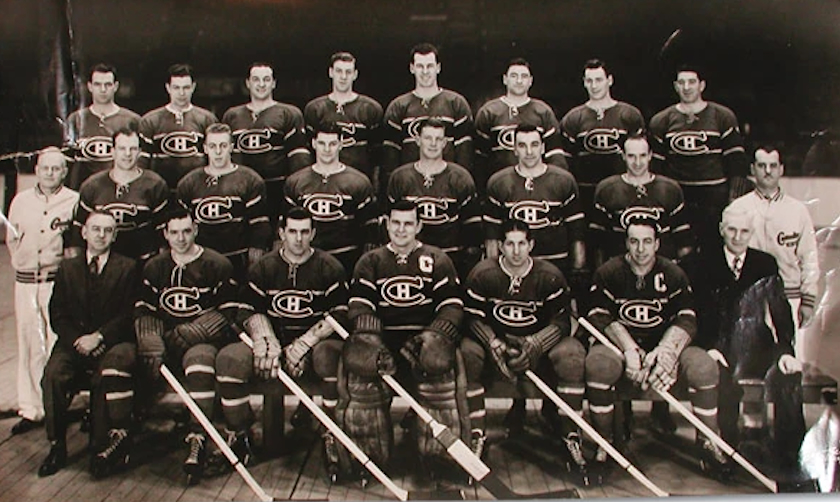
In the past, years ending in ‘6’ have been good ones for Montreal teams. The Montreal Victorias lost the Stanley Cup to the Winnipeg Victorias in February of 1896, but won it back in December 1896. The Montreal Wanderers won the Stanley Cup for the first time in 1906, the Montreal Canadiens won their first title in 1916, and the Montreal Maroons won in 1926. After the Red Wings beat the Maple Leafs in 1936, the Canadiens won the Cup again in 1946, 1956, 1966, 1976 and 1986! No such luck in 1996, 2006 or 2016, but the Montreal Victoire just won the Walter Cup as champions of the Professional Women’s Hockey League in the first ‘6’ year in league history and the Canadiens are still alive.

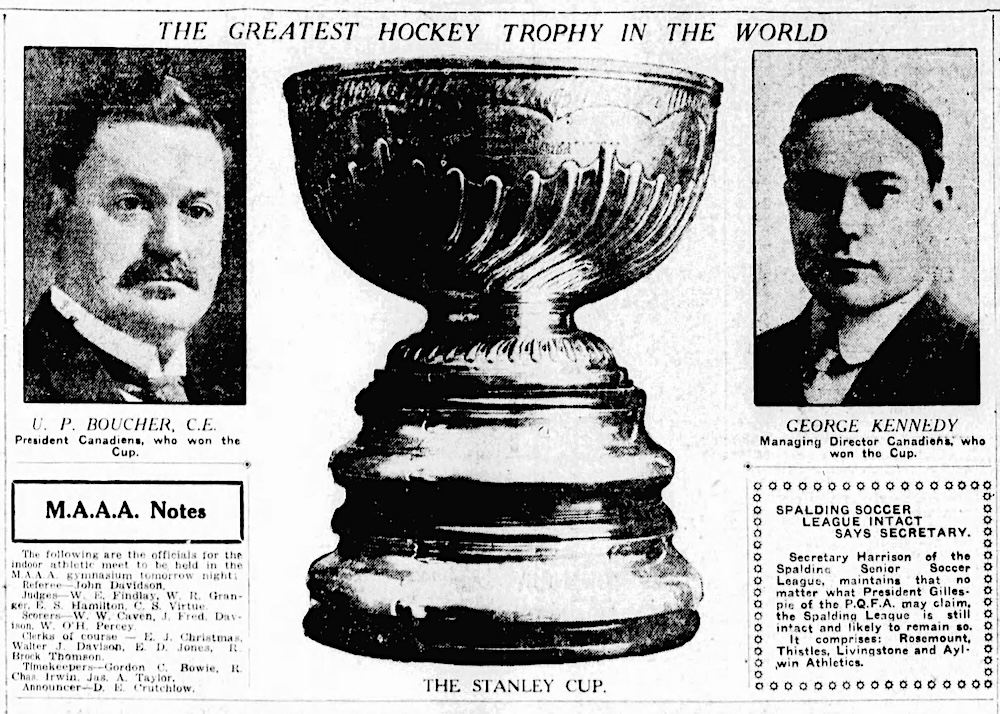
The Montreal Star, March 31, 1916.

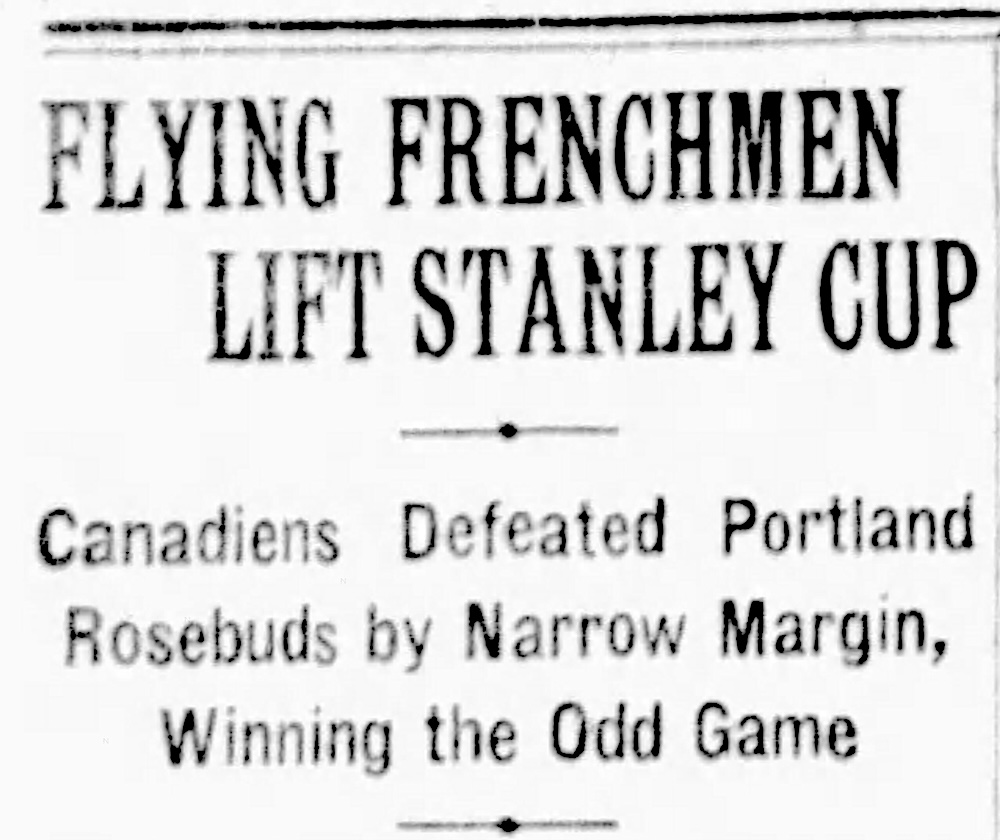
The first Canadiens Stanley Cup in 1916 came when the team played in the National Hockey Association (forerunner of the NHL) and at a time when the NHA champions faced the champions of the Pacific Coast Hockey Association for the Stanley Cup. In 1916, that was the Portland Rosebuds. The team is sometimes referred to as the Uncle Sams, though Portland is known as The Rose City and by whatever name they were called (mostly Rosebuds), they were the first American team to play for the Stanley Cup but fell to the Canadiens in the last game of a best-of-five series.

The Montreal Gazette, March 31, 1916.

The Canadiens beat Portland to win the Stanley Cup in 1916, but then lost it to Seattle (the Metropolitans of the PCHA) in 1917. Those two teams faced each other again in 1919 when their series was halted by the Spanish Flu Epidemic, but mostly, Montreal has faced teams from more traditional hockey markets in the Stanley Cup Final: fellow “Original Six” teams Toronto, Detroit, Chicago, Boston and New York, but also Calgary as well as Philadelphia and St. Louis, who’ve been around long enough now that they don’t seem like non-traditional hockey markets. And I guess we have to include Los Angeles in there too. Tampa Bay (who beat the Canadiens for the Stanley Cup in 2021) still seems like a less traditional market, but certainly a successful one … which is what you’d have to say about Colorado and Vegas as well, one of whom the Canadiens will meeting in the Final if they should knock off another less traditional market in Carolina.

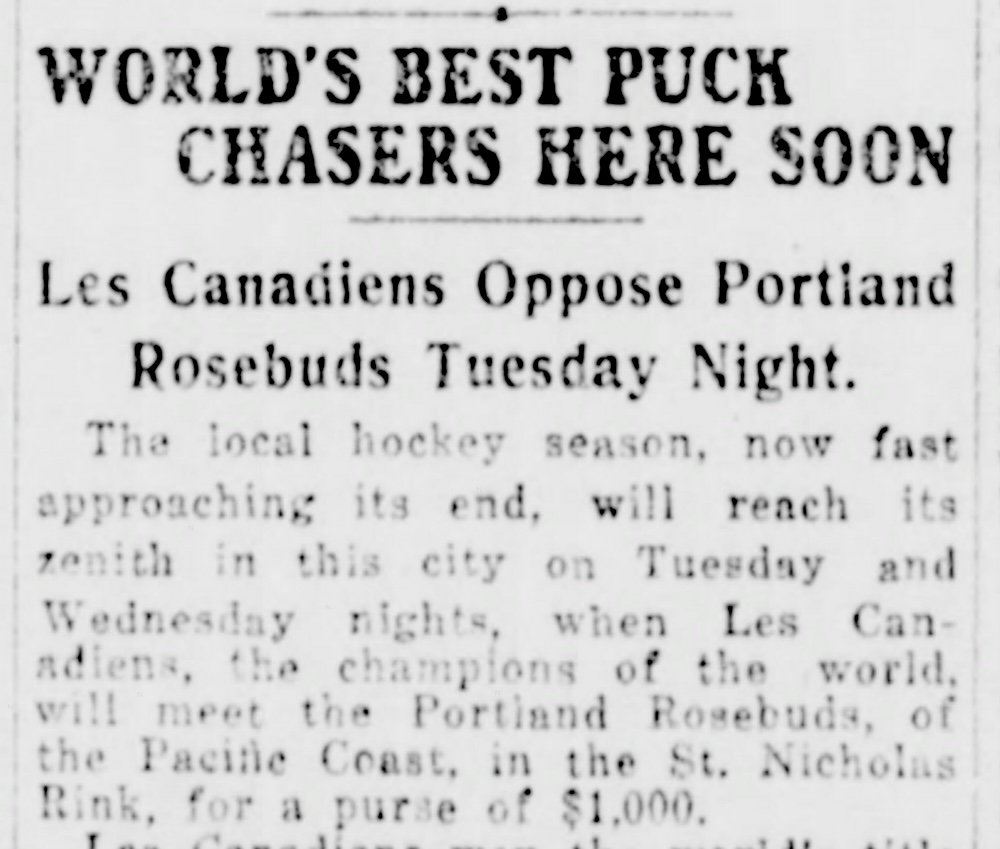
The New York Tribune, April 2, 1916.

After wrapping up their 1916 Stanley Cup series with Portland in Montreal on March 30, the two teams went on a U.S. barnstorming trip, which wasn’t uncommon at the time. While the Quebec Bulldogs and Montreal Wanderers of the NHA traveled to Boston for exhibition games, the Canadiens and Rosebuds went to New York for a two-game, total-goals series at the St. Nicholas Rink on April 4 and 5. The Canadiens won the opener 6–3 with stars Didier Pitre and Newsy Lalonde scoring twice each. The New York Tribune referred to the contest as “what is said to have been the greatest game of hockey ever played in this country,” although newspapers of this time were fond of hyperbole. “The crowd of probably 2,000 persons that gathered to watch these wonderful professional players in action [and seems to have been considered a sizeable crowd] was thrilled for every minute of the struggle.”

Goalie Georges Vezina was the true star of Game 1, with the Tribune saying he “was the personification of coolness as he parried the storm of shots that came buzzing, zipping and tearing at the cage.” The paper estimates Vezina made at least 40 saves. In Game 2, Portland scored a 4–1 victory, which made the score 7–7 overall. Overtime was needed, and Didier Pitre scored after just 1:59 of extra play so that while the final score was 4–2 Portland, Montreal took the series 8–7. New York newspapers mention a $1,000 prize, but the Montreal Gazette on April 12, 1916, notes Canadiens players split up $700 as their winning share with the Portland team getting $500.

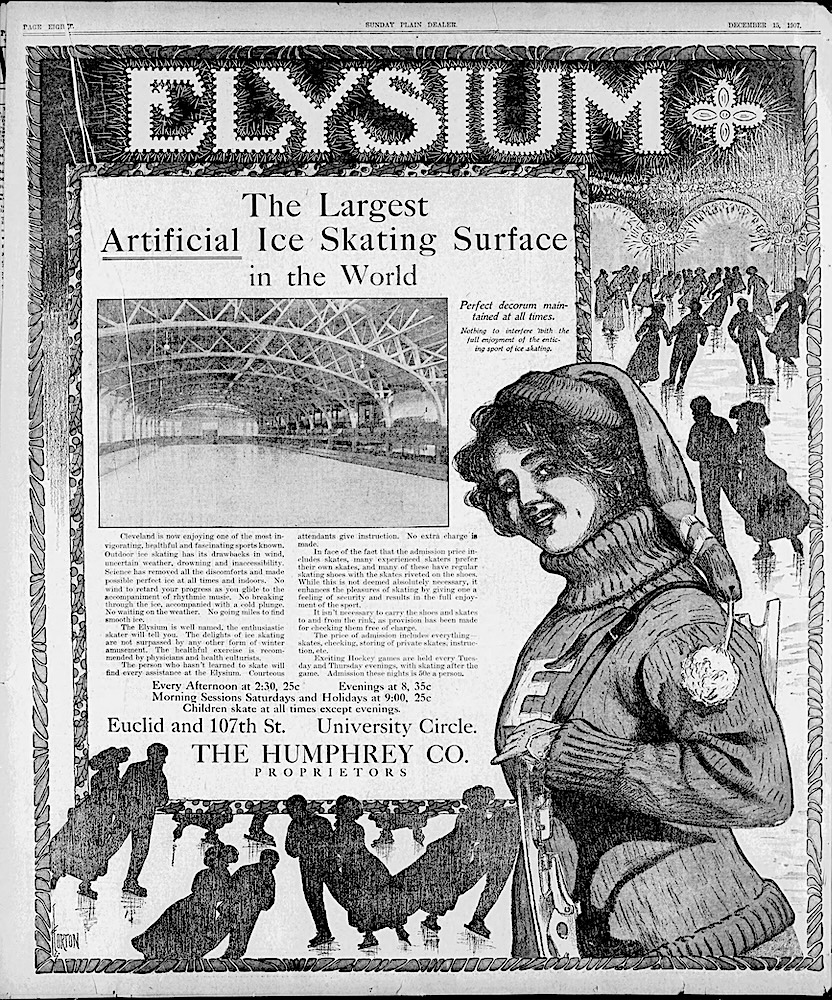
The Cleveland Plain Dealer, December 15, 1907.

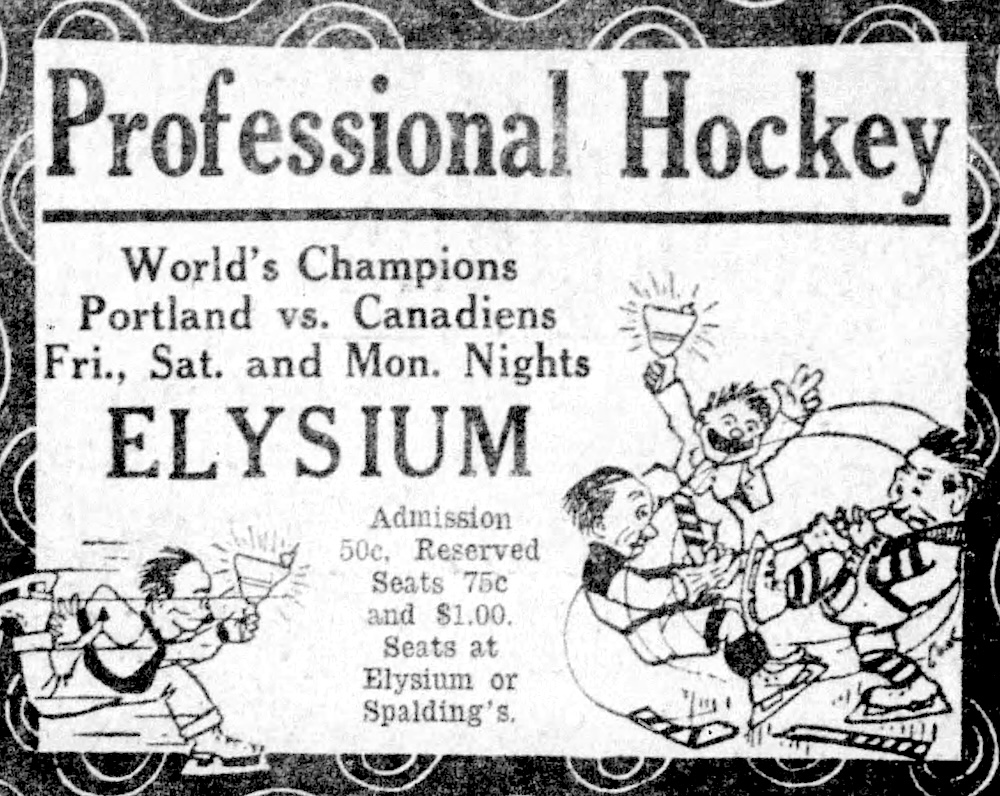
There wasn’t much time for sightseeing in New York as the teams were scheduled next for a three-game series in Cleveland, Ohio, on April 7, 8 and 10. Games would be played at the Elysium, which opened in 1907 and was said to have been (at least in its first few years) the largest artificial ice surface in the world. Despite many newspaper stories and ads boasting about the size, the only reference I could find at the time said the ice surface measured 160×100 … feet, I assume. But while 100-feet in width would definitely have been large at the time, 160 in length wouldn’t be. Wikipedia, however, notes the dimensions as 86×238, which would have been plenty long and seems more in keeping with what is visible in the images available online and in the newspaper clipping above.

The Cleveland Plain Dealer, April 7, 1916.

The Canadiens won the opener 7–6 after taking a 7–0 lead midway through the second period and hanging on at the finish. Portland continued their late scoring onslaught early in the second game with five goals in the first period en route to an 8–5 victory that tied the series. Didier Pitre was hurt in that game and didn’t play the finale, but Montreal romped to a 13–2 win behind three goals from Newsy Lalonde, four from Goldie Prodger (who’s name was usually written as Prodgers at the time) and five from Amos Arbour.

The Canadiens pocketed $600 for their victory in Cleveland with Portland players settling for $400, but the big windfall came with the fact that in winning the series, Montreal had their travel expenses covered too. “The players all got a piece of coin and travelled like princes,” said managing director George Kennedy in The Montreal Star on April 12, 1916. “What more could they want?” Still, “the club made little,” Kennedy complained.

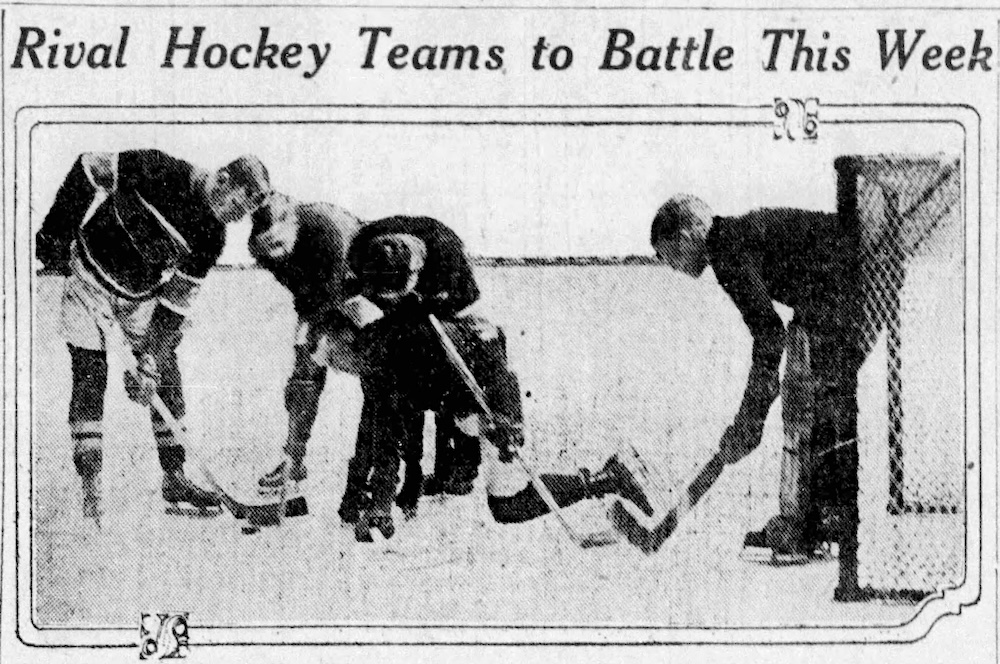
The Cleveland Plain Dealer, April 6, 1916. Players pictured (from left to right) are:
Bert Corbeau, Canadiens; Tommy Dunderdale, Portland; Amos Arbor, Canadiens;
Ernie “Moose” Johnson, Portland; and Tom Murray, Portland.

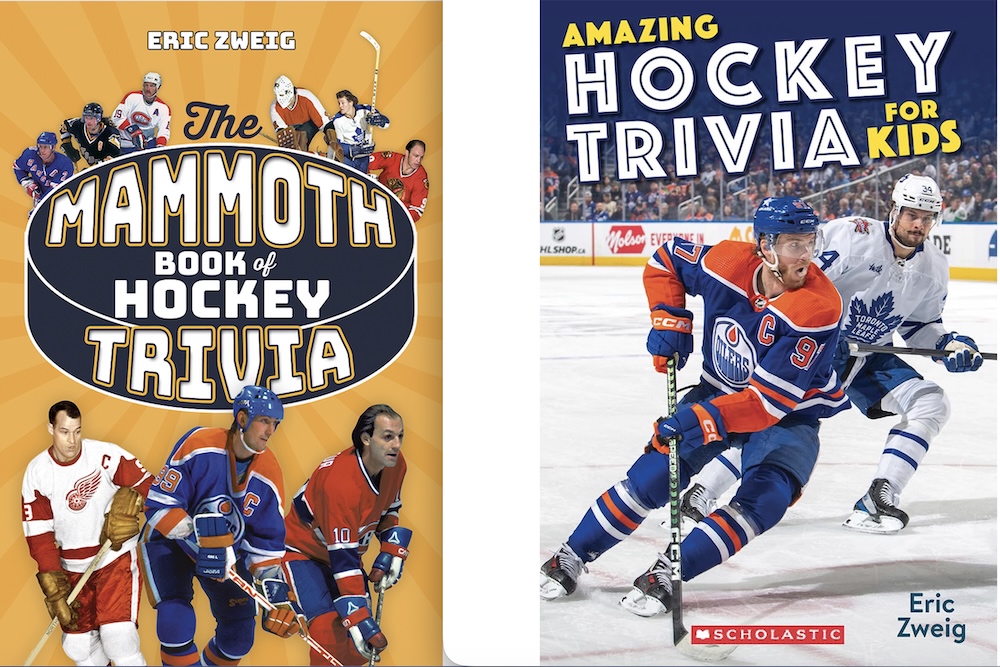
I knew nothing about this trip, and found it interesting … but another reason why I’m writing this now (and why I haven’t written very much this year), is because I have a new book coming out in the fall with Firefly Books. It’s taken up most of my hockey-writing energy of late. It’s called The Mammoth Book of Hockey Trivia, and while I don’t love “Mammoth” in the title and, like my kids book series for Scholastic – of which I’m also currently doing updates for the most recent one, and which this book is like a G-I-G-A-N-T-I-C (you might say, Mammoth!) version of – it’s facts and figures and stories and statistics, not questions-and-answers. As some people know, I’ve grumbled my way through much of this project, but now that it’s in the home stretch I’m pretty happy with it. Feel free to pre-order a copy now … but I’m sure you’ll hear more about it from me after the summer.

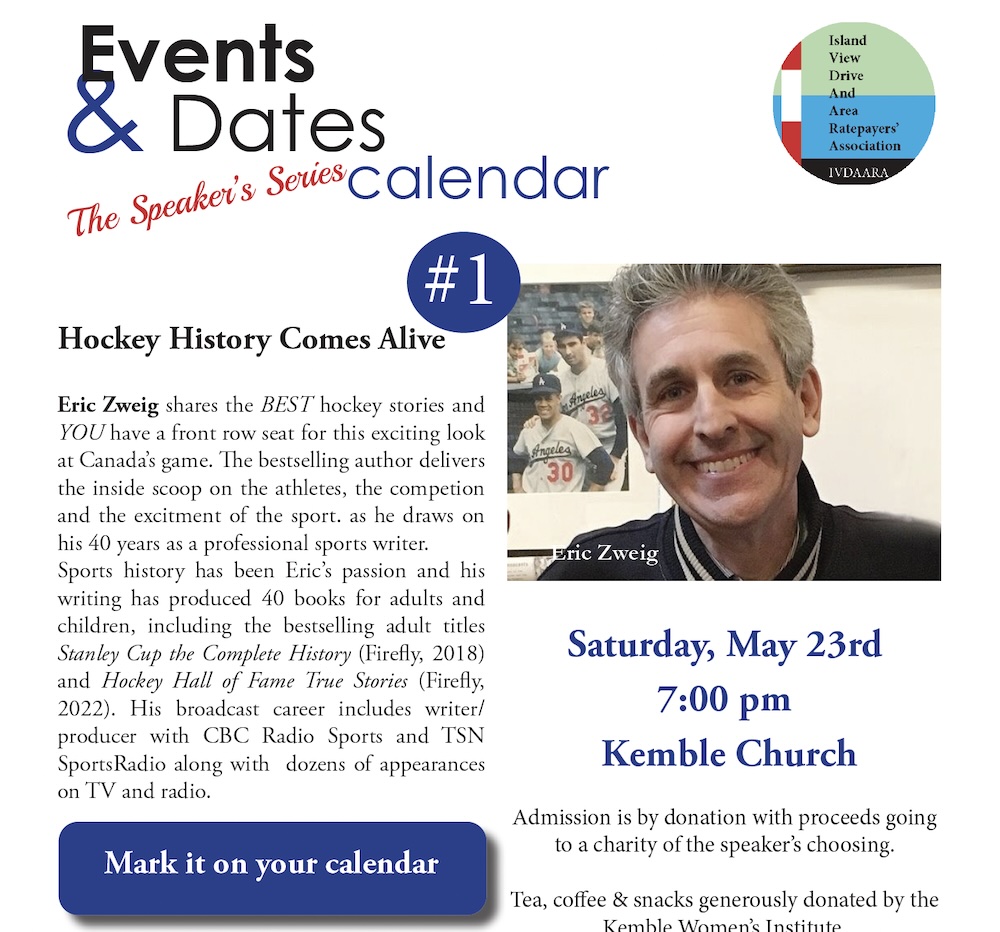
And, hey, if you’re in and around Owen Sound tomorrow, don’t forget my talk for the Island View Drive Rate Payers Association at the Kemble Church…

My Trade Deadline Day

No, you haven’t missed anything. Or, at least, you probably haven’t. The last time I sent out a story was my Happy Holidays post back in December. Just haven’t much felt like it lately. A winter spent squeezing in plenty of drives back and forth to Toronto between snowstorms hasn’t helped. Let’s go with that… Also, I don’t know about anyone else, but I enjoy these stories more these days when there’s something at least a little more involved with my own personal history rather than just hockey/sports history. (And yes, I did write about this a few years ago, but if you don’t like me repeating myself, you can ask for your money back!)

Anyway, with the better weather lately, and as I was driving home to Owen Sound this afternoon (yesterday as I post this), listening to speculation about the NHL Trade Deadline (which is today) and thoughts on the difficulty of dealing players in these days of no-trade clauses (Colton Parayko of St. Louis chose not to waive his when the Blues tried to trade him to Buffalo this week), I was reminded of my own personal Trade Deadline Day.

My best hockey team. Andrew Morrison Real Estate. I missed the picture at Mitchell Field, so that’s me in the inset. The captain is Kerry McIntyre, standing in front of his dad and our coach, Andy. Ross Takeuchi is holding the white helmet. Andrew Spitzer is our goalie. My defense partner Blake Jacobs is next to him with the yellow helmet.

Like most Canadian kids, I played hockey as a boy. I started the year I turned nine years old. It was the winter of 1972–73. I was terrible. But I improved a lot that summer after the first of two years at the Roger Crozier Hockey School in Barrie, Ontario, near where we had a summer cottage. I played six years, but never beyond house league. My best years were my second and third seasons, when I was an Atom and a Minor Pee Wee. My teams won the championship in both of those seasons. (Kind of sad, but I peaked in hockey at age 11!)

Playing house league, the Willowdale Boys Club tried to keep the teams even. I can’t remember it all exactly, but I think we were just assigned to teams. I don’t know if our parents rated our skills on sign-up forms, or if we’d been “scouted” from previous seasons, but after playing for four or five weeks, the league would switch players around if some teams were too weak and others too strong.

The North York Mirror reported on our house league games!

I was a pretty good house league player. A defenceman who liked to rush the puck. (I knew I wasn’t Bobby Orr … but I tried!) Anyway, in December of 1974, I was traded to a weaker team to help prop them up. I remember it as being the night of our family Hanukkah party at our Freedman cousins’ house. Looking it up, I see Hanukkah started on Sunday night, December 8, 1974 … so I bet it was that very night. I remember getting a call from the convener of the league before we left home. He told me the coach of Andrew Morrison Real Estate wanted me for his team. But it was my choice.

I didn’t want to go. My current team, Jerrett’s Funeral Home (honestly!) was in first place. I agonized over what to do, but I remember my father saying, “The coach wants you. He thinks you can help them.” I can’t remember anymore how I actually made up my mind (and I’m pretty sure they didn’t give kids the choice any more after me!), but we called back the convener later that night and I told him I’d go.

Stills from home movies shot by my father at Bayview Arena in 1975. Top left, patrolling the front of our net. Top right, picking up the puck on my backhand. Bottom left, carrying the puck out of our zone. Bottom right, at the opposing blue line.

It turned out, Andrew Morrison was a pretty strong team. We were led on offense by the coach’s son, Kerry McIntyre and Ross Takeuchi. I anchored the defence with Blake Jacobs. Our goalie was Andrew Spitzer; the best in the league. And we went on to win the championship.

Maybe the team would have come together without me. But they hadn’t yet.

Not until after my Trade Deadline Day.

NOTE: Later in the day, in the Zweig Brothers text group, David (who usually doesn’t remember things as well as Jonathan and I do), wrote: “wasn’t someone else who had to make a decision part of that trade?” I didn’t remember that, but when David and I were talking afterwards, he said he thought it was Ross Takeuchi. Then we sort of put it all together. Yes, Ross and I had been playing together with Jerrett’s and as I remember it now, Ross (who had played with David in our first season) only agreed to the trade after he heard that I’d agreed too! So, it was a more complicated Deadline Day deal than I first remembered.

Happy Holidays (2025)

No sports in this year’s Holiday post (except for the fact my father and grandfather were both big sports fans, and a big part of the reason my brothers and I are too). Instead, Season’s Greetings courtesy of Toronto newspaper messages from the hat-making company owned by my grandfather and great-grandfather (and partner Ben Banks).

Toronto Star, December 23, 1939
Toronto Star, December 24, 1941
Toronto newspaper ads from the late 1950s

So, best wishes for whatever you celebrate at this time of year and a healthy and happy 2026 from four generations of Zweig men: my grandfather, my father, me (the Little Prince!) and my great-grandfather, circa 1964.

My Blue Jays Journey…

It’s taken me a few days to get around to writing this. Obviously, I was saddened by the Blue Jays’ Game 7 loss to the Dodgers. It’s funny, because I really didn’t believe this team could win it all, but I had been enjoying the unexpected run. It was SO MUCH FUN! As underdogs all season, it wasn’t until they were coming home up 3–2 in the World Series that it suddenly seemed like it would be disappointing if they didn’t win. And, of course, they didn’t. And it was.

Still, it’s hard to complain. Like I said, it was so much fun. And this team was so easy to root for. Sure, you can blame Isiah Kiner-Falefa for not getting a bigger lead (though I fault Daulton Varsho even more), or Jeff Hoffman for the ninth inning homer (I was already envisioning the perfection of a final out where Ohtani grounded to Bichette, who fired to Vladdy). But really, the Jays had so many opportunities to score more runs. After doing exceedingly well at hitting with runners in scoring position all season, they left too many runners on base throughout the World Series — especially in Games 6 and 7.

But why wallow in the disappointment at the end when it really was a season to celebrate?

I think what I’m saddest about now that it’s over is that it’s over.

No game tonight. Winter is coming.

Another part of why this has been hard to write is that my relationship with the Blue Jays runs so deep that there’s so much I could write about. I was lucky to attend plenty of games throughout the playoffs. (See the pictures below.) Our family has had season tickets pretty much since the day they went on sale back in 1977. Our subscriber number is 840, which I assume means we were the 840th people in the city to buy seats. I wonder how many of the 839 people ahead of us still have their tickets? I was at Opening Day on April 7, 1977, with my brothers David and Jonathan. We were 13, 11 and 9 at the time. We were all there again for Game 7 on November 1, 2025. We’re currently 62, 59 and 58.

I wonder how many other people were at both of those games?

I wonder if any of them were as young as we were?

Our mother is the reason we’re baseball fans. My father was a sports fan, but my mother loves baseball. Those of you who’ve seen her on TV (she had plenty of media hits this postseason, in addition to her almost annual Opening Day appearances since 2018) have heard her explain that baseball was the only sport she really understood as a girl. She played in gym at school, and went to the minor league games of the Toronto Maple Leafs baseball team. She became a fan of the Brooklyn Dodgers when a teacher she liked brought a radio to class to listen to the World Series. She was in Grade 7. Which would make her 12 years old. Which would make this 1949.

One of my mother’s many media moments this fall.

When we learned in 1976 that Toronto was going to get a Major League team for the 1977 season, my mother told my father we had to get tickets. And we did. I had not been much of a baseball fan before that. I played hockey and football as a boy, and was pretty good at those sports. I started playing softball in 1972, but I was terrible. Even so, I started watching World Series games with the Oakland A’s and Cincinnati Reds that October. The A’s won in 1972, 1973 and 1974. I would sometimes watch the Expos in those years too, but it was the legendary World Series of 1975 between the Reds and the Boston Red Sox that really captured my imagination. I’m pretty sure my Dad woke me up to see the end of Game 7 on Wednesday night, October 22, 1975.

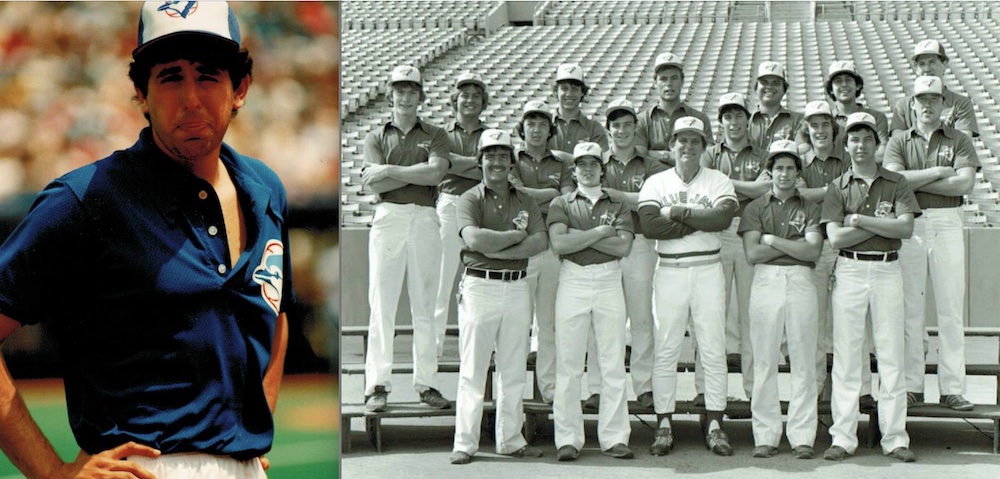
My first team, in the Willowdale Boys Club. I’m the kid on the left in the top row.
Sadly, I’d say the expression on my face sums up my abilities a little too well!

But what really made me a baseball fan wasn’t so much the 1975 World Series itself, as it was the official film of the 1975 World Series, which I watched in a blue-and-white-striped tent promoting baseball in Toronto just outside CNE Stadium at the Canadian National Exhibition during the summer of 1976. My guess is this was on opening day for the Exhibition, August 13, 1976, when the Toronto Argonauts of the Canadian Football League (who we had season tickets for in those days) were hosting the Hamilton Tiger-Cats. If so, this would have been one day after the name Blue Jays was announced for Toronto’s new American League expansion team. I do remember learning about the name in a story in The Toronto Star while up at our summer cottage, but I don’t connect it at all in my memory with attending the CNE the next day. Still, I do remember how enthralled I was by the behind-the-scenes look presented by the World Series movie.

I would pretty much say I’ve been hooked on baseball, and loved the Blue Jays, ever since.

This is what my mother and I are looking at in the photo album picture above.
A picture she took from our seats before the Home Opener on April 7, 1977.

The Blue Jays were terrible in the early days, but no one seemed to mind. In our house, when a game was on — home or road — there was a radio on in practically every room. (Not a lot of TV games in the early days.) And when the team was home, on weekends especially, we were there! Sometimes, we got to sit in “the good seats” with one of our parents, or even two brothers by themselves. But, as often as not, we were headed down in a group on the TTC. We needed to take a bus, a subway, and a streetcar to get there from where we lived. It took about an hour-and-a-half, but kids could do that in those days. You could buy bleacher seats for $2, and even sometimes get them for $1 at Dominion grocery stores, but we always preferred to buy the $3 seats down the right field line. That way, we were in the main grandstand and could “sneak down” to “the good seats.”

Honestly, it’s great how many new fans the team has attracted with this successful season and World Series run. The same thing happened in 2015 and 2016, but hopefully it’ll last longer this time. Still, I honestly feel sorry for people who haven’t gotten to follow the Blue Jays since the very beginning. Learning to love a terrible team in the 1970s, watching them grow into a contender in the 1980s, and finally winning it all in 1992 and 1993… If you weren’t along for the ride, you really missed something!

Those 17 years took me from age 13 to 30, so I truly did grow up with this team. And I loved it. As I’ve gotten older, I’ve often said I feel like I’ve only stuck with the Jays out of loyalty to my younger self. But this year reminded me again how good it can be!

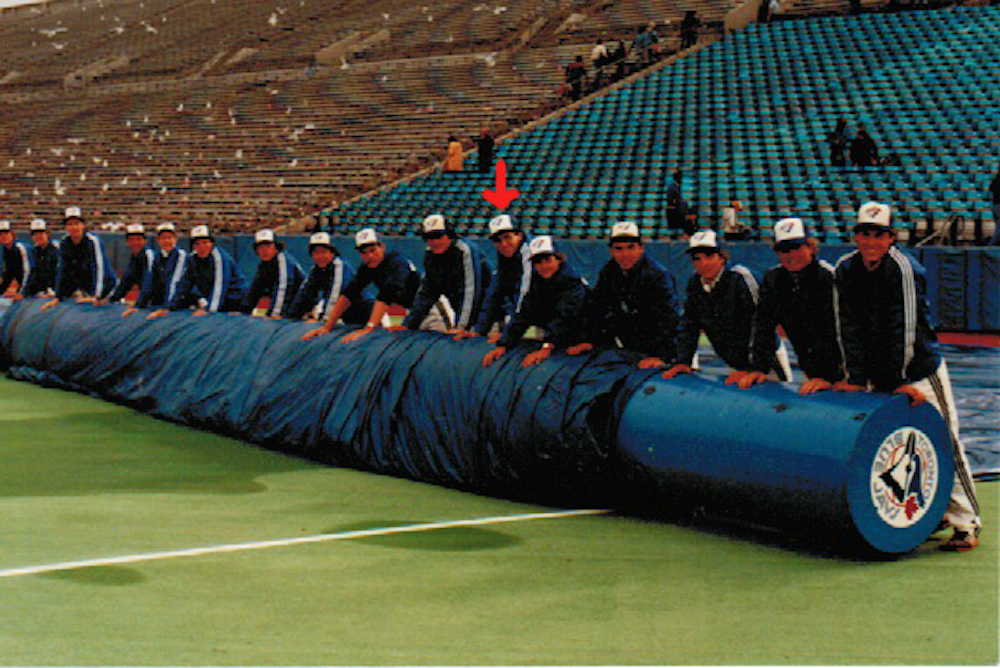
I joined the Blue Jays ground crew in 1981. My father had a cousin (Herb Solway, technically a cousin by marriage) who was a big wig with the team. He helped get me the job, but when I showed up for what turned out to be my first day — I thought it was only a job interview! — I was wearing nice clothes and spent the day shoveling sand into a big wooden box that broke before we could fill it! So, we shoveled it into a nearby … closet … room … I don’t really know what to call it, but there was still sand in there five seasons later!

I was with the ground crew through the 1985 season, so truly in the “Worst to First” years. I don’t remember the year for this picture, but it might be 1985. It looks like it must have rained at least a little that night, but we’re actually rolling out the tarp to cover the field after the game was over. No matter what the weather forecast, we covered the infield every night.

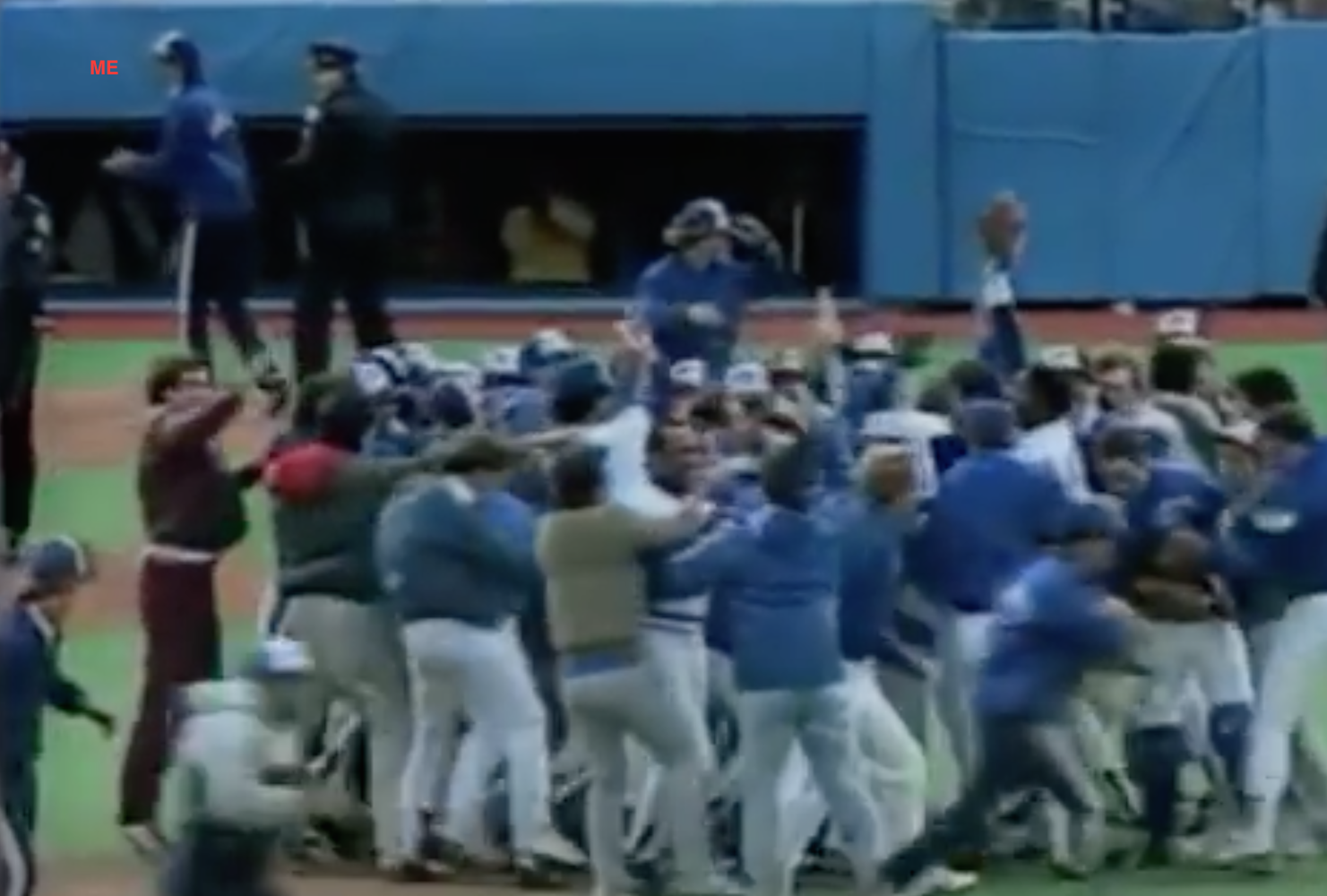
That’s me on the field (identified by the red ME) when the Blue Jays clinched the American League East for the first time in 1985.

I still have a champagne bottle (empty) that I took from the Blue Jays clubhouse at Exhibition Stadium after the 1985 celebration. It’s currently among the boxes of Blue Jays items from over the years that are being stored in Jonathan’s basement. And that’s me, in the clubhouse again at Skydome in 1989 while working for Digital Media, holding a tape recorder in front of Blue Jays GM Pat Gillick and George Bell.

Jumping ahead to this year, that’s me in the stands, repeatedly saying “I don’t believe it!” after George Springer’s seventh inning homer put Toronto ahead of Seattle in Game 7 of the American League championship series, then hugging Jonathan after the game was over.

The Jays celebrating their 2025 American League pennant on the field after the game. I didn’t get into the clubhouse this time!

But I did get to celebrate with my brother Jonathan. In the picture of me on the field in 1985, I’m looking at Jonathan in the seats while I’m clapping.

Game 1 of the 2025 World Series. Addison Barger and company coming off the field after Barger’s pinch-hit grand slam. Barger’s blast was part of a seven-run sixth inning that broke open a 2–2 tie en route to an 11–4 victory. It was fun!

David and I were at Game 1 of the World Series, as we had been in 1993 (and also at Game 4 in 1992). The win that night ran our World Series record at games together to 3–0. Unfortunately, the streak wouldn’t last.

With Jonathan, his daughter Zara, and wife Sheri in our season ticket seats before the start of Game 7 of the World Series. David and his wife, Carrie, were seated elsewhere. Maybe David and I should have been sitting together. Oh, well…

Three shots of Bo Bichette heading for the plate after his three-run homer in the third inning put Toronto up 3–0. Though I hoped we’d score more runs to make the lead a little more comfortable, I really thought the Blue Jays were going to win the World Series at this point…

But no. This is the Dodgers celebrating on the field shortly after Alejandro Kirk’s broken bat double play ground ball ended the game in the bottom of the eleventh. Boo!

OK, Blue Jays!

Well, I’ve avoided writing about the Blue Jays all season long. Truth is, I never believed they could do this. I tried to put my skepticism aside and just enjoy it. But, any time trouble arrived, I’d think, ‘That’s it. They stink. Can’t keep it up.’ I didn’t think they could hold off the Yankees down the stretch. I was pretty nervous heading into the Division Series too. Don’t think I’ve ever been so happy to be wrong!

Our family has had Blue Jays season tickets pretty much since the moment they went on sale prior to the first season in 1977. We were all there, in the snow, on Opening Day. I was at every opener until 2018, when Barbara was diagnosed with cancer. I’d even skipped school again in 1980 to attend the makeup game after the official opener was rained out. My mother (Joyce) and brother Jonathan still have their home opener streaks in tact.

Me, with my brother Jonathan, at Game 2 on Sunday afternoon.
With the Jays wearing their white-paneled hats for luck, I had to
dig out my original fitted cap from the summer of 1977!

My mother is the reason our family became Blue Jays crazy. (Many of you will have seen her TV appearances over the years, including one on the CBC last week. There might be another on CTV this evening!) My father was a sports fan, but my mother was a baseball fan! She always says it was the only game she really understood as a girl. She used to attend the minor-league Toronto Maple Leafs baseball games in the 1950s and root for the Brooklyn Dodgers against the New York Yankees watching the World Series on television.

Vladimir Guerrero reaching home plate after his grand slam on Sunday.

Of course, I watched plenty of games this year — and attended a few — but I wish I’d more fully embraced the team. I should have! They play the type of baseball I really enjoy … putting the ball in play and making things happen, as opposed to slugging and strikeouts. And they really do seem to like each other. But after the playoff flame-outs of recent years, and the terrible season last year, I didn’t think they’d done nearly enough to turn things around. (I certainly wasn’t alone with that thought!) The Jays got off to a good start, but then sort of fell apart and it was easy to believe it would be another frustrating season.

The last pitch last night. (Took the picture off my TV.)

I was hopeful Bo Bichette would bounce back, and even though Vladimir Guerrero has mostly been good-but-not-great (and I have trouble wrapping my head around anyone making $500 million!), I figured they really did have to re-sign him. Still, I wasn’t very optimistic. My friend Leslie was an early believer. I warned her not to get too excited, but it turns out she was right!

Like I said, I don’t think I’ve ever been so happy to be wrong.
Doesn’t get much better than beating the Yankees!

And now, it’s on to the American League Championship Series.

Whether it’s Detroit or Seattle, it should be exciting!!

Spraying champagne after the game. (Again, taken while watching TV.)

Memories of Ken Dryden

I knew Ken Dryden, but not very well. I’ve been a little bit surprised by how the news of his death has affected me. As I said to someone on Facebook recently, we (I) am now at an age where the heroes of our youth are passing away. It’s a sad reminder of how quickly life goes.

Ken became (and remained) good friends with my NHL publishing boss Dan Diamond during Ken’s time as president of the Toronto Maple Leafs from 1997 to 2004. We at Dan Diamond and Associates did a lot of work with Ken when the Maple Leafs were moving from the Gardens to the Air Canada Centre. Dan also worked with Ken during his political career and we were all at the event at Ken’s old elementary school in 2006 when Ken announced he was running for the Liberal leadership.

I met Ken a handful of times over the years, when he would attend parties Dan held either at home or for the office. In more recent years, I would sometimes call or email him if I wanted advice or an opinion for something I was working on. He was usually quite accommodating. The last time he and I talked was in early May. His voice sounded raspy, and he said he hadn’t been well, but he gave no indication of anything worse than that. Ken had called me about my interest in something an old friend had come to him with. I was a little surprised it wasn’t something he wanted to get involved with himself … but, I guess, we now know why.
When Ken attended some of our Dan Diamond curling parties,
my brother Jonathan wanted a picture of the two of them leaning
on their curling brooms a la the classic Dryden goalie stick pose.

When Ken called in May, I took the opportunity to ask him something for a book I’m working on that I hadn’t previously because (more big name drops!) I had already been in touch with Scotty Bowman and Dick Irvin about it. My question was, did he remember anyone referring to the line of Guy Lafleur, Steve Shutt and either Pete Mahovlich or Jacques Lemaire as The Dynasty Line during the Canadiens’ 1970s Stanley Cup Dynasty. Like Bowman and Irvin, Ken had never heard that term. Ken said something along the lines of “it would have been silly to call them that then.” Then I quoted him something from an Al Strachan article in the Montreal Gazette from the 1975–76 season. Pierre Bouchard had apparently dubbed the line of Lafleur, Shutt and Mahovlich The Donut Line as a shot at Mahovlich, “because the line had no center.” Shutt responded by saying Mahovlich called them The Helicopter Line “because they had no wings.” Ken laughed and said, “that sounds like Shutty!”

Ken was always very approachable and I remember at our office Christmas party in 2002 mentioning that I had recently watched the DVD of all the games of the 1972 Canada-Russia series, which had come out around then. He told me he’d never seen it and that he didn’t like to watch any old footage of his games, which I’ve read again recently in various memories of him. (I do believe he finally re-watched the 1972 games for his 2022 book on the 50th anniversary of the series.) He was pleased when I told him the intensity and skill displayed in the series still held up, and then I screwed up my courage to ask him something I’d long wondered about. How come he, and some of the other players, who had spent time with the Canadian National Team hadn’t been able to convince their Team Canada teammates how good the Soviets really were? Ken said something along the lines of, “I just thought NHL players were that much better.”

I’ve kept this package of Ken Dryden’s Big Canada Chocolate Chip Cookie since 2006!

One thing I never had the guts to tell Ken was how much I didn’t like him when I was a boy! In truth, I did like him at first. Like most people, I became aware of him during the 1971 playoffs when — though not yet even officially considered an NHL rookie — he led the Canadiens to that huge upset of the Bruins and then all the way to a Stanley Cup championship. Of course, I was seven years old at the time, and I can’t really say anymore how much I actually remember versus how much I now know. And, of course, there was his role in the 1972 series. But by the time I was 12 years old, the Leafs had Darryl Sittler, Lanny McDonald, Borje Salming et al and I was hooked on my hometown team.

I was barely 13 when Mike Palmateer became the Leafs goalie, and I was way more into him that I was into Ken Dryden! The two playoff losses to the Canadiens in 1978 and 1979 didn’t help … but, I’m sure, had I told Ken that young me had hated him, he wouldn’t mind. He was a sports fan above all and would have understood childhood loyalty. After all, he had that quote about the best era of the game being “whenever you were 12 years old.” (Though you sometimes see the age recorded as young as 10 or 11.)

I’ll conclude this with an email/phone conversation I had with Ken back in 2010. This was regarding some early work that would lead towards my Stanley Cup books for Firefly in 2013 and 2018. I’ll begin with an except from my email to him, and then my notes based on our phone conversation.

I was one of several people Ken sent this photo to to get the word out
about the importance of wearing masks during the Covid pandemic.

Dear Ken,

The best of the season to you and Lynda and your family. I hope you are all well … and that you will have a few minutes to spare over the holidays to think about this question I have for you…

When I first started pitching [my Stanley Cup history book] to a few publishers, I got a lot of responses along the lines of “this is a great book that somebody should do” but no commitment to take it on, or, worse yet, “hockey fans don’t like history, and history buffs don’t like sports.” Well, as one hockey fan who loves the history of both the game and his country, I think they’re wrong!

Though I’m honestly not sure how I’d fit it into the narrative as I’d like to do it, I have been asked to consider adding some sort of “what my Stanley Cup win meant to me” angle … and so I am wondering what sort of connection, if any, the players I grew up watching or the ones playing now have to the history of the Stanley Cup.

When you won, either for the first time in 1971, or as part of the “dynasty” later in the decade, or when you first saw your name engraved on the trophy, did you personally feel any kind of connection to the history of the game? Or, if not at the time, do you look back on your Stanley Cup wins now as something that will forever make you a part of hockey history? Do you think other players have felt this? Is this an angle at all worth pursuing in a book about the early history of the Stanley Cup?

A response by email is certainly sufficient, but if this is something you’d be at all interested in talking about in any more depth, please feel free to call me at home.

Thanks, Eric

Notes from Ken’s phone call:

Unreal feeling joining the Canadiens … like, “if this is the real Canadiens, why am I here?”

Even more of a disconnect in the playoffs. “If this is the real Stanley Cup … Conn Smythe Trophy … then why am I winning it?”

Being in the NHL didn’t really hit him until coming home after game seven in the first round against Boston and there were big crowds at the airport.

Didn’t feel a connection to history when they won. He never felt there was a quiet moment where you took a deep breath and thought, “this is what the Rocket did.”

Parades helped to make it feel real.

How each team got there was what really mattered, and the harder the journey the more rewarding.
Best was in 1976. “The quest.” He felt that he, and probably everyone, starting preparing for that as soon as they were eliminated from the playoffs in 1975. Thought about it all summer. Played Philly tough in the preseason (see Denault book), set the tone in regular-season games. “Felt like a full-season quest.”

As to history, Ken only had a very general awareness of the challenge history … and thought the NHL took over the Stanley Cup right way in 1918. Feels the seeds of the modern sport (all modern NA sport) where sowed in the 1920s. Probably due to radio. Created first media stars (Babe Ruth, Red Grange, Bobby Jones et al.)

Not sure any player feels the connection to history. Thinks modern players have been programmed to give the answer you’d want to hear (“I thought about my heroes when I lifted the Cup…” but he doesn’t believe they really do). You’d really have to dig to get a thoughtful answer about what they really felt.

The Pride of Paris, Ontario? There’s an Apps for that!

These days, whenever I post a story on my web site, I feel like it might be the last one I ever do. Like, I’m all out of ideas and this is it. It’s been a long time since I’ve actively searched out subjects for these stories … but, then, something always comes up. Usually it’s a current event that reminds me of something historic. Sometimes it’s something in my own life. Whatever it is, an idea for a story will suddenly seize me. Then, I go down too many rabbit holes trying to put it all together before reining it in. And then, a post. Like today’s.

Lynn and I recently had a short getaway in Paris. (Not THAT Paris — although, as some of you will remember, we were in France in May of 2024 and it was lovely.) This was Paris, Ontario, and until we arrived and I saw a sign for the Syl Apps Community Centre, I’d forgotten the long ago captain of the Toronto Maple Leafs who was voted the second greatest player in franchise history for the team’s centennial in 2017 was from there.

Syl Apps plaque in Paris, Ontario and Apps with the Hamilton Tigers (SIHR).

Charles Joseph Sylvanus Apps was born in Paris on January 18, 1915. After being named the NHL’s rookie of the year for the 1936–37 season, his hometown honoured him on the night of June 11, 1937, as part of a three-day Lions Club Carnival. That season, NHL president Frank Calder was encouraged by Toronto Star sports editor Andy Lytle and Maple Leafs owner-manager Conn Smythe to donate a trophy for the winner of the annual (since 1933) Canadian Press sportswriters poll selecting the league’s top rookie. Perhaps this was because the Leafs boasted rookie stars Apps, Gord Drillon and Turk Broda that season!

As the story goes, Frank Calder was en route from Montreal to Paris by train with his trophy when he realized something. Unlike the NHL’s other individual awards — at the time, there was just the Hart for MVP, the Lady Byng for sportsmanship, and the Vezina for the best goalie — a player named the NHL’s best rookie could never win that award again. So, the league boss decided he would give Syl Apps the Calder Trophy to keep. Every year after that until his death in 1943, Calder bought a new trophy and presented it to the NHL’s top rookie. Official approval for the permanent Calder Memorial Trophy was given by the league governors at an NHL meeting in Montreal on September 7, 1945.

Brantford Expositor, June 11, 1937.

Apps received the first Calder Trophy at a star-studded gala held at the Paris Arena. Unknown to me when Lynn and I visited, the Paris Arena was originally built in 1921–22 … and is still housed within the Syl Apps Community Centre! It now boasts a much more modern brick exterior, and there’s no longer a hockey rink inside, but the old arena space is used for indoor soccer and still features the same wooden beams and ceiling/roof from the early days. From behind, the modern community centre still looks looks like an old-time auditorium.

Syl Apps played 10 years with the Toronto Maple Leafs from his rookie season of 1936–37 through 1947–48, missing two years due to military service in World War II. He was named captain in 1940 and led the Leafs to Stanley Cup victories in 1942, 1947 and 1948. At 6 feet tall and 185 pounds, he was big and handsome and played a stylish game. (For those old enough to remember, think Jean Béliveau.) Apps is one of few Maple Leafs of whom it can honestly be said he was among the very best players in the NHL in his day. He never won the Hart Trophy as MVP, but in his first seven seasons before the War, Apps was second in voting three times and third in voting twice.

Brantford Expositor, June 12, 1937.

Apps likely started playing hockey as a young boy. He played midget hockey in Paris as a 14-year-old during the winter of 1928–29 and was a member of the local Ontario Hockey Association junior team in 1930–31 when he turned 16. There were reports in the spring of 1932 that after high school Apps would attend Western in London, but that fall he left Paris for Hamilton to attend McMaster University. He would play hockey there, as well as football, and though he’d apparently played little of that sport in Paris (he did play basketball in high school), Apps became quite the star on the gridiron. He was also on the McMaster track team, where he competed in the pole vault which he’d taken up in high school at least as early as 1928. He also competed in the long jump and the high jump as a student in Paris, and while still in high school he placed second in the junior division in a pole vaulting competition in Hamilton in conjunction with the first British Empire Games (now the Commonwealth Games) in 1930. Four years later, Apps wasn’t just the best pole vaulter in Canada but won the gold medal on August 6, 1934, at the second British Empire Games in London, England.

Brantford Expositor, October 1, 1927. The photo is from August 27, 1930.

While in his final year at McMaster, Apps joined the Hamilton Tigers hockey team for the 1935–36 season. He led them to the OHA senior champion and was the top scorer in the province. At the end of April, Apps traveled to Los Angeles for hockey (and lacrosse) games with a Canadian Legion team from Hamilton, although he and teammate Norval Williamson flew home early to complete their final university exams.

By the spring of 1936, it was well known that several NHL teams wanted Syl Apps and the Maple Leafs had put him on their negotiation list. Still, he had no interest in turning pro before taking his shot at the 1936 Summer Olympics in Berlin. (There had been stories he was being considered as an addition to the Canadian Olympic Hockey team earlier in 1936, but he hadn’t wanted to interrupt his studies.) In July, Apps won the Ontario championship in the pole vault with a jump of 12 feet, 11 inches. Barely a week later at the Canadian Olympic trials in Montreal, he jumped 13 feet and a half inch to win that competition. A few days later, Apps was on board the Duchess of Bedford with the rest of the Canadian Olympic team sailing for France before a train ride to Berlin.

The Montreal Star, July 13, 1936. Syl Apps is #3.

Canadian papers noted Apps would likely need to improve his height by at least a foot to earn a medal in the pole vault in Berlin. On July 4, 1936, American George Varoff had set a new world’s record of 4.43 meters (14 feet, 6 1/2 inches) … although a few days later he slumped to fourth place at the American Olympic trials and didn’t even make the U.S. team. In the Olympic final on August 6, 1936, another American, Earle Meadows, won gold with a jump of 4.35 meters (14 feet, 3 1/4 inches). Apps did improve his performance by nearly a foot, clearing an even 4 meters (14 feet, 1/8 inches) but that was only good enough to tie for sixth place. (In reading about Apps over the years, I’d always assumed it was a two-way tie for sixth place, but he was actually one of 11 men tied at 4 meters.)

On August 25, 1936, Syl Apps arrived back in Canada aboard the Duchess of Richmond with about one-third of the Canadian Olympic team. He said he’d made up his mind not to try out for the Hamilton Tigers football team that fall and there were also reports he’d turned down offers from several hockey teams in London, England while he was in Europe. Football in Canada and hockey in England were strictly amateur at the time, yet Apps still hadn’t decided whether to go pro with the Maple Leafs. He made up his mind soon enough, signing a contract on September 2, 1936.

Colourized photograph of Syl Apps from Canadian Colour, 2015.

“In our circle,” Apps would tell Stan Fischler for his book Those Were The Days (1976), “professional athletes were not looked upon as the right sort. But economic conditions were poor at the time and jobs were scarce. Molly [girlfriend Molly Marshall] told me the chance with the Leafs was a golden opportunity. I decided to sign although I was scared when I went to see Mr. Smythe.”

He would have to give up his amateur athletic pursuits, but “Sylvanus Apps loves hockey above all other games,” reported Andy Lytle in The Toronto Daily Star on October 28, 1936, a few days before the start of his rookie season.

The decision worked out pretty well.