It’s been a while since I’ve written anything new for my web site. There’s no particular reason for this one now, except that we’re halfway through the Stanley Cup playoffs. I’m certainly not making any predictions, but it seems to me I should be writing something at this point! As people generally know, it’s been 33 years since a Canadian team – a Canadiens team – last won the Stanley Cup in 1993. Will this be the year?
In the past, years ending in ‘6’ have been good ones for Montreal teams. The Montreal Victorias lost the Stanley Cup to the Winnipeg Victorias in February of 1896, but won it back in December 1896. The Montreal Wanderers won the Stanley Cup for the first time in 1906, the Montreal Canadiens won their first title in 1916, and the Montreal Maroons won in 1926. After the Red Wings beat the Maple Leafs in 1936, the Canadiens won the Cup again in 1946, 1956, 1966, 1976 and 1986! No such luck in 1996, 2006 or 2016, but the Montreal Victoire just won the Walter Cup as champions of the Professional Women’s Hockey League in the first ‘6’ year in league history and the Canadiens are still alive.
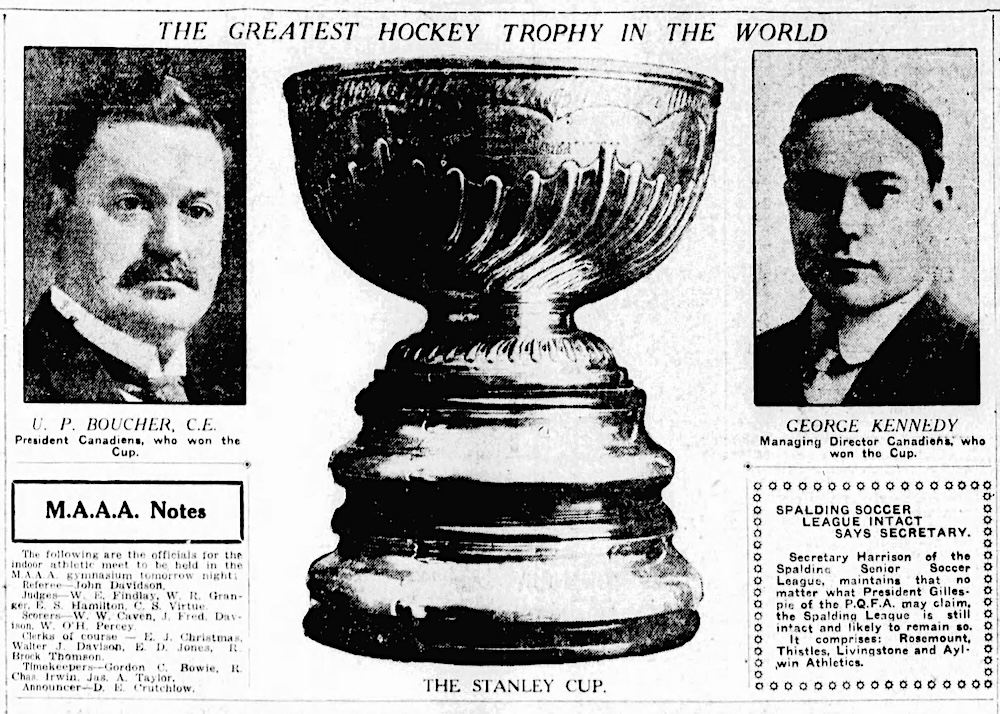
The first Canadiens Stanley Cup in 1916 came when the team played in the National Hockey Association (forerunner of the NHL) and at a time when the NHA champions faced the champions of the Pacific Coast Hockey Association for the Stanley Cup. In 1916, that was the Portland Rosebuds. The team is sometimes referred to as the Uncle Sams, though Portland is known as The Rose City and by whatever name they were called (mostly Rosebuds), they were the first American team to play for the Stanley Cup but fell to the Canadiens in the last game of a best-of-five series.
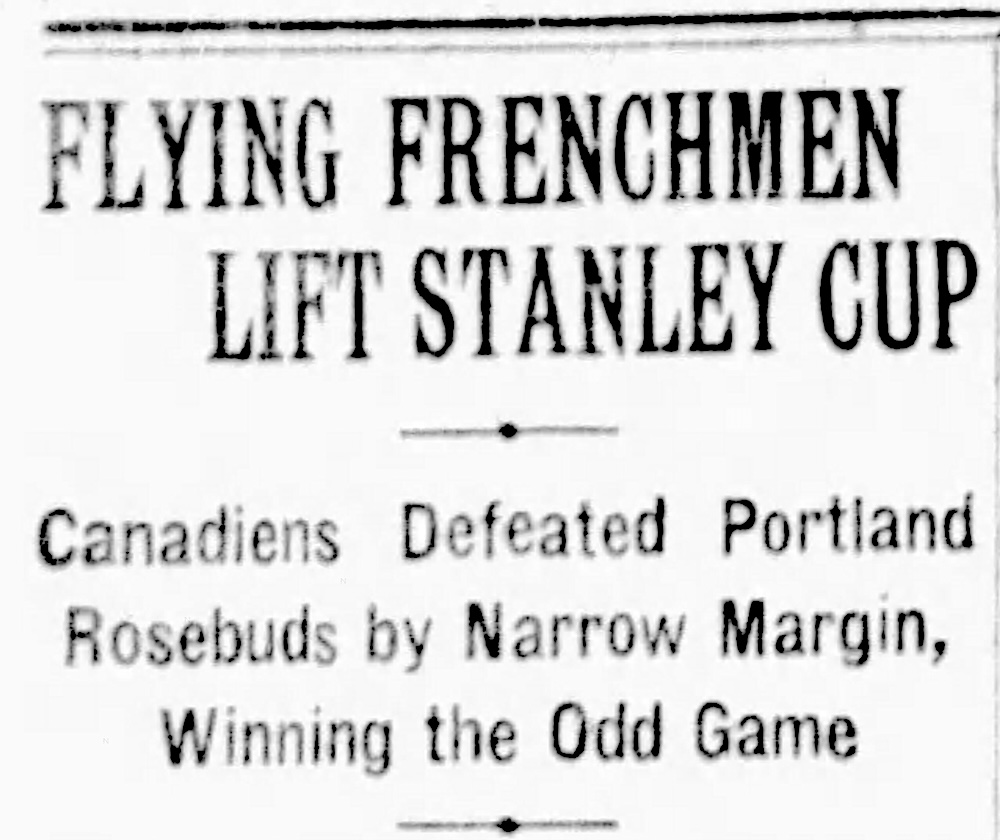
The Canadiens beat Portland to win the Stanley Cup in 1916, but then lost it to Seattle (the Metropolitans of the PCHA) in 1917. Those two teams faced each other again in 1919 when their series was halted by the Spanish Flu Epidemic, but mostly, Montreal has faced teams from more traditional hockey markets in the Stanley Cup Final: fellow “Original Six” teams Toronto, Detroit, Chicago, Boston and New York, but also Calgary as well as Philadelphia and St. Louis, who’ve been around long enough now that they don’t seem like non-traditional hockey markets. And I guess we have to include Los Angeles in there too. Tampa Bay (who beat the Canadiens for the Stanley Cup in 2021) still seems like a less traditional market, but certainly a successful one … which is what you’d have to say about Colorado and Vegas as well, one of whom the Canadiens will meeting in the Final if they should knock off another less traditional market in Carolina.
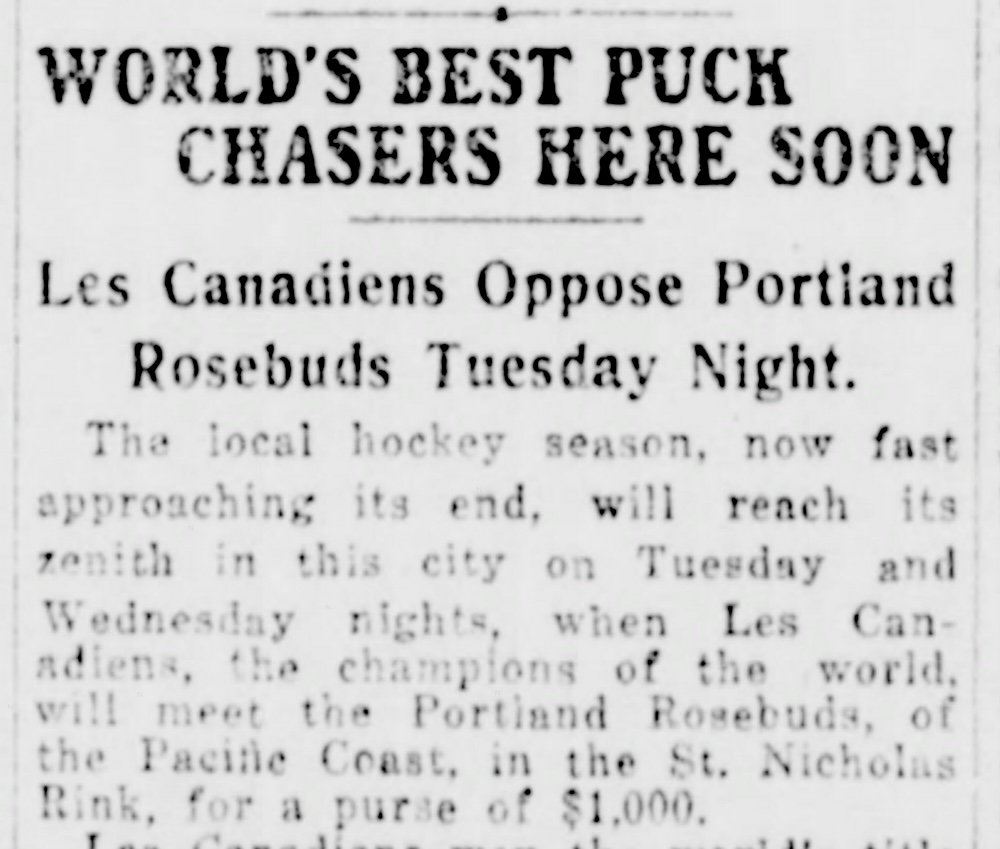
After wrapping up their 1916 Stanley Cup series with Portland in Montreal on March 30, the two teams went on a U.S. barnstorming trip, which wasn’t uncommon at the time. While the Quebec Bulldogs and Montreal Wanderers of the NHA traveled to Boston for exhibition games, the Canadiens and Rosebuds went to New York for a two-game, total-goals series at the St. Nicholas Rink on April 4 and 5. The Canadiens won the opener 6–3 with stars Didier Pitre and Newsy Lalonde scoring twice each. The New York Tribune referred to the contest as “what is said to have been the greatest game of hockey ever played in this country,” although newspapers of this time were fond of hyperbole. “The crowd of probably 2,000 persons that gathered to watch these wonderful professional players in action [and seems to have been considered a sizeable crowd] was thrilled for every minute of the struggle.”
Goalie Georges Vezina was the true star of Game 1, with the Tribune saying he “was the personification of of coolness as he parried the storm of shots that came buzzing, zipping and tearing at the cage.” The paper estimates Vezina made at least 40 saves. In Game 2, Portland scored a 4–1 victory, which made the score 7–7 overall. Overtime was needed, and Didier Pitre scored after just 1:59 of extra play so that while the final score was 4–2 Portland, Montreal took the series 8–7. New York newspapers mention a $1,000 prize, but the Montreal Gazette on April 12, 1916, notes Canadiens players split up $700 as their winning share with the Portland team getting $500.
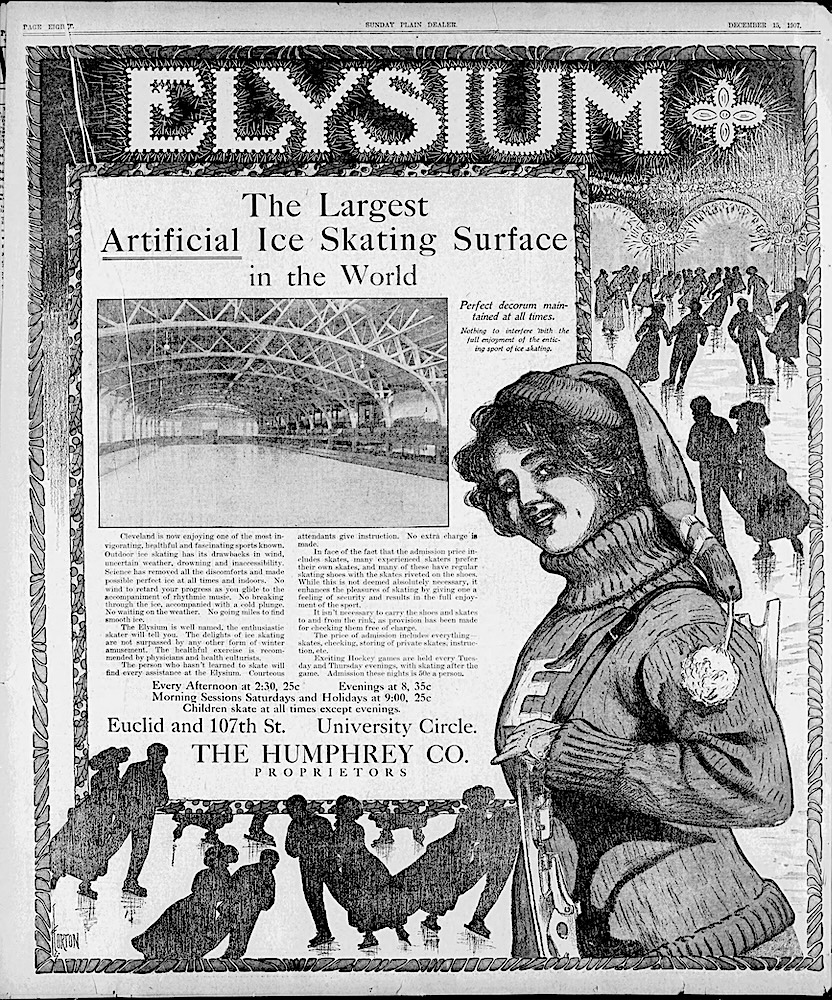
There wasn’t much time for sightseeing in New York as the teams were scheduled next for a three-game series in Cleveland, Ohio, on April 7, 8 and 10. Games would be played at the Elysium, which opened in 1907 and was said to have been (at least in its first few years) the largest artificial ice surface in the world. Despite many newspaper stories and ads boasting about the size, the only reference I could find at the time said the ice surface measured 160×100 … feet, I assume. But while 100-feet in width would definitely have been large at the time, 160 in length wouldn’t be. Wikipedia, however, notes the dimensions as 86×238, which would have been plenty long and seems more in keeping with what is visible in the images available online and in the newspaper clipping above.
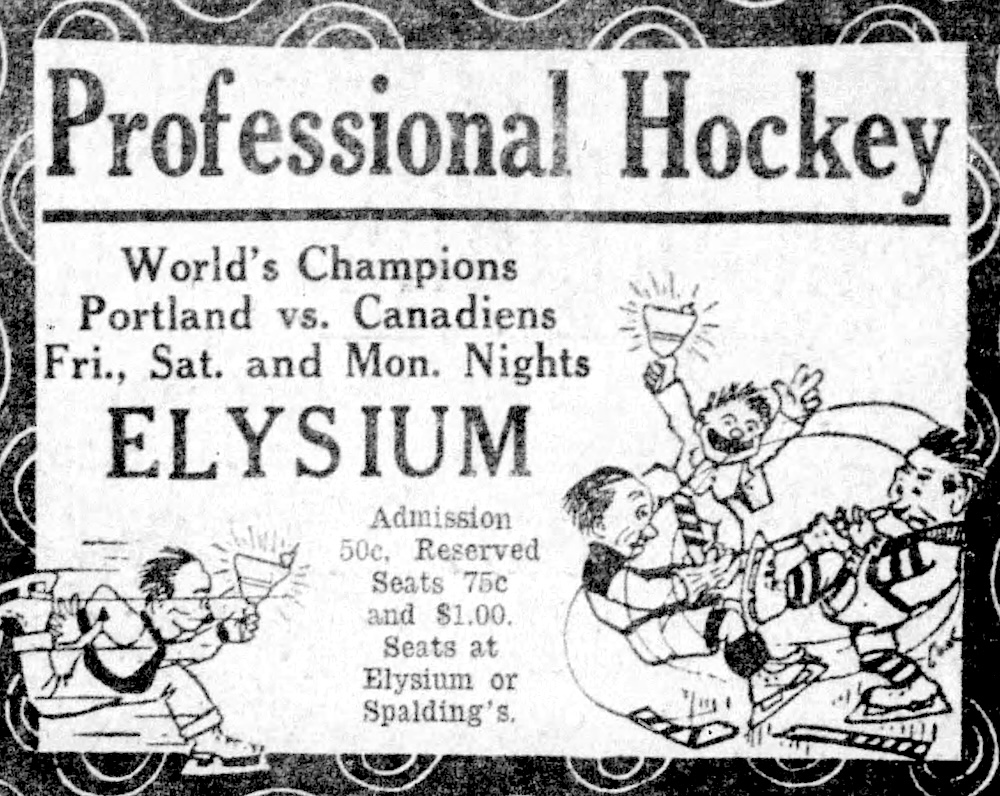
The Canadiens won the opener 7–6 after taking a 7–0 lead midway through the second period and hanging on at the finish. Portland continued their late scoring onslaught early in the second game with five goals in the first period en route to an 8–5 victory that tied the series. Didier Pitre was hurt in that game and didn’t play the finale, but Montreal romped to a 13–2 win behind three goals from Newsy Lalonde, four from Goldie Prodger (who’s name was usually written as Prodgers at the time) and five from Amos Arbour.
The Canadiens pocketed $600 for their victory in Cleveland with Portland players settling for $400, but the big windfall came with the fact that in winning the series, Montreal had their travel expenses covered too. “The players all got a piece of coin and travelled like princes,” said managing director George Kennedy in The Montreal Star on April 12, 1916. “What more could they want?” Still, “the club made little,” Kennedy complained.
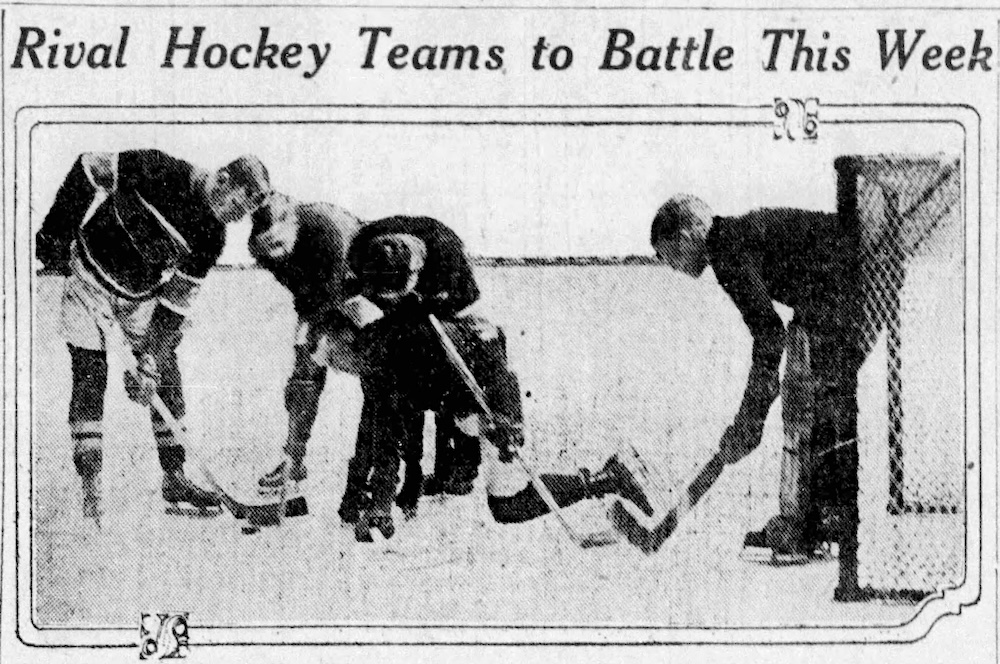
Bert Corbeau, Canadiens; Tommy Dunderdale, Portland; Amos Arbor, Canadiens;
Ernie “Moose” Johnson, Portland; and Tom Murray, Portland.
I knew nothing about this trip, and found it interesting … but another reason why I’m writing this now (and why I haven’t written very much this year), is because I have a new book coming out in the fall with Firefly Books. It’s taken up most of my hockey-writing energy of late. It’s called The Mammoth Book of Hockey Trivia, and while I don’t love “Mammoth” in the title and, like my kids book series for Scholastic – of which I’m also currently doing updates for the most recent one, and which this book is like a G-I-G-A-N-T-I-C (you might say, Mammoth!) version of – it’s facts and figures and stories and statistics, not questions-and-answers. As some people know, I’ve grumbled my way through much of this project, but now that it’s in the home stretch I’m pretty happy with it. Feel free to pre-order a copy now … but I’m sure you’ll hear more about it from me after the summer.

And, hey, if you’re in and around Owen Sound tomorrow, don’t forget my talk for the Island View Drive Rate Payers Association at the Kemble Church…
So nice to “read you” again! And your photo shows you getting more handsome all the time!! Congrats on your new book!
This is a wonderfully refreshing piece which hit home on a personal note…
Eric, of course, could not know, but number 6 has been my favorite number ever since #6 visited Ebbets Field and consistently bombed the Brooks. In fact, Stan Musial got his nickname in Brooklyn because when he came to bat one day, a worried Brooklyniter bawled out, “Here comes The Man.” Musial was many more times The Man. As for the update Habs, this man is rooting for them because of many things, including coach Marty St. Louis. The Cards were from St. Lou and so was #6!
Another great story. The Portland Rosebuds stopped in Houghton on their way to Montreal and played an exhibition game against a team of Michigan Upper Peninsula All-Stars on March 17, 1916 in the Houghton Amphidrome. Portland defeated the All Stars 7-6. One of the All-Stars was Jack Adams and one of the Portland players was Charlie Uksila. Uksila was born and rasied in Calumet. After Uksila retired he started a new career in figure skating and in 1940 he became a producer and choreographer for the newly formed “Ice Capades”. He even refereed some NHL games in the 1930s.
I didn’t know about Portland stopping in Houghton!
And I knew a little about Charles Uksila, but not the figure skating/Ice Capades connection.
Thanks!
Another great historical article.
You always get me searching for stories relating to your articles.
May THE 6th be with the Canadiens!!!
Last nite’s game was spectacular! I have all my parts crossed!!!
Great post Eric….nice to have you back.
Sincerely Sherri-Ellen (BellaSita Mum) & **purrss** BellaDharma (who watchess Hockey now too!)
A great history on the on battles for the Stanley Cup. Let’s hope the Flying Frenchmen can take it all the way.
Hopefully Montreal will repeat again.
Against the Rosebuds? What a fearless name! Maybe the Pussycats or Barbie Dolls?
You really excel as a historian.