Category Archives: Baseball History

A 1935 Hockey Vision of Baseball’s Future

Congratulations to the 2014 World Series champion San Francisco Giants, and to MVP Madison Bumgarner. He was pretty amazing! Historically speaking, three championships in five years is quite an accomplishment … but somehow, the Giants just don’t feel like a dynasty to me. It’s not like there’s been that overwhelming feeling going into any season that there’s just no way to beat them. To me, that’s as much a part of being a dynasty as the winning.

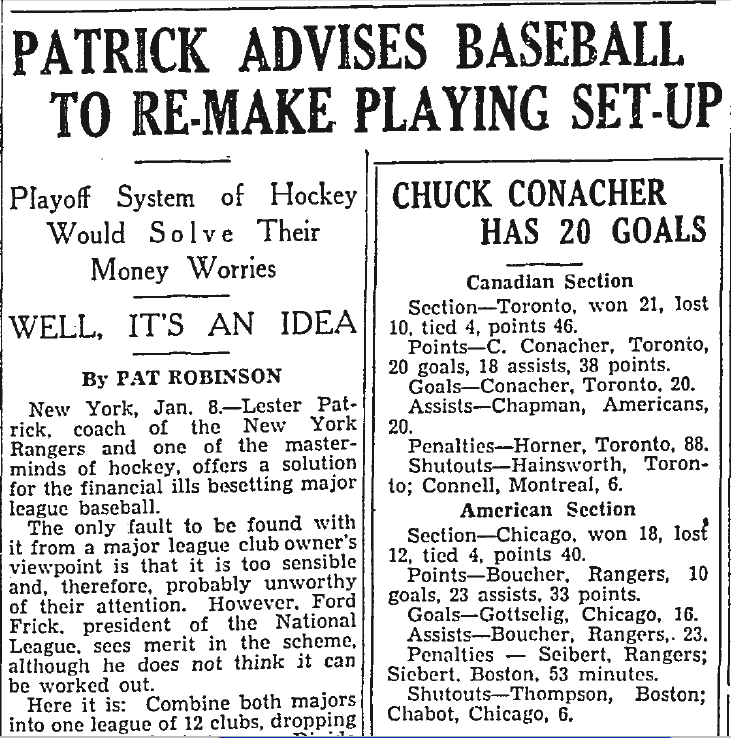
This was the last World Series to be overseen by baseball commissioner Bud Selig. People seem to be well past saying that his legacy will be the canceled World Series of 1994, and are instead praising his developments of interleague play, the expanded playoffs with first one and now two wild card teams in each league, and the huge expansion of revenue those two ideas helped to create. But even though I truly do believe you might see something you’ve never seen before any time you watch a baseball game, it really seems that there are very few ideas in sports that someone hasn’t thought of before! Many of Bud Selig’s innovations for baseball – and even his ill-fated plans for contraction – were all advanced back in 1935 … by Hockey Hall of Famer Lester Patrick.
LP 1935 story

Lester Patrick was a big baseball fan, and a pretty good ballplayer in his younger days.
A couple of years ago, I wrote a story for The Hockey News making the case that the World Series of 1912 inspired Patrick to push for hockey to change the Stanley Cup playoffs away from the one-, two-, or three-game challenge series the Stanley Cup trustees had always favored toward the best-of-seven format used in baseball.

By 1934, Major League Baseball was a money-losing proposition in many cities because of The Great Depression, but Patrick had a few ideas to fix that. His plan, reported in newspapers in January of 1935, was to take the eight-team American League and eight-team National league and combine them into one 12-team circuit with two divisions of six teams each. They would play an interlocking schedule, and then – instead of only the pennant winners advancing directly into the World Series, as baseball had always done – the top three teams in each division would qualify for the playoffs. In the NHL, finances weren’t exactly booming at this time either, and American sportswriters loved to mock the league’s playoffs for being needlessly complicated and giving less worthy teams a chance to win. Still, Patrick said:

“If we had two major hockey leagues we’d lose money like the baseball people do. Our race would be over right now and we wouldn’t draw files playing out the schedule. Instead, interest is sustained for the playoffs, the crowds keep coming, and we make money. And we play to standing room only in the playoffs. But in baseball all too often one or two teams have the race sewed up long before the season is over and attendance fades to nothing. Under my plan, interest would be sustained throughout the year.”

As for interleague play:

“Imagine how towns like Pittsburgh and Brooklyn would turn out to see Babe Ruth, Jimmy Foxx and other stars playing the Pirates or Dodgers. Or how Washington and Cleveland would go for Dizzy Dean and other stars they never see. You may think Babe Ruth has been over exploited but, really, the baseball people have been dumb. They haven’t exploited him half enough. Think of the millions they could have made with him under a set-up as I have outlined.”

National League president (and future Major League commissioner) Ford Frick saw merit in Patrick’s plan but wasn’t sure how it could be carried out … particularly the contraction part. “Granting that it would work out well in baseball,” Frick said, “what towns could be dropped? No town would want to be deprived of its baseball.

To Patrick, the answer was obvious. “Drop the four weakest towns financially.” His plan was to cut the St. Louis Browns, the Boston Braves, and the Philadelphia Phillies, all of whom already had other teams in the same cities (the Cardinals, Red Sox, and the Philadelphia Athletics) who were doing much better. The fourth team Patrick planned to drop was the Reds. “Only Cincinnati would be deprived of a major league club and judging by the box office receipts, that isn’t a major league town anyway.

In the long run, Lester Patrick and Bud Selig were probably wrong about contraction, but the rest of Patrick’s plan looks an awful lot like the makeup of baseball Selig has given us today … although without the drug testing and instant replays!
Home Run Baker

The World Series starts tonight. If you haven’t been paying attention, Kansas City is 8-and-0 in the postseason. The Royals are coming off of pretty stunning sweeps of the two best teams in the American League after returning to the playoffs for the first time since their World Series victory in 1985. San Francisco is back again, for the third time in five years, after winning the World Series in 2010 and 2012.

The Giants reached the World Series this time with a five-game win over St. Louis, wrapping up the NLCS with a three-run walk-off home run by Travis Ishikawa in the bottom of the ninth. The guy who caught the home run ball gave it back to Ishikawa the other day. “Ishikawa is the guy who hit the ball,” explained lifelong Giants fan Frank Burke. “I’m just the lucky guy who caught it.” Burke was taken down to the clubhouse and handed the ball to Ishikawa, who gave him a signed bat in return. Burke also asked if he could get tickets to the World Series, and later received four for Game Three, which will be the first to be played in San Francisco.

I like to think I would have done the same thing … but I don’t know.

I remember when the groundskeeper who caught Mark McGwire’s record-breaking 62nd home run ball in 1998 returned it to him for nothing, even though other balls from the home run race with Sammy Sosa had already been sold for thousands of dollars. I remember thinking then that I would have liked to do the same thing … but soon McGwire’s 70th home run ball sold for $3 million! Then there was that epic battle in the stands, not to mention the courts, over the ball a few years later when Barry Bonds broke McGwire’s record.

The market for home run balls (like everything else!) seems to have dropped considerably since then, but the mania for baseball memorabilia dates back a lot further than the sports card craze of the 1980s and ’90s and the home run daze of the ’90s and early 2000s.

In 1911, Frank Baker of the Philadelphia A’s hit home runs against the New York Giants in back-to-back games of that year’s World Series, and became known ever after as “Home Run Baker.” Baker’s first home run, in Game Two, went complete out of Philadelphia’s Shibe Park and landed on Twentieth Street. It was scooped up by a red-headed boy, who grabbed it and ran off with a policeman (who also wanted the ball) in hot pursuit. Obviously, the ball had some value.

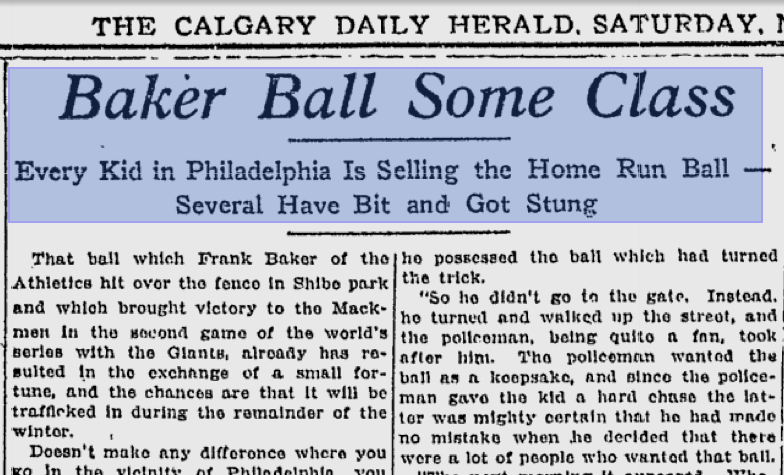
After local papers printed the story, red-headed boys all over Philadelphia suddenly turned up selling the supposed Baker Ball! Stories about this illicit enterprise soon showed up in newspapers all across North America. So far, I’ve come across them in November of 1911 in newspapers from Auburn, New York; Calgary, Alberta; and Spokane, Washington. Here’s part of the account from The Calgary Daily Herald:

Baker Headline

Doesn’t make any difference where you go in the vicinity of Philadelphia, you will find that ball. And it’s usually for sale. The funny part of it is that while you are standing in the heart of the shopping district, admiring the ball, some other fan will be standing upon the outskirts of the city, also admiring a sphere which Baker is supposed to have driven over the fence

I’m the boy what got the ball what Frank Baker hit over the fence,” was the introduction. “This is the ball.

Then the dickering began.

If this fan looked prosperous the kid started at about $25… Of course, he was willing to accept anything upward of $1.25, the price which he paid for the sphere

Returning visitors say that the rage is still on. They claim you can see the identical ball in any portion of Philadelphia. Also that it is on exhibition in the suburbs. Some say that it has crossed to the Jersey Shore.

Some of the wild-eyed fans claim to have invested from $30 to $50.

Depending on how you choose to calculate inflation, that would range from as little as $750 to more than $24,000 today. Not quite $3 million, but still a nice little racket!

How It All Started For Me

My favorite part of writing is doing the research. I love to look things up. Nowadays, I can spend hours at a time reading old newspapers on my computer, but I’ll always remember the day back in 1983 when I discovered newspapers on microfilm. Corny as it sounds, it changed my life. Until I found those little orange boxes containing the New York Times, microfilm had only existed for me in spy movies. It was something someone smuggled out of an Iron Curtain country. Now, it would let me travel through time!

Having made this discovery, some people might choose to look up the moon landing, the Kennedy assassination, the bombing of Pearl Harbor, or maybe the day they were born. I chose to look up the seventh game of the 1926 World Series. The day that Grover Cleveland “Pete” Alexanderstruck out Tony Lazzeri of the New York Yankees with the bases loaded and went on to save the first World Series championship for the St. Louis Cardinals.

Why did I look up that game? One reason was that I knew the exact date (October 10, 1926). Another was the reason why I knew the exact date, which is because the legend of Alexander striking out Lazzeri was one of the featured stories in the very first book I ever had about baseball history: Big Time Baseball by the late Maury Allen. Mostly, the reason I chose to look up that game is because there were so many different versions of what happened that day. The people involved couldn’t even agree on the weather! Alexander himself remembered it as a “dark, chilly afternoon,” but his manager (and second baseman) Rogers Hornsby recalled Alex being out there “in the sunlight.”


The World Series of 1926 was a classic. The Yankees of Babe Ruth and Lou Gehrig were already a powerhouse, while the Cardinals had just won their first National League pennant. The Yanks won the opener and went out to a 3-2 series lead, but Alexander kept the Cardinals alive with a complete-game victory in New York in game six. St. Louis was clinging to a one-run lead in game seven the following day at Yankee Stadium when starter Jess Haines injured his pitching hand. There were two out and the bases loaded when Hornsby called on Alexander again. As Big Time Baseball put it:

Why, many wondered, was it Alexander, and not [Art] Reinhart or [Flint] Rhem coming in toward the mound? After his nine-inning chore of the day before, Ol’ Pete had no reasonable expectation he would be called on again. In view of that he had done some celebrating — perhaps a little too much celebrating — the night before. Was he rested enough — was he in condition to pitch?

Alexander was an alcoholic, drinking to hide his epilepsy and to forget the horrors of combat in World War I. There are many who say the pitcher was hung over when Rogers Hornsby called on him. Others claim he was still drunk. Hornsby said fans would tell him to his face that he’d had to send a cab to get Alex out of a barroom after the game had started, but Alexander always maintained he was sober and Hornsby backs him up. Still, the pitcher admits he took a long time making the walk from the bullpen to the pitcher’s mound to face Lazzeri. Alexander and Hornsby spoke briefly, and then the pitcher got to work.

Everyone seems to agree that Alexander started the young slugger with a curveball, but the story gets fuzzy again after that. Some say the pitch was a strike. Others a ball. Then there are those who maintain it was the very first pitch that Lazzeri launched deep down the left field line.

The piercing crack was like a rifle report. Sixty thousand fans jumped to their feet howling, as a mighty line drive whistled toward the left field stands. The ball zoomed over the fence and the shouts rose to a deafening roar — and then suddenly died away. The drive was foul by a foot!

Hornsby would say the ball was two feet foul, but Alexander claimed the drive “had a tail-end fade and landed foul by eight to ten feet.” He shrugged it off, and struck out Lazzeri to end the threat. For all practical purposes, it was ball game over. Alexander had little trouble in the eighth and ninth, and the Cardinals were World Series champions.


The microfilm was going to give me the chance to find out what really happened. I didn’t figure there was any way I would read about how drunk or hungover Alexander was or was not, but I knew I would at least find out what the weather was and which pitch Lazzeri hit. Most importantly, I hoped to find out just how far foul that ball really was!

As I suspected, there was no mention of Alexander’s drinking. Just talk that it seemed to be “a sort of questionable bit of diplomacy” to call on him after his performance the day before. The weather, however, was summed up nicely: “It is cold; it is dreary; it is dark; it is dripping; it is damp and thick and all that.”

As for the pitch, the newspaper confirmed that Alexander started Lazzeri with a curve, but he didn’t swing and it was ball one. Lazzeri didn’t swing until the third pitch, when, with the count 1-and-1, he hit the famous foul ball. But no account would say how far foul. One writer said simply, “Lazzeri fouled it into the stands.” Another reported only that, “Lazzeri drove a long foul fly to the leftfield stands.” The written account of the radio play-by-play called it “a long shot into the left field stands.”

So, my first foray into microfilm had produced success and failure. I had found some of what I was looking for, but I couldn’t uncover everything. Some things, even simple things, really are lost to history.