All posts by Eric Zweig

Expansion Now and Then

The NHL’s newest team officially got a name last week when it was announced that the expansion franchise in Las Vegas for 2017-18 will be known as the Vegas Golden Knights. The official colours will be steel grey (for strength and durability), gold (because Nevada is the largest producer of gold in the USA), red (for the Vegas skyline and the Red Rock canyons of the nearby desert), and black (for power and intensity.) Grey, Black and Gold are also the colours of the United States Military Academy at West Point, whose sports teams are known as the Black Knights, and where the new hockey team’s majority owner Bill Foley graduated in 1967.

There have actually been professional hockey teams in Las Vegas since 1970, and serious interest in an NHL team since 2007. The current ownership group has been involved in the discussion since the spring of 2014. The NHL authorized a formal expansion process on June 24, 2015 and made applications available to interested parties that July. It was then announced on July 21, 2015, that Las Vegas and Quebec City had applied. Nearly a year later, on June 22, 2016, it was announced that Las Vegas would become the NHL’s 31st team. Five months later, the team got its name. In about 11 more months, they’ll play their first game.

Vegas

Things moved a lot faster when the NHL first expanded back in 1924! Yes, teams had been added – and subtracted and relocated – prior to this, but the admission of a second Montreal team and the first U.S. club for the 1924-25 season (which saw the league grow to six teams – although not the so-called “Original Six”) was the first true expansion.

There had been internal talks for a few years already, but the first public indication that the NHL was considering the addition of American teams came in March of 1924 when Colonel John Hammond, representing Madison Square Garden of New York, and Charles Adams of Boston were invited to Montreal during the Stanley Cup playoffs. Reports on March 20, 1924, had Adams confirming that he’d purchased an option on a franchise for Boston. Little more is heard again until September 26, but by September 30, the Boston Arena had agreed to give ice to Adams for his new team, and Art Ross had agreed to serve as the coach, manager and vice president.

Admitted

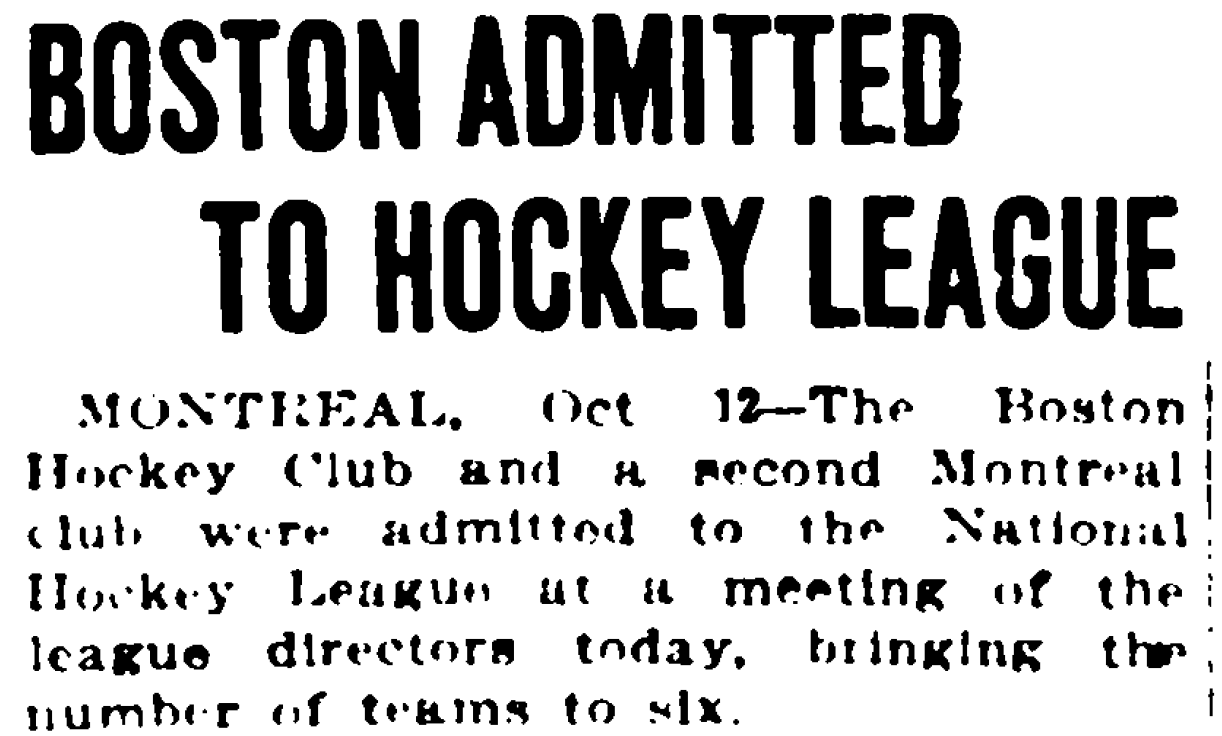
The NHL wouldn’t actually confirm the new entries in Boston and Montreal until October 12, 1924; the Boston Professional Hockey Association, Inc. wasn’t officially formed until October 23; and formal approval of the franchises didn’t actually come until the NHL’s annual meeting in Montreal, on November 1, 1924. Even so, the two teams would play their first games against each other in Boston just one month later– meaning there was no time to waste!

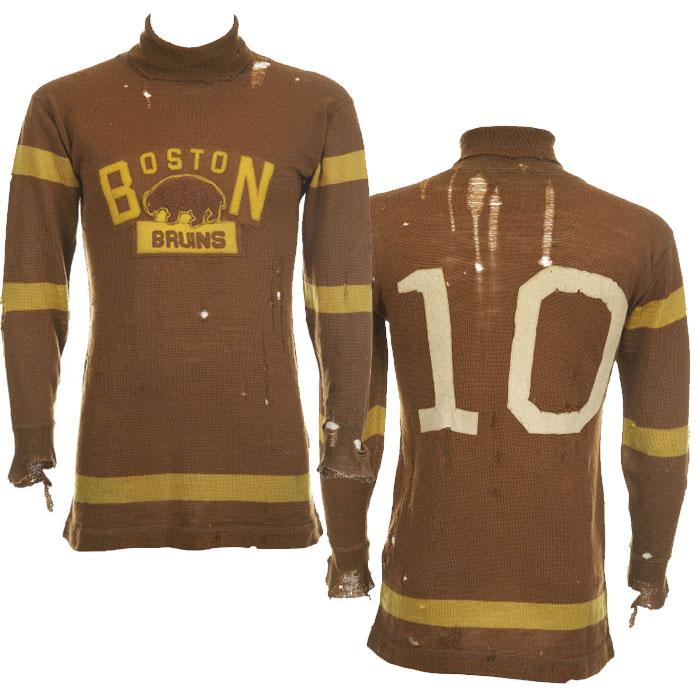
On September 30, 1924, it had been reported that Boston would take over the now-defunct Seattle franchise of the rival Pacific Coast Hockey Association, but that story quickly proved false. Ross would sign a few over-the-hill PCHA veterans for the new Boston team, but mainly he was on the road for the next few weeks trying to recruit promising amateurs. Most of the players he assembled met up in Ross’s hometown of Montreal on November 14, 1924, and proceeded to Boston together by train. The team also got its name that day, and its colours too. Brown and yellow, same as Adams’ chain of grocery stores. (Black would replace the brown in the Bruins uniform in 1934–35.)

Name

“An interesting item is connected with Pres. Adams’ partiality towards brown as the team color,” noted that day’s Boston Globe. “The pro magnate’s four thoroughbred [horses] are brown … his Guernsey cows are of the same color; brown is the predominating color among his Durco pigs on his Framingham estate, and the Rhode Island hens are brown, although Pres. Adams wouldn’t say whether or not the eggs they lay are of a brown color.” Browns was even considered as the team nickname, but Adams was concerned that people would call them the Brownies, which struck him as childish. The team name, of course, would be the Bruins.

Bruins

The stories surrounding the Bruins name are all pretty much the same. Charles Adams held a contest, but had very definite ideas about what kind of name he wanted. He wanted the name to relate to “an untamed animal.” He wanted the animal to be big, strong, ferocious and smart. (Of course, it wouldn’t hurt if that animal happened to be brown!) A secretary in the team office is usually given credit for coming up with Bruins – which comes from an old English term for a Brown bear first used in a medieval children’s fable. In his book “The Bruins” famed hockey writer Brian McFarlane specifically names Bessie Moss, whom he says was a transplanted Canadian working for Art Ross in Boston. When I was working on my Art Ross biography, I asked McFarlane about the story – which had proven impossible for me to confirm. He was pretty sure he’d come across it in either an old book or newspaper story some time during his hockey travels in the 1970s, but no longer had the source among his collection.

Game

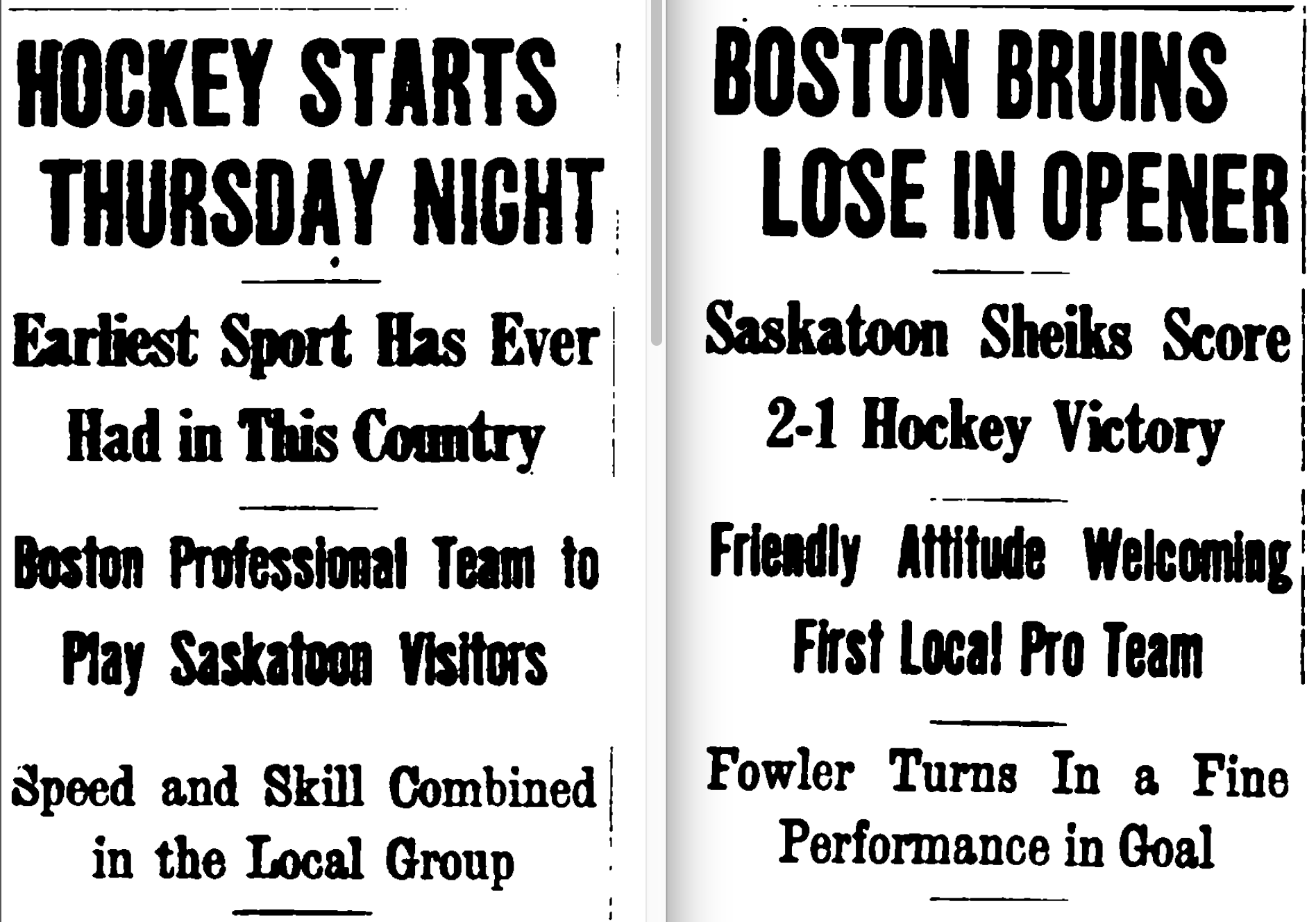
Whoever and however they got the name, the Bruins hit the ice for their first practice on November 15, 1924, and played their first game on Thanksgiving night, Thursday, November 27. It was an exhibition game against the Sasktoon Sheiks of the Western Canada Hockey League. Boston lost 2-1. They would beat their expansion cousins from Montreal (who were not officially named the Maroons until the following season) by the same 2-1 score in their first NHL game on December 1, 1924. Still, it would be a long, trying, season for the Bruins, who finished that first year with a record of 6-24-0. Montreal was only slightly better at 9-19-2.

The NHL will be counting on a better showing by Vegas – but they’ll be hard pressed to match the Maroons, who improved so quickly they won the Stanley Cup in their second season, or the Bruins, who were champions by year five.

Pyle and the St. Pats

In my story last week, I made a brief mention of C.C. Pyle as the agent for both Red Grange and Suzanne Lenglen. Charles C. Pyle (sometimes referred to as “Cold Cash” Pyle, and more often as “Cash and Carry” Pyle) was responsible for bringing both stars to Toronto in the fall of 1926 … but he was looking to take something away with him too: the city’s professional hockey team – The Toronto St. Pats.

Lenglen
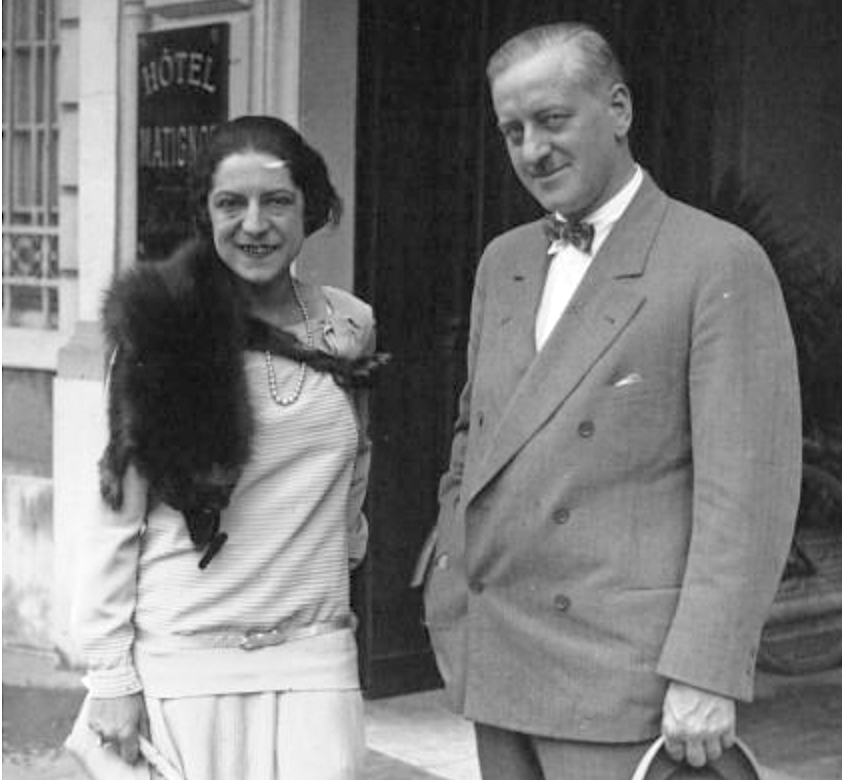
Suzanne Lenglen and her agent, C.C. Pyle.

Writing in the Toronto Daily Star on October 8, 1926 (a few days before Lenglen’s appearance in the city), W.A. Hewitt noted: “Cash-and-Carry Pyle, who has Red Grange and Suzanne Lenglen under his wing, is trying desperately to break into professional hockey…” Hewitt wrote that Pyle had recently raised his original offer of $200,000 to $400,000 in an effort to buy the New York Americans, the NHL’s first franchise in The Big Apple.

By the middle of November, shortly after Grange’s visit to Toronto, came stories that Pyle had now set his sights on breaking into the NHL through Toronto. He had asked the owners of the St. Patricks what it would take to buy their team and was reportedly told $200,000. Though he’d offered double that for the Americans, Pyle was said to consider this price too high for the Toronto team. (Conn Smythe – who would soon put together a syndicate to buy the St. Pats for $160,000 – told the Star in 1977 that the team “might have been worth $15,000.”)

TO Papers
The Toronto Telegram had the story of Pyle’s interest in the St. Pats first on November 19.
Other local papers, such as the Globe, shown here, didn’t have it until the next day.

While it appears there would be more serious offers from Montreal investors (who likely would have left he team in Toronto) in the coming weeks, it was widely reported that if Pyle bought the St. Pats, he would move them to Philadelphia. Smythe used this threat of losing the city’s NHL team to an American city to rally his own group of investors and save the team in Toronto. He closed his deal on February 14, 1927, and renamed the team the Maple Leafs.

How close did Toronto really come to losing its team in 1926? It’s hard to know for sure. But C.C. Pyle’s interest in hockey seems to have been genuine. In the spring of 1927, he and Red Grange bought a large rink in Los Angeles, made plans to build another in San Francisco, and announced their intention to establish a four-team California Professional Hockey League. The league would run until 1933, though Pyle and Grange sold their interests in it around 1929.

Three Stars in Three Months

Over a three-month period 90 years ago, during the fall of 1926, three of the greatest sports stars of the Roaring Twenties made appearances in Toronto. A time-machine type of moment for someone like me, and yet – given the historical significance of these performers – they don’t appear to have attracted the size of crowds they should have.

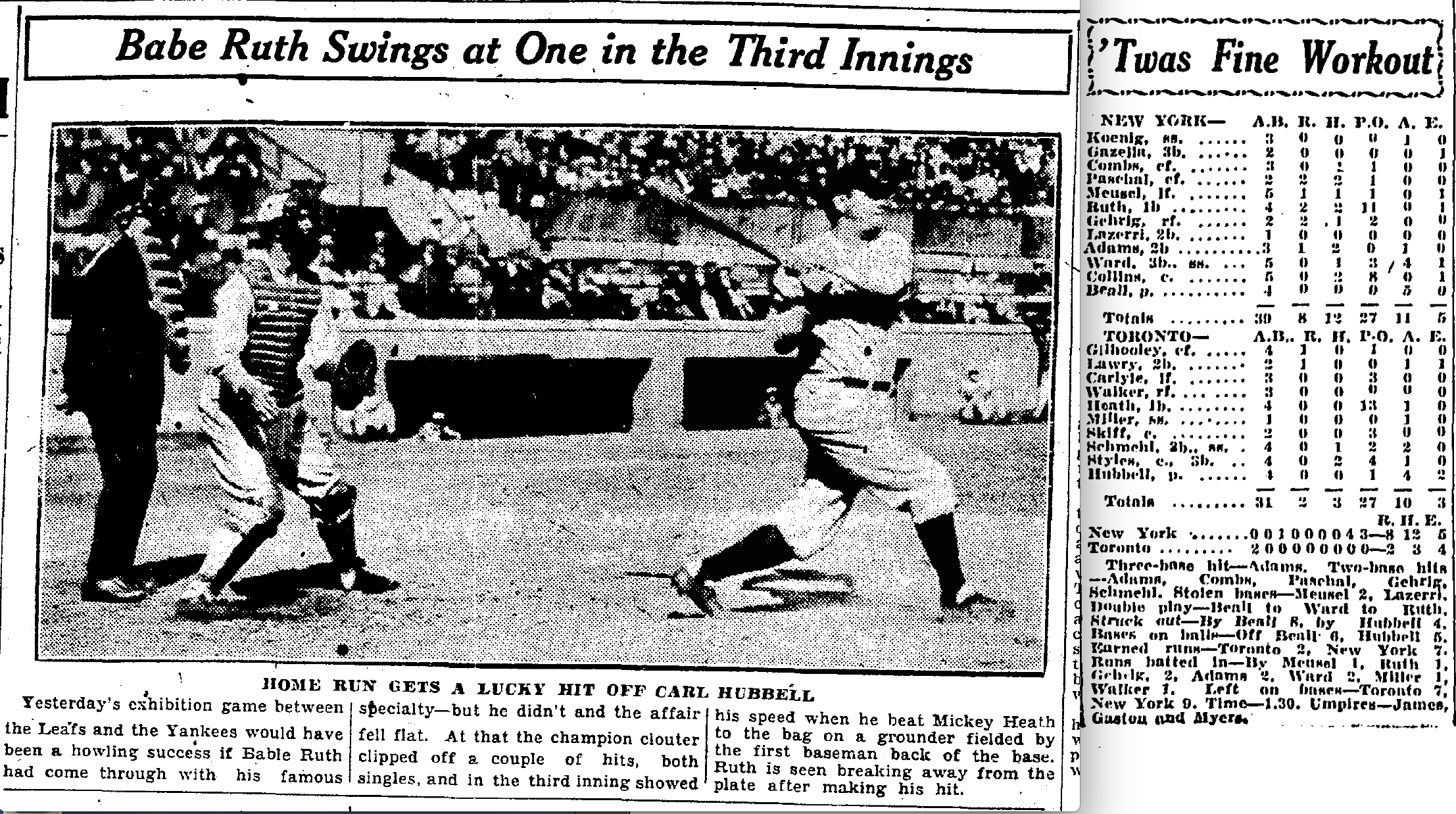
First up was Babe Ruth, who appeared on a Friday afternoon, September 10, 1926, for an exhibition game between the New York Yankees and the Toronto Maple Leafs baseball team. The Yankees featured most of their star players, including Tony Lazzeri, Mark Koening and Bob Meusel, although Ruth played first base in this game and when Lou Gehrig came in late it was as the right fielder.

Ruth
Photograph from the Toronto Star, box score from the Globe, September 11, 1926.

The Leafs, behind soon-to-be New York Giants star Carl Hubbell, led 2-1 for most of the game before the Yankees scored four in the eighth and three in the ninth for an 8-2 victory. The whole game was played in just an hour-and-a-half! Only about 6,000 fans showed up at Maple Leaf Stadium, and by most accounts, it wasn’t much of a game. The crowd had come to see Ruth hit home runs, but he managed only two singles. Still, he was swarmed on the field by about 100 young boys the moment the game ended.

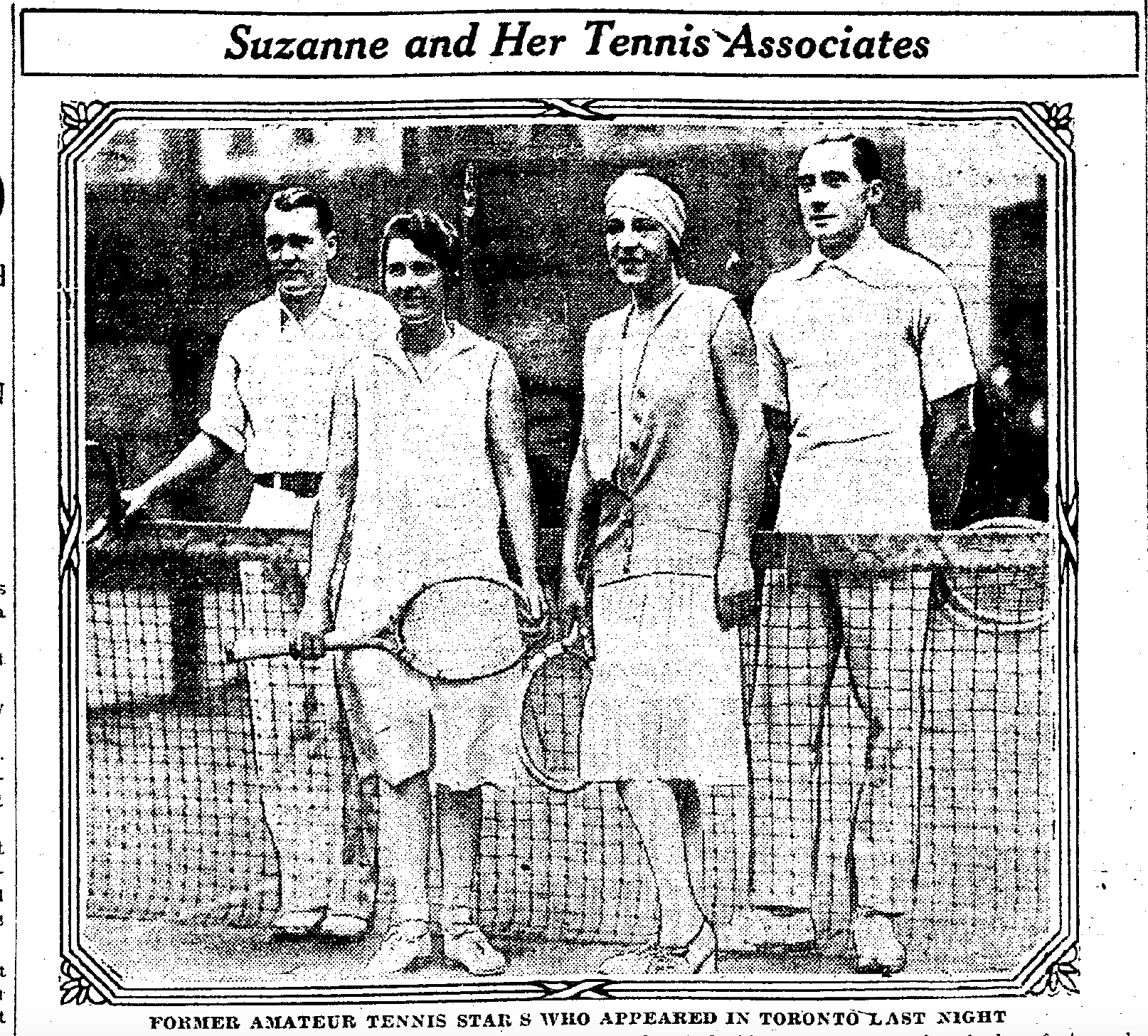
A month later, on October 12, 1926, tennis star Suzanne Lenglen of France was in Toronto. Lenglen was the Serena Williams of her day. Not only was she the world’s most dominant female tennis player, she helped to change tennis fashions and was a hard-nosed businesswoman. In an era when tennis was strictly amateur, she was the first to become a professional. In fact, that’s what brought her to Toronto. It was her second stop on a pro exhibition tour across North America that had begun at Madison Square Garden in New York two nights before.

Lenglen’s star power had made tennis a popular spectator sport, and while I couldn’t find a specific attendance figure for her exhibition at Toronto’s Arena Gardens, stories note it was a large and particularly well-dressed crowd. Lenglen defeated American Mary Browne 6-0, 6-2 in a singles match, but she and her French partner Paul Feret were defeated by Browne and fellow Californian Harvey Snodgrass in mixed doubles.

Lenglen
Photo from the Toronto Star, October 13, 1926. Lenglen is wearing the head scarf.

Of particular note throughout her tour was the question of why Lenglen had turned pro – a widely criticized decision that saw the All-England Club at Wimbeldon (where she had won six championships in a seven-year span) revoke her honorary membership. Lenglen was up front about it, saying she did it for the money. She estimated that she’d made millions of francs for others while spending thousands of her own on entrance fees.

“I have worked as hard at my career as any man or woman has worked at any career. And in my whole lifetime I have not earned $5,000 – not one cent of that by my specialty, my life study – tennis…. I am twenty-seven and not wealthy – should I embark on any other career and leave the one for which I have what people call genius? Or should I smile at the prospect of actual poverty and continue to earn a fortune – for whom?

“Under these absurd and antiquated amateur rulings, only a wealthy person can compete, and the fact of the matter is that only wealthy people do compete. Is that fair? Does it advance the sport? Does it make tennis more popular – or does it tend to suppress and hinder an enormous amount of tennis talent lying dormant in the bodies of young men and women whose names are not in the social register?”

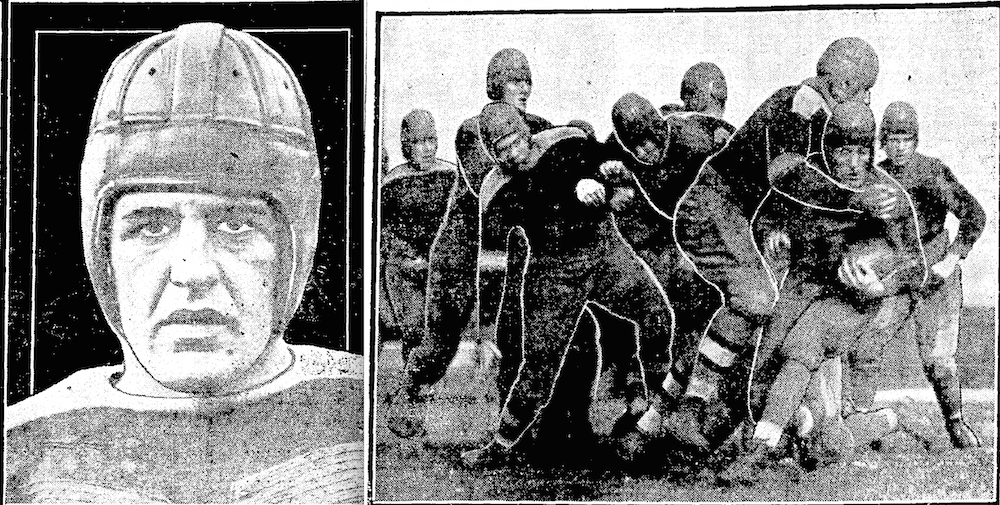
Another professional pioneer was in Toronto the next month, on November 8, 1926, when Red Grange was in town to play football. Grange had been a star at the University of Illinois at a time when college football ruled the sport and the fledgling National Football League was barely an afterthought. Grange – known as “The Galloping Ghost” – changed all that with his decision to sign with the Chicago Bears in 1925. He drew huge crowds to NFL games that season, and as a barnstormer afterward, but when he got into a dispute with Bears owner George Halas, Grange and his agent C.C. Pyle (who also represented Suzanne Lenglen!) formed their own team and their own league the following year.

Grange
Red Grange on the left, an action shot of the game on the right.
From the Toronto Star, November 9, 1926.

Grange was playing with the New York Yankees of the American Football League when he came to Toronto for a league game against the Los Angeles Wildcats at Maple Leaf Stadium. Unlike the huge crowds he attracted in the United States, there were only about 10,000 to 12,000 fans at this game. After a scoreless first half, Grange scored on a 70-yard touchdown run and the Yankees went on to a 28-0 victory.

Legendary Toronto sportswriters W.A. Hewitt (father of Foster), Lou Marsh and Mike Rodden all covered the game. Given today’s NFL-envy among so many Toronto football fans, it’s interesting to note that these writers believed the Toronto crowd was unimpressed with the American rules. Too much passing; not enough running; and not enough kicking. (The game was called football, after all!) And where were the single points? Why didn’t the American players have to run back punts? Why wasn’t the ball turned over when the punting team downed it? Forward passing was not yet allowed in Canadian football, and the fans also wondered why it wasn’t a fumble when an incomplete pass hit the ground.

All in all, the Canadian fans (or, at least, the sportswriters) felt there were just too many rules in American football. And for his part, Grange – who attended a game between Balmy Beach and the Hamilton Tigers at Varsity Stadium earlier in the day – liked all the punting and the running … but he thought the Canadian game was too rough!

I Love A Parade

Well, after 108 years of waiting, Cubs fans couldn’t have asked for a much nicer day for a parade last Friday. They say there was a total of 5 million people who lined the streets or were on hand for the “Cub-stock” rally at Grant Park.

Parade

According to Major League Baseball’s web site, it was the seventh-largest gathering of human beings in world history… and the largest ever in the Western Hemisphere.

  1. Kumbh Mela pilgrimage, India, 2013 (30 million)
  2. Arba’een festival, Iraq, 2014 (17 million)
  3. Funeral of C.N. Annadurai, India, 1969 (15 million)
  4. Funeral of Ayatollah Khomeini, Iran, 1989 (10 million)
  5. Pope Francis in the Philippines, 2015 (6 million)
  6. World Youth Day, 1995 (5 million)
  7. Cubs World Series parade (5 million)
  8. Funeral of Gamal Abdel Nasser, 1970 (5 million)
  9. Rod Stewart concert, Brazil, 1994 (3.5 million)
  10. Hajj pilgrimage, Mecca, Saudi Arabia, 2012 (3 million)

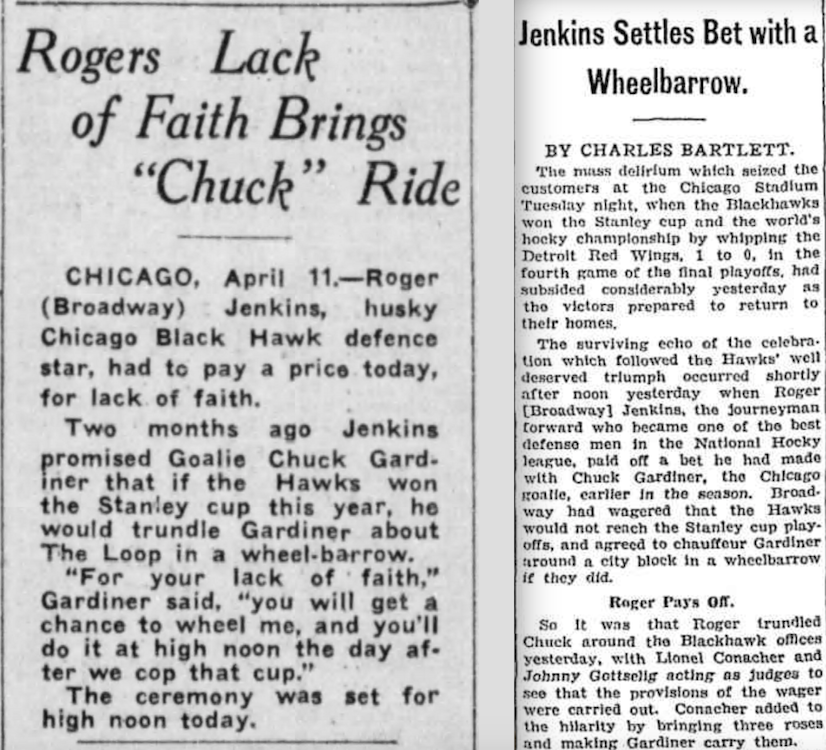
Since the parade, Cubs players have been to Disney World, appeared on Saturday Night Live, and taken the World Series Trophy to a Blackhawks game. None of them, however, have attempted to duplicate the old Blackhawks’ celebratory feat of rolling a star player through the downtown business area in a wheelbarrow.

Hawks Clips

Not only did Roger Jenkins do this with goalie Chuck Gardiner in 1934,

Hawks Pic

He did it again with Mike Karakas in 1938.

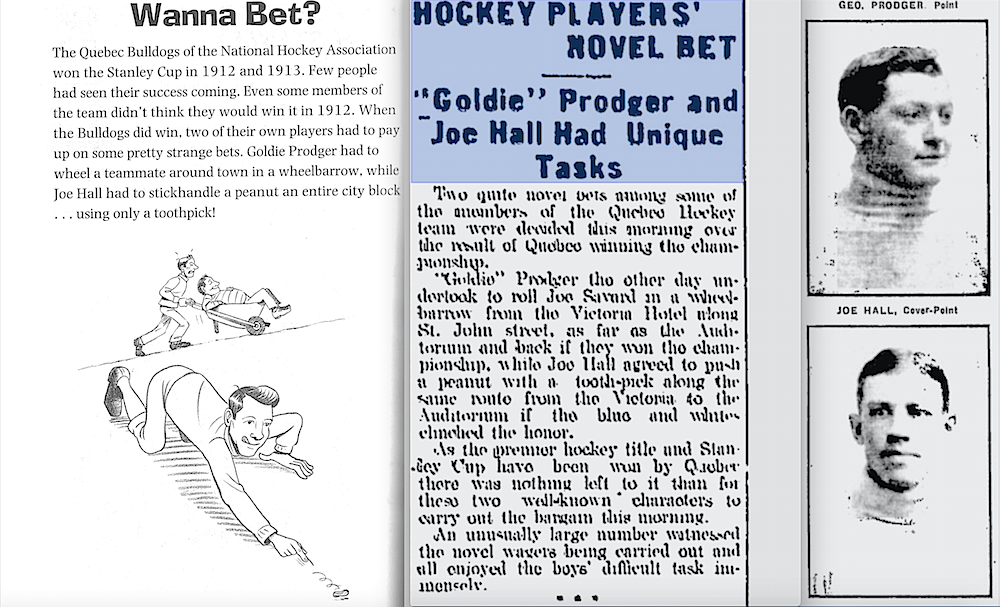
But it seems that this odd wheelbarrow tradition dates back nearly as far as the Cubs’ last World Series win in 1908, as it may well have begun with hockey’s Quebec Bulldogs in 1912 – a story that appears in a couple of my children’s books and which I often tell when I’m visiting classrooms.

Quebec

Tuning In Over Time

Game Seven of the World Series. As classic phrases go, it doesn’t get much better than that! I don’t really have a favorite in this one, but it’s hard not to be rooting for the Cubs. Still, if they do win it, it’ll certainly be tough not to feel bad for fans in Cleveland.

 Cleveland
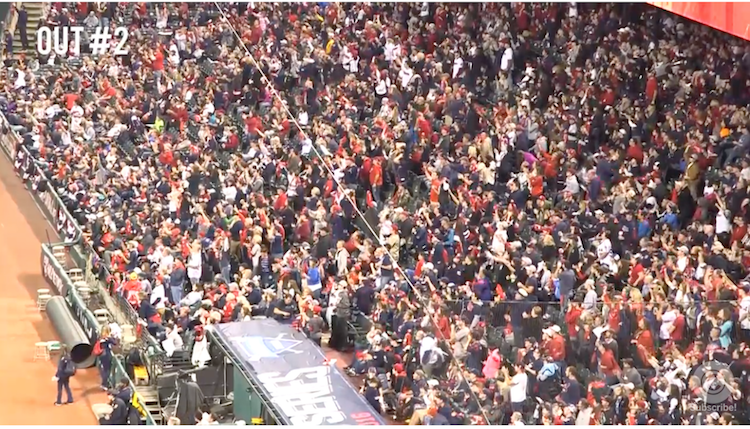
These fans in Cleveland are reacting to the game played in Chicago.

The Indians drew more than 67,000 fans to Progressive Field for games three, four and five of the series … which were played at Wrigley Field in Chicago! These fans paid $5 for a ticket (proceeds going to local charities) to watch the game on the giant video board. This has become something of a thing in recent years, but fans have been gathering to follow their teams on the road like this for more than a century!

When the Winnipeg Victorias hockey team traveled to Montreal to play their Victorias for the Stanley Cup in February of 1896, telegraph wires were run to local hotels so that Winnipeg fans could receive play-by-play updates during the game. Soon, fans all across Canada were showing up at train stations or outside of newspaper offices to “listen in” on these telegraphed reports. As early as 1907, fans gathered inside the rink in Kenora, Ontario, to receive updates from Montreal as the Thistles battled the Wanderers for the Stanley Cup.

Crowds
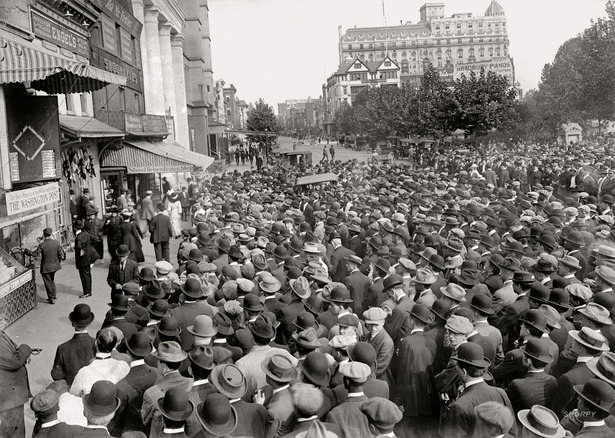
Fans gather in the street to follow the World Series.

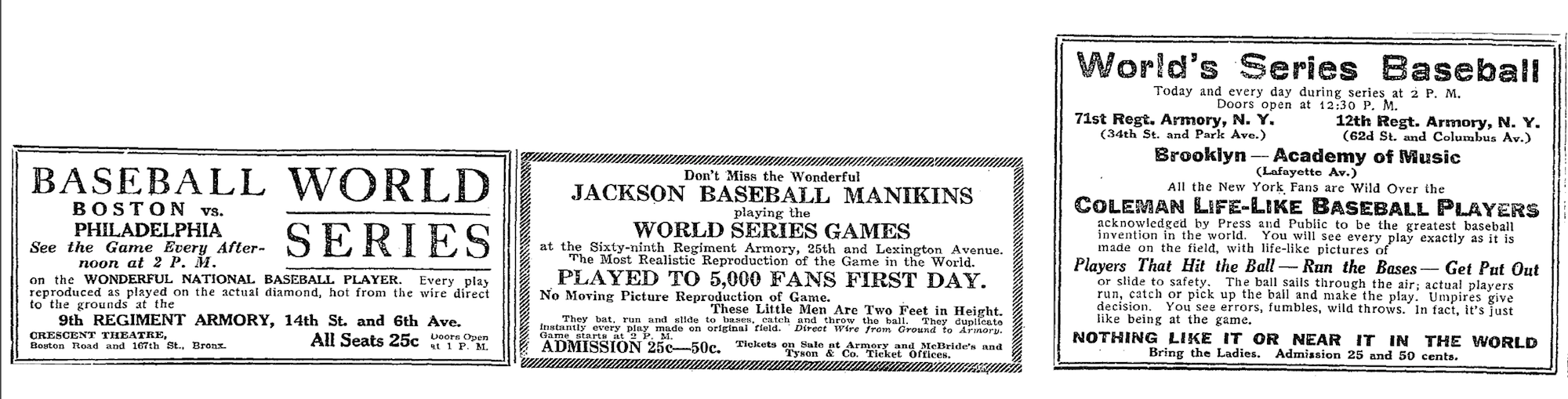
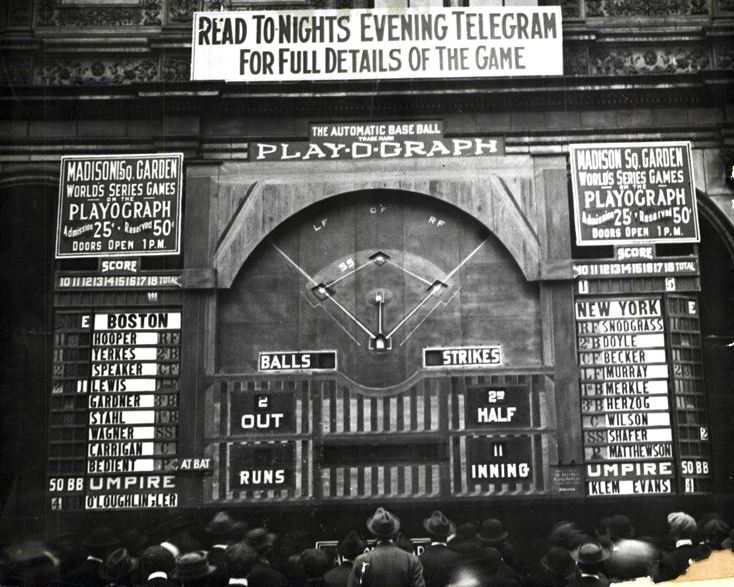
Baseball has similar traditions, with a history of elaborate electronic scoreboard devices set up in American cities to follow the action of the World Series. Often, these devices drew big crowds in the streets outside of newspaper offices, but there were also set ups in theaters, armories, and other reception halls.

Ads
Ads in the New York Times in 1915.

Perhaps it’s just me, but I find it amazing how much the Gameday display on the web site for Major League Baseball…

MLB

looks like one of those old-fashion scoreboard machines…

1912

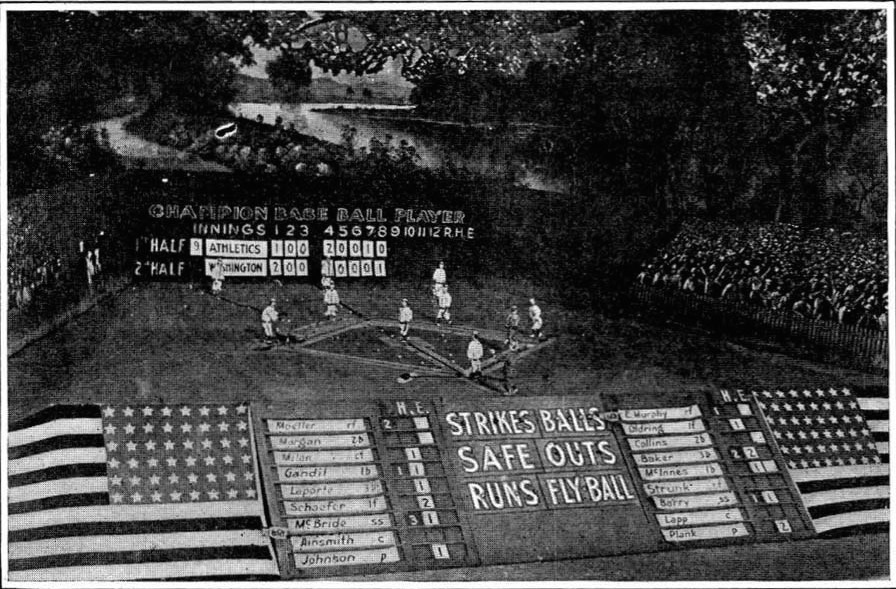
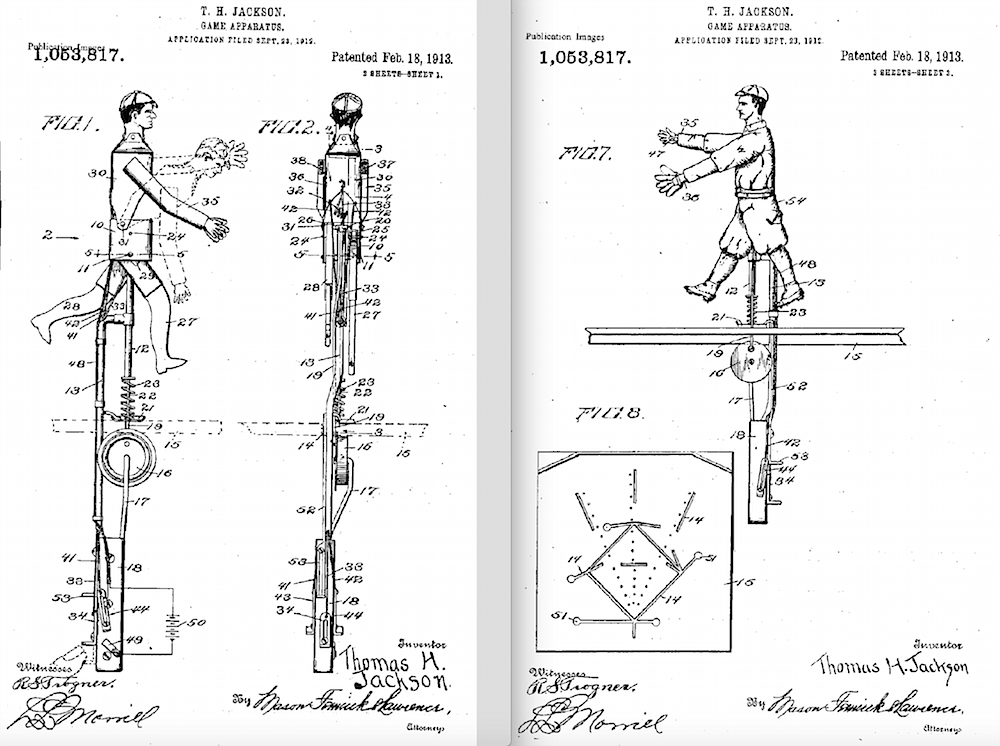
My favorite of these old-time devices is something call the Jackson Manikin Baseball Indicator. It was like a giant arcade game which used mechanical men to re-enact each play in a game as it was received via telegraph. For more on this one, you can see a story I wrote a few years ago for the Society for American Baseball Research.

Manikin Field
The Jackson Manikin Baseball Indicator, circa 1913.

Manikins
Details of the Manikins from Thomas Jackson’s patent application.

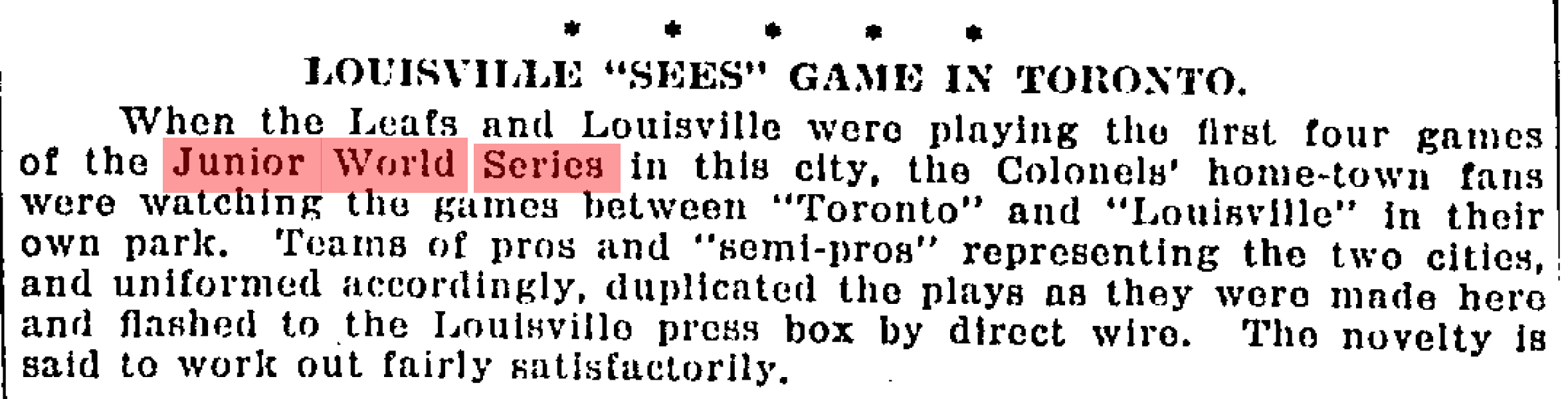
And during the 1926 Junior World Series when the Toronto Maple Leafs defeated the Louisville Colonels, fans in Louisville had a unique way of following the action when their team was in Toronto.

1926
From The Globe in Toronto, October 5, 1926.

So, as it so often seems to be, the more things change, they more they stay the same!

It Only Feels Like Forever!

Well, I’d still like to have seen the Blue Jays in it, but fans in Chicago and Cleveland have been waiting for a World Series championship a lot longer than Toronto baseball fans, who haven’t seen a title since 1993. Their droughts make even the Toronto Maple Leafs’ last Stanley Cup win in 1967 seem pretty recent!

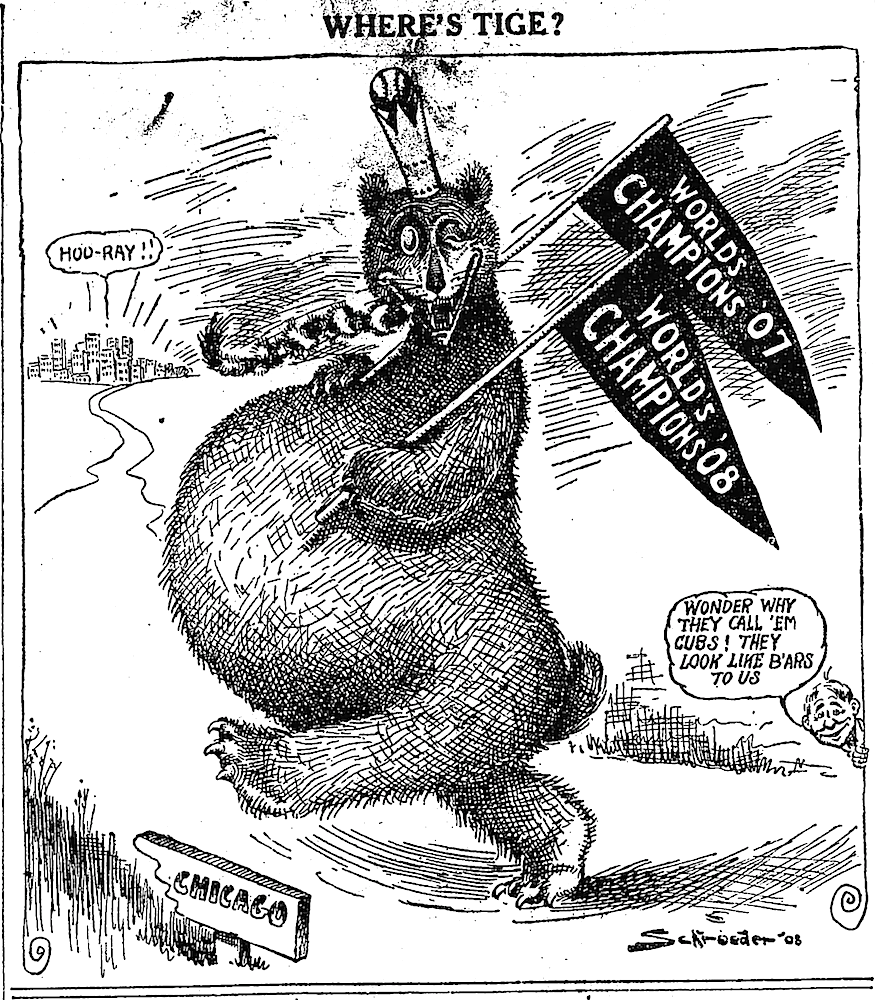
Cleveland just got to celebrate the Cavaliers’ NBA championship, and the city’s first of any kind since 1964, but they haven’t seen their baseball team win the World Series since 1948. And even that, of course, pales in comparison to the mother of all championship droughts. The Chicago Cubs haven’t even been to the World Series since 1945, and they haven’t won it since their back-to-back titles in 1907 and 1908! Both wins came over the Detroit Tigers.

Not surprisingly, some of the coverage of those Cubs wins looks a little bit different than what we’re used to today…

Cubs 1
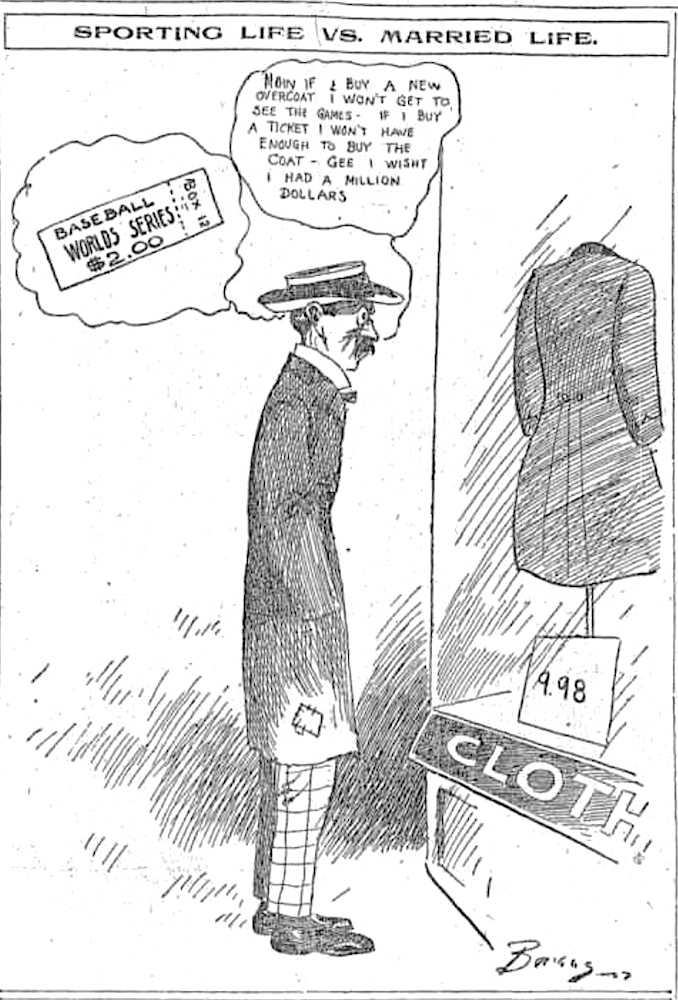
From the Chicago Tribune on October 6, 1907. Prices go up, but the dilemma remains.

Cubs 2
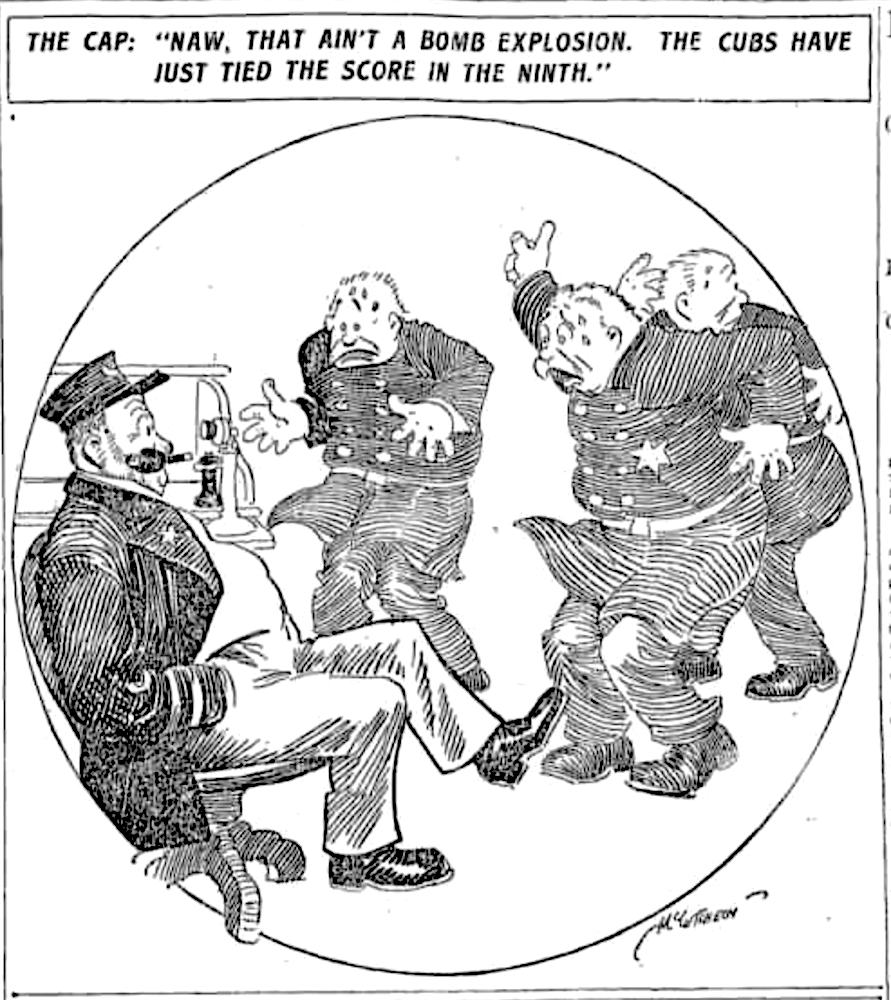
Cubs fans roared when their team scored two in the bottom of the ninth
to tie Game 1 at 3-3 on October 8, 1907 as depicted in the Tribune the
next day. The game was called after 12 innings, still tied 3-3.

Cubs 3
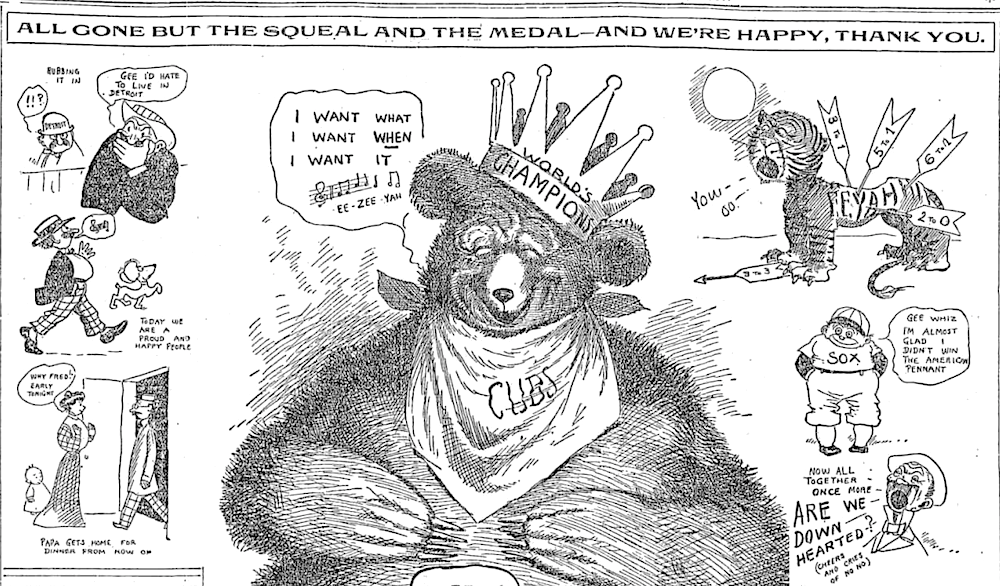
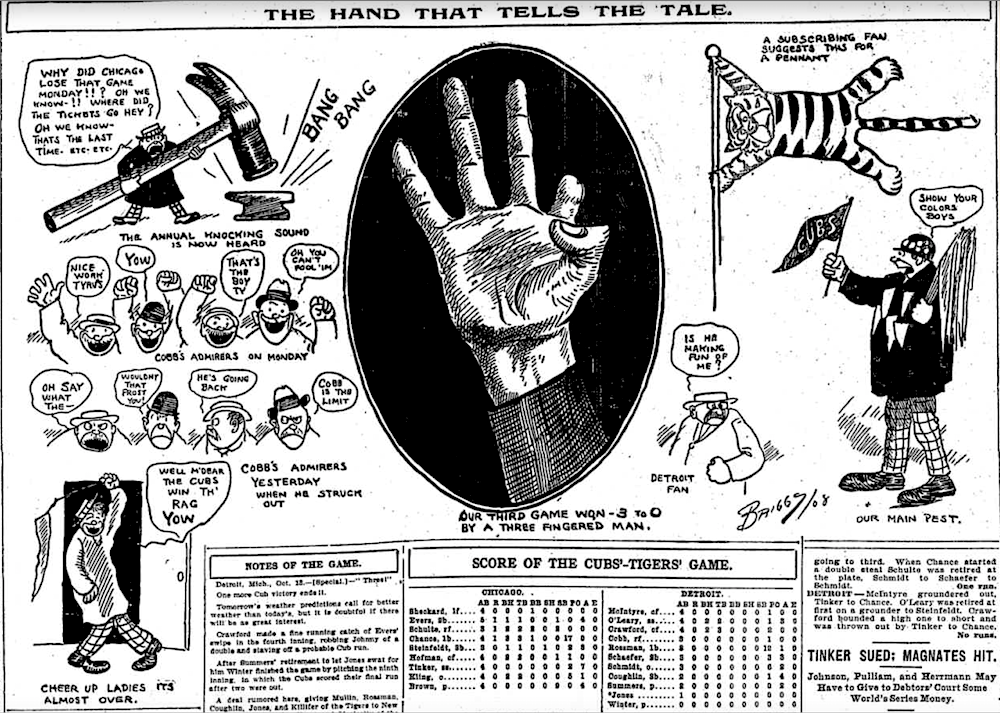
Because of the tie game, it took five for the Cubs to sweep the Detroit Tigers in 1907.
This cartoon appeared in the Tribune on October 13, 1907.

Cubs 4
A year and a day later, October 14, 1908, the Tribune commemorated
the previous day’s 3-0 victory of Mordecai “Three Finger” Brown that
gave Chicago a 3-1 lead over Detroit in the 1908 Series.

Cubs 5
The Cubs then made it two in a row, as noted in the Tribune on October 15, 1908.

Cubs 6
And in the Detroit Free Press the same day.

An Ace Of An Idea!

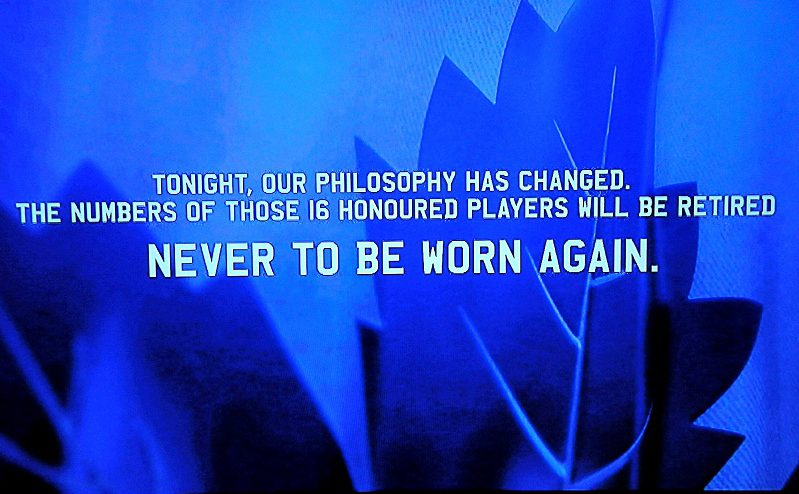
As you likely know by now, the Maple Leafs’ lavish ceremony on Saturday night to open the 100th season of NHL hockey in Toronto was a huge success. After years of choosing to “honour” players numbers but keep them in circulation, the team announced it would retire those numbers – as every other team in sports does for its greatest franchise heroes.

What Dave Keon had long perceived as this lack of proper recognition is what had kept him away from the team for so long, rather than any lingering resentment over his feud with Harold Ballard. Now Keon is back, and while I might quibble with his selection as the number-one player in Leafs history, his number 14 has taken its rightful place among the rest of the team’s greats.

Uni 1

In the past, the Leafs had only retired the numbers of Bill Barilko (5), who was famously killed in a plane crash after scoring the Stanley Cup-winning goal in 1951, and Ace Bailey (6) whose career ended in 1933 when he fractured his skull after being knocked to the ice by Boston’s Eddie Shore. Even so, James van Riemsdyk was the only current Leaf wearing one of these newly retired numbers, and he gladly gave up Borje Salming’s now-retired 21 and took 25.

Team president Brendan Shanahan had something very interesting to say when asked about the decision to change the Leafs’ policy regarding retired numbers. “When you asked questions, people really didn’t have a reason why we [weren’t doing it]. I like the story of players handing numbers down … to another player. But I don’t remember Borje Salming handing a sweater to JVR. It wasn’t happening. It’s a great story. But if you’re not doing it, then let’s do the right thing.”

Uni 2

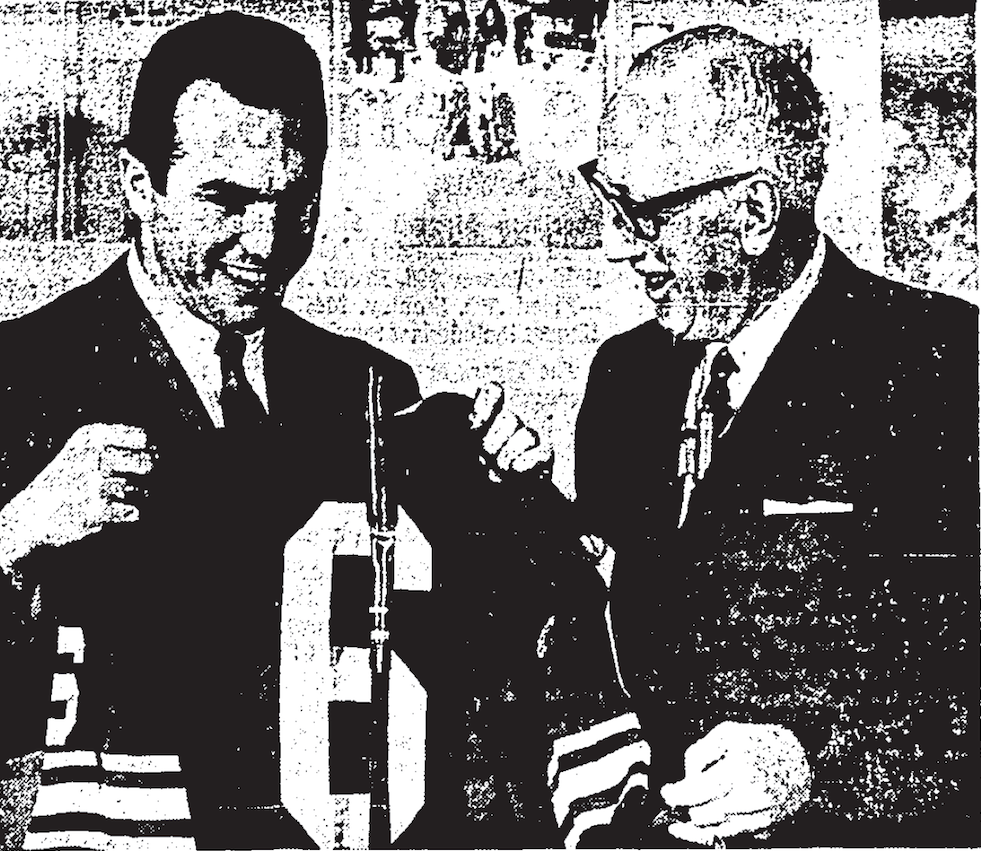
I have read accounts from Teeder Kennedy saying how pleased he was when he was given the number of his hero Charlie Conacher, and I know that Darryl Sittler has talked about his belief that the team had big plans for him because he was given Frank Mahovlich’s #27. But the only Leafs story I’m aware of where a player literally handed his former number to a current player was when Ace Bailey requested that Ron Ellis be given his #6.

Bailey handed his number to Ellis in a ceremony at the Hot Stove Lounge at Maple Leaf Gardens on September 24, 1968. “My family and I wanted to see somebody wear the number while I was still active in hockey,” said Bailey, who was a timekeeper at the Gardens. “Ron is a real hockey player who never gives his club any trouble. I think he’ll be an all-star in years to come.

“This number is two digits lighter than your old number,” Bailey joked to Ellis, who had worn #8 since his junior days, “so you should go a little faster.”

“I’ll wear this sweater with a great deal of pride,” Ellis told him.

Uni 3

But as the Toronto Star noted the following day, Ace Bailey handed a #6 sweater to Ron Ellis, but not the #6 sweater. Bailey had kept his retired jersey for nearly 30 years, but it had recently been discovered that it was missing!

Bailey had loaned his sweater to the Hockey Hall of Fame about seven years earlier, but a short time later the Maple Leafs asked the Hall if they could have it and Barilko’s #5 sweater for a display at Maple Leaf Gardens. Gardens officials swore they had returned it, but the Hall of Fame’s new curator Lefty Reid was “99 percent sure it was not in the building.”

Speculation was that Bailey’s sweater may have been destroyed a few years earlier when a drain backed up at the Hall of Fame building and flooded some storage rooms, or that a workman might have made off with it during recent renovations there.

“If anyone has seen a blue hockey sweater, 1933 vintage, with a white Maple Leaf on the front and the number 6 on the back,” wrote Jim Crerar in the Star, “please contact Lefty Reid at the Hockey Hall of Fame immediately.”

I don’t believe the sweater has ever turned up.

P.S. As a late note to this story, the dean of hockey historians Bill Fitsell points out that Charlie Conacher DID hand a #9 sweater to Teeder Kennedy, as noted in the Globe and Mail of September 11, 1946. Click on the link to the right: leafs-unis-4

Great Start … But Is It A Record?

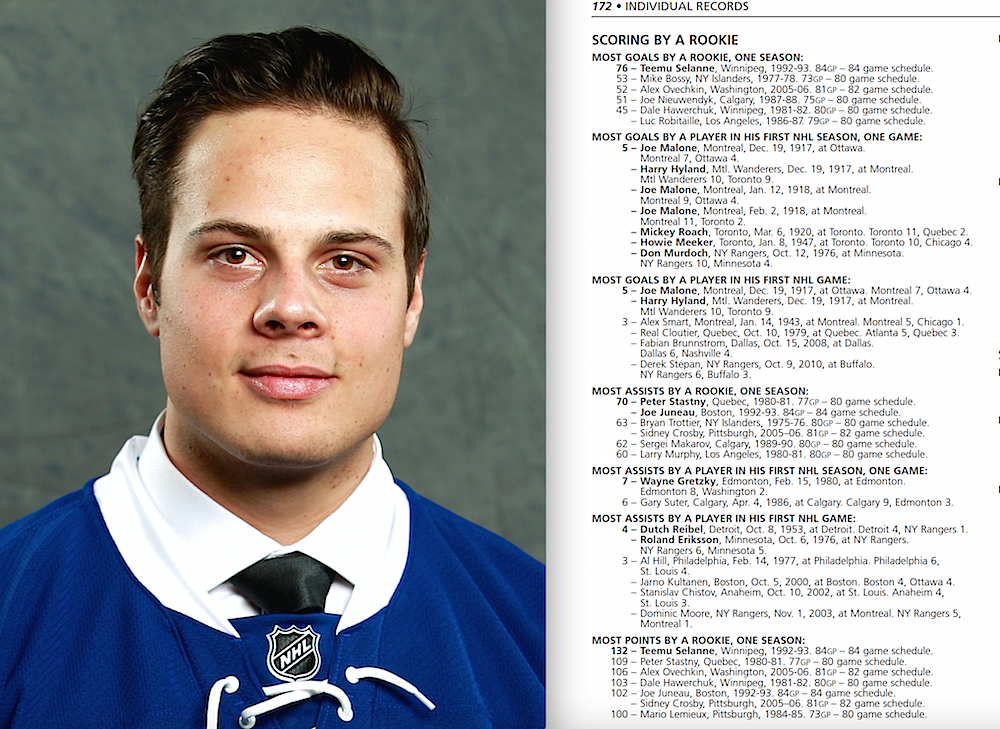
Toronto Maple Leafs rookie Auston Matthews scored four goals last night in his first NHL game. It’s pretty amazing! (Although marred somewhat by Toronto’s 5-4 loss in overtime to Ottawa.) So, was it an NHL record? That’s not as straightforward as you may think!

The confusion probably goes back to the 1979-80 season when the NHL didn’t want to consider Wayne Gretzky a rookie because of his one year as a professional the season before in the World Hockey Association. Gretzky had 51 goals, 86 assists, and 137 points that season. His 51 goals would have been two short of Mike Bossy’s then-rookie record of 53 … but his 86 assists and 137 points should have been records. They still should be, but instead, you’ll see those ROOKIE records are held by Peter Stastny, Joe Juneau (70 assists) and Teemu Selanne (132 points).

M1

The records Gretzky is credited with for the 1979–80 season are all records for A PLAYER IN HIS FIRST NHL SEASON … but not rookie records. It can certainly get a bit confusing!

For years, the NHL listed the record for most goals by A PLAYER IN HIS FIRST NHL GAME as 3, first by Alex Smart in 1943, and then, more recently, by Real Cloutier, Fabian Brunnstrom and Derek Stepan. Unfortunately, I don’t have NHL Guide’s going back far enough, but my guess would be that before Cloutier (who, like Gretzky — but with even more years — was a WHA veteran) this was actually listed as a rookie record, but ever since I’ve been working on the Guide the wording has stated FIRST GAME and not ROOKIE.

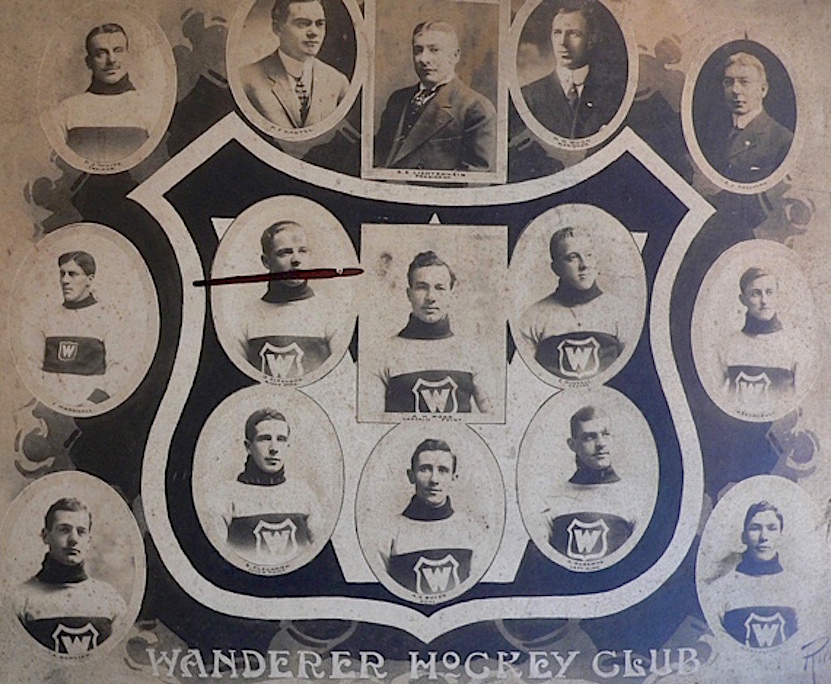
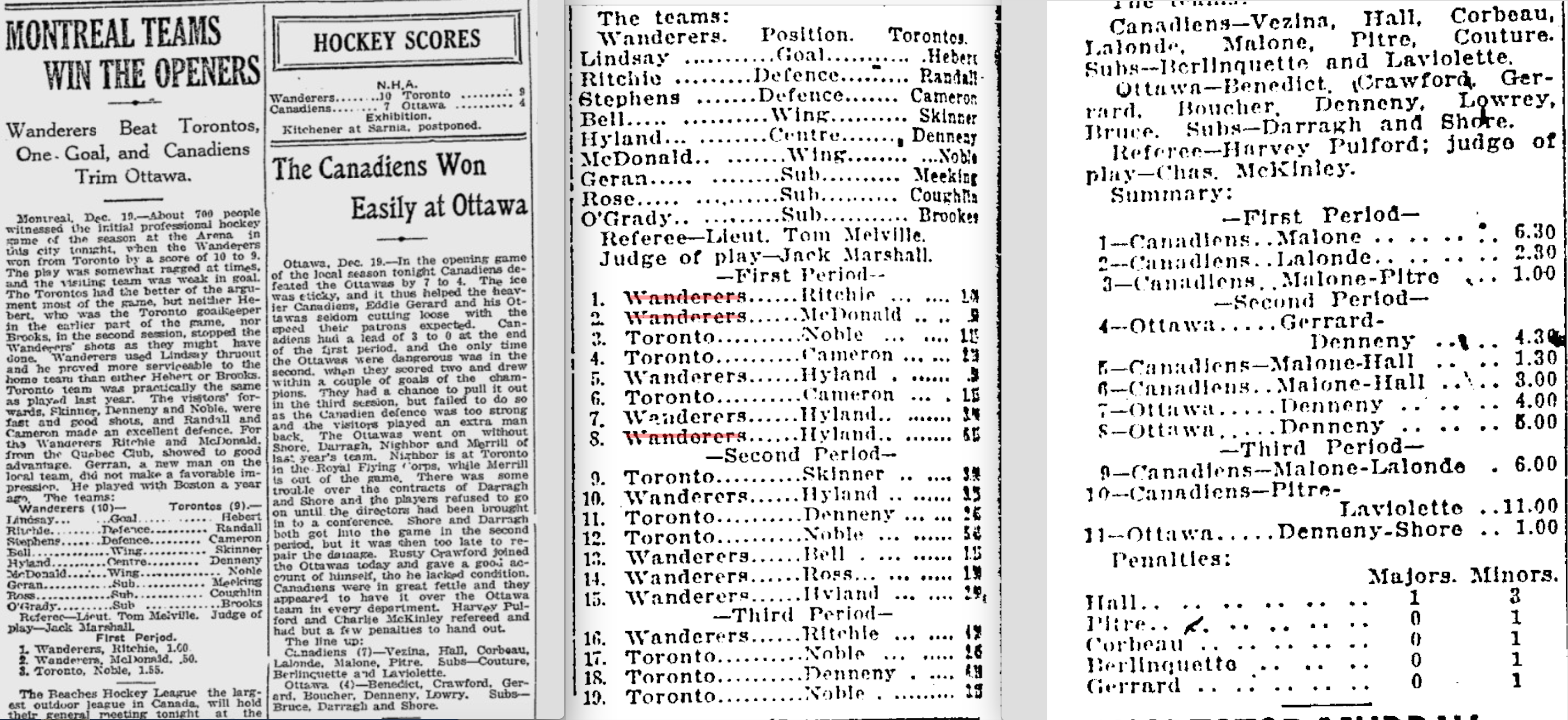
There has also been a record for MOST GOALS BY A PLAYER IN HIS FIRST NHL SEASON, ONE GAME that for years was shared by Howie Meeker and Don Murdoch. But then, beginning with the NHL Official Guide & Record Book for 2010-11, we added the much older five-goal games by Joe Malone, Harry Hyland and Mickey Roach during their first NHL seasons. Since Malone and Hyland had both scored 5 goals in the two games played on the very first night in NHL history back on December 19, 1917, we had to add them to the record for most goals by a player in his first NHL game as well.  Given that the rule book already had a distinction between rookies and first-year players, how could we not?

M2
Stories from The Toronto World, December 20, 1917.
Summaries from the Toronto Star of the same date.

Malone and Hyland had both been pros, playing in the highest leagues of their day, since 1908. So, it’s certainly hard to consider them NHL “rookies” in 1917-18. Still, given that it was the league’s first season, there’s no denying that they each scored five goals in their first NHL games.

So, technically, while Auston Matthews seems to have set a rookie record last night, it’s not a record for a player in his first NHL game. But it’s still a pretty impressive debut! And if you check the summary above, you’ll note that Reg Noble scored four goals for Toronto against the Wanderers in that December 19, 1917 game. So, it looks like we’ll need to add that to the list along with Matthews for next year.

It Could Have Been Worse

Winning last night certainly takes a lot of the sting out of it! I still can’t explain the hitting woes (except that I think we’ll find out that Josh Donaldson has been hurt worse than they’ve let on), but before you go saying what a horrible collapse the Blue Jays had this September, consider this. At no point during the 2016 season did Toronto ever have more than a 2-game lead in the American League East  – and they only led by that much for four days. Four! They only led the division at all for 32 days during the entire season. That’s basically one month out of six.

Now, admittedly, the Jays did hold that 2-game lead from August 28 through August 31, and 29 of their 32 games in first came after July 30. Obviously, that makes their September slide feel all the more painful. But even if they hadn’t won last night, I really think it seems a lot worse than it actually was.

Edwin
Edwin Encarnacion reacts to his game-winning three-run blast in the 11th inning.

Not convinced? Well, consider this. The Jays spent 111 days in either second or third place this year. That’s three times more time than they spent in first. And, really, they were never more than about 5 games from falling completely out of the playoff picture. So, hanging on for that home wild card berth was probably where they should have ended up anyway.

Since the two-team wild card format was introduced in 2012, I’ve always wondered how much qualifying for that wild card game would really feel like making the playoffs. Well, having gone through it now,  I think it really does … and I’m not saying this just because we won! Still, it does seems strange to have the fate of an entire season come down to a single game. The baseball season has always been a marathon, not a sprint. But then again, it’s not like this never happened before the advent of the wild card.

Back in 1908 – the last time the Chicago Cubs won the World Series! – the fate of the National League season came down to just one postseason game. It wasn’t actually a playoff. It was a makeup game made necessary by the fact that the Cubs and the New York Giants had finished the season tied in first place and now had to replay a tie game from a few days earlier, on September 23, 1908.

Dunnell
Milt Dunnell of the Toronto Star didn’t get much out of Fred Merkle even 40 years later.

Even now, 108 years later, that tie game is one of the most famous in baseball history. If you don’t already know the story, in a nutshell, the Giants should have won that day with a walk-off single in the bottom of the ninth, but the baserunner on first base, 19-year-old rookie Fred Merkle, never touched second. When the Cubs made a play to force him out, the ruling was made that the Giants apparent winning run didn’t count. For plenty more, you can Google Fred Merkle, or watch this clip of Keith Olbermann from 2013.

Merkle was dubbed “Bonehead” for his baserunning blunder and after the Giants lost the makeup game on October 8, 1908, his so-called “boner” would literally haunt him until his dying day. And beyond, really, because anyone who knows his name today is likely to know it because of that play.

Headlines
A sample of some of the headlines that appeared above his obituary in
newspapers across North America the day after Fred Merkle died on March 2, 1956.

You may have heard Sandy Koufax recently, lauding Vin Scully and telling about how when Scully was covering the Dodgers in the World Series, he would say a prayer before it got started. Scully didn’t pray for the Dodgers to win, but for no one to make the type of mistake that would live on in infamy. No doubt Vin Scully had Fred Merkle in mind.

Canada’s Cup, But…

I like the chances of Team Canada wrapping up the World Cup of Hockey tonight in game two of the best-of-three final against Team Europe. I don’t mean to get ahead of things, but with gold medal wins at three of the last four Winter Olympics, and even at the last two World Championships (where we don’t get to play our best on best), Canadian men, as Wayne Gretzky said the other day, “seem to be getting better and strong.

Canada’s been Canada,” Gretzky said of the team’s performance at the World Cup. “We’ve been as good as we’ve ever been. We sell our sport worldwide, the game is getting bigger all the time, each and every year, but we seem to be getting better and better in our own country.

Everybody gets nervous and scared, are we losing our game? We’re never going to lose our game. It’s Canada’s game. I am just so impressed by how much depth and how many good players we have in this country.

Logo

One big advantage we still have over all the other hockey countries – even those with much bigger populations than ours – is that (with the possible exception of Latvia) we’re the only country in the world where the majority of the top athletes want to play hockey. Perhaps the biggest threat to that going forward will be the crazy-high costs of the game forcing more and more of those top athletes to choose less expensive games like basketball and soccer. Global warming probably isn’t going to help either.

In the meantime, while it’s nice to be the best in the world at the sport we care about the most, winning global titles isn’t the only thing that make Canada’s game Canadian. It won’t stop people from worrying about the Americans taking over the NHL. Not when so many decisions coming out on the NHL head office in New York can appear to Canadians to be based solely (soullessly!) on business rather than a love of the game … like when the NHL chooses to place its next expansion team in Las Vegas instead of Quebec City, or when it never seems to consider Hamilton – although that probably has as much to do with the influence of the Toronto Maple Leafs as it does with an unpopular American NHL Commissioner.

Globe 1924
One of the earliest warnings of a U.S. takeover of the NHL came in a Hamilton Spectator
story picked up by Toronto’s Globe newspaper on December 12, 1924.

When Las Vegas comes on board in 2017-18, that’ll make 24 U.S.-based teams to only seven in Canada. And before that, when the spring of 2017 comes around, we’re likely to hear plenty once again about how no Canadian team has won the Stanley Cup since 1993. And remember, not a single one of those seven Canadian teams even reached the playoffs last year! Of course the NHL is big business, but things like this hardly make hockey feel like Canada’s game.

But fear not! With the NHL gearing up to celebrate the 100th anniversary of its 1917 founding, it turns out that worrying about Americans taking over our game dates back almost as long as that. With Boston having just become the first U.S. entry in the NHL, one of the first voices of concern was sounded by the Hamilton Spectator in December of 1924. The newspaper warned that, with more American teams to come, “[t]he arenas across the border will be bigger than those in Canada, and the admission charges will be higher, which means that the United States magnates will be in a position to get the pick of the players.

Globe 1925
The Globe expressed Canadian fears with stories such as this one on September 26, 1925, although the story notes that it may be a while before the U.S. could produce enough good players. It also warns that a salary cap may be necessary to save Canadian teams.

New York would get its NHL franchise with the admission of the Americans – at the expense of Hamilton losing its Tigers! – in 1925-26, and the NHL would add a team in Pittsburgh that year too. Canadians were definitely starting to worry about a U.S. takeover, and The Globe in Toronto became the lead voice of that fear. On January 22, 1926, Sports Editor Frederick Wilson warned that Canadian cities could become nothing more than an afterthought as the NHL expanded into more and more populous U.S. cities with “their fat bank-rolls.” Canadian teams would be forced to sell out to American owners, leading to predictions of All-American leagues with cities like Toronto, Montreal, Ottawa, and others banding together to become little more than all-Canadian minor leagues.

Globe 1926
Conn Smythe used stories like this one on November 20, 1926, to convince the owners of the Toronto St. Pats to sell the team to his group. He would rename the team the Maple Leafs.

Fears became even worse when the New York Rangers, Detroit Cougars (later the Red Wings) and Chicago Blackhawks entered the NHL in 1926-27. The NHL was now a 10-team circuit with six of those clubs in the United States. Canada would never again have the majority of NHL teams, yet all these years later, it’s still our game … although it would be nice to see the Stanley Cup paraded through the streets of a Canadian city some time soon!