All posts by Eric Zweig

Frank McGee R.I.P.

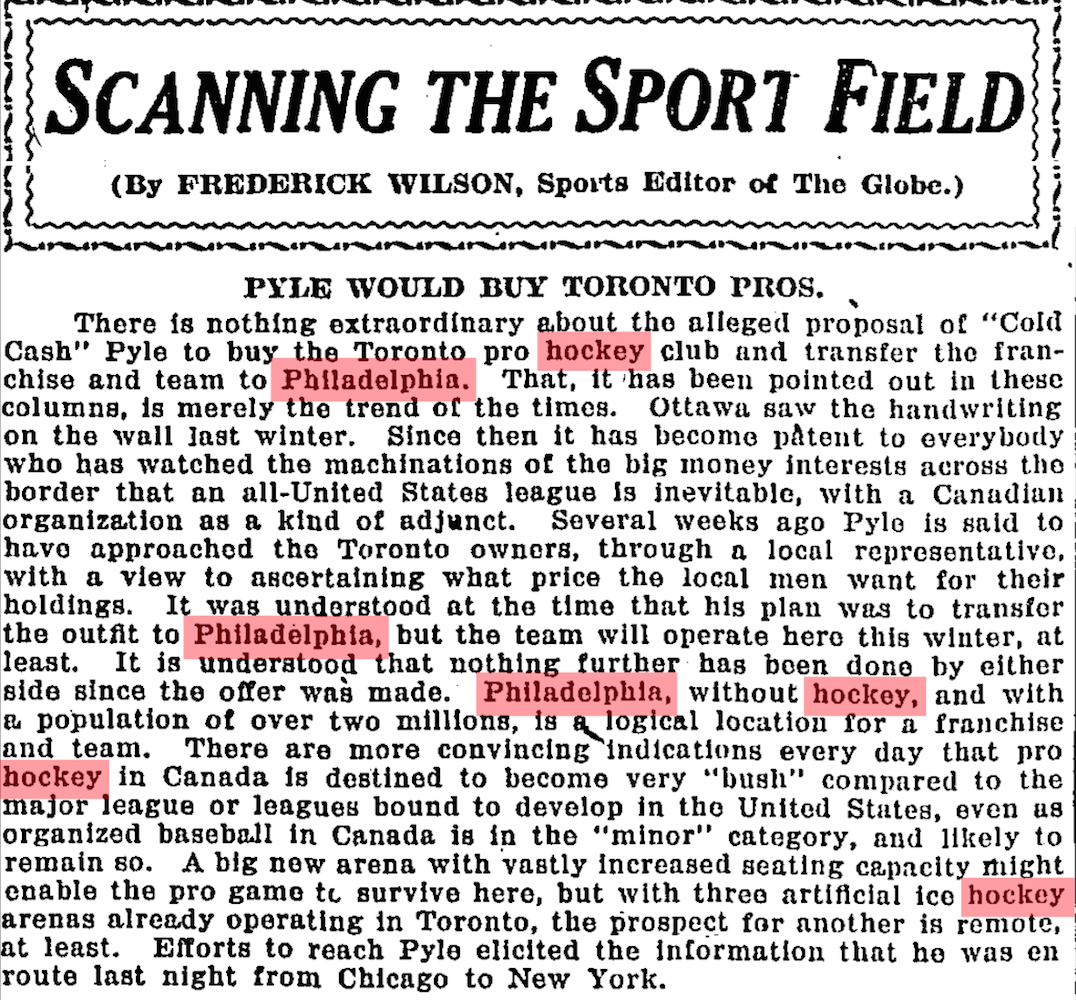
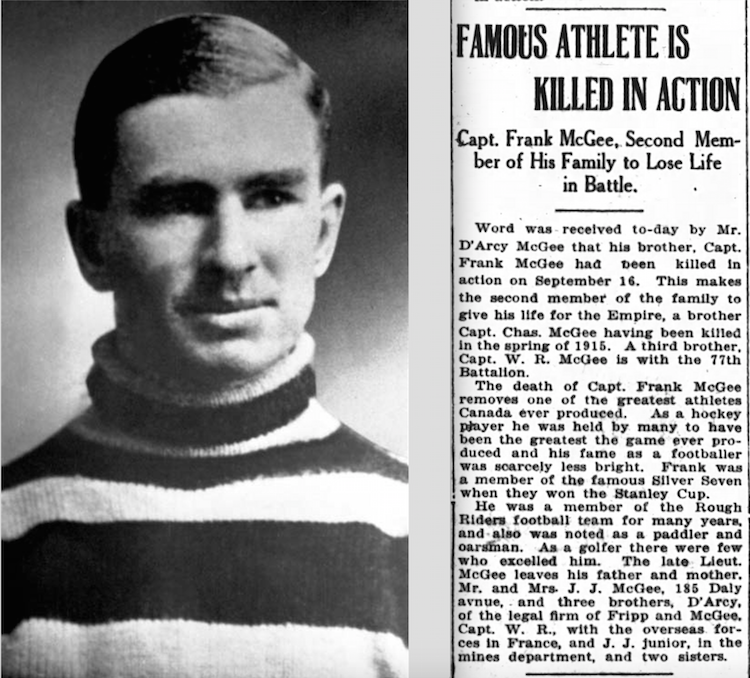
One hundred years ago tomorrow, on September 23, 1916, word reached his family in Ottawa that the greatest hockey player of his day had been Killed in Action in World War I. Frank McGee had died in fighting at Courcelette in France, one week earlier, on September 16, 1916.

Pic Paper
The newspaper story is from The Ottawa Journal on
September 23, 1916,  confirming the death of Frank McGee.

McGee had left instructions that in case of casualty, his brother D’Arcy should be notified rather than his father, whom he’d listed as his next of kin. Rumours had begun to circulate on Friday, September 22, that McGee had died and D’Arcy McGee received confirmation that it was true while in his home at 12 Marlborough Avenue in Ottawa’s Sandy Hill District on Saturday. Another brother, Charles, had been been killed in the spring of 1915. A younger brother, Walter, would be shot through the shoulder in November, but he would survive the war.

Kin
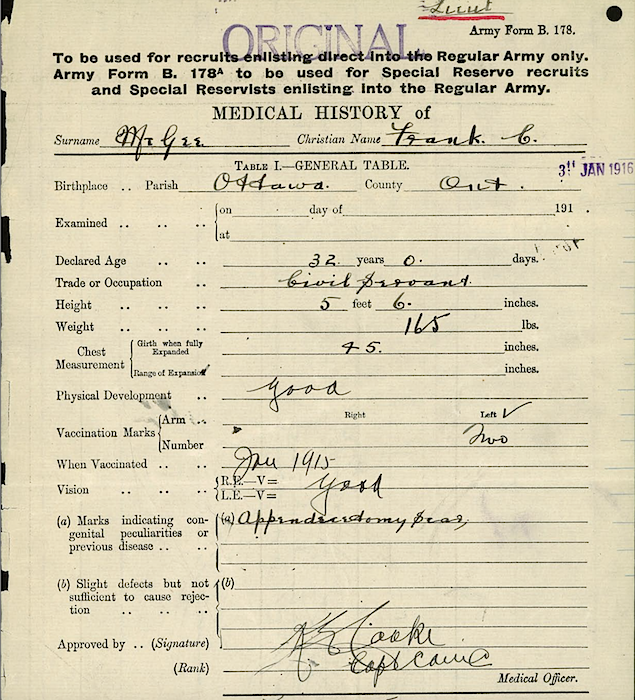
From the war records of Frank McGee available on the Library and Archives Canada web site.

Frank McGee was one of thousands of Canadian casualties during the Battle of the Somme. His death hit his hometown, where he’d starred for the legendary “Silver Seven,” particularly hard.

[O]nce again there has been brought home with gripping grief and pain the grim reality of the present conflict of nations,” reads a story in the Ottawa Citizen. “It is doubtful if the loss of any one of the splendid young Ottawans who have fallen at the front since the outbreak of war has occasioned such keen regret as that of the late Lt. Frank McGee … Frank McGee dead? Thousands of Ottawans knew him. Few seemed able to believe that he too had given up his life in the struggle for freedom.

Frank McGee had a brief career at hockey’s highest level, playing only a handful of games over four short seasons from 1902-03 to 1905-06. But his Ottawa team won the Stanley Cup in each of those years (although lost it before the 1905-06 season ended) and he averaged nearly three goals per game during that time. He is best remembered today for scoring 14 goals in Ottawa’s 23-2 win over Dawson City in a Stanley Cup game on January 16, 1905.

1905
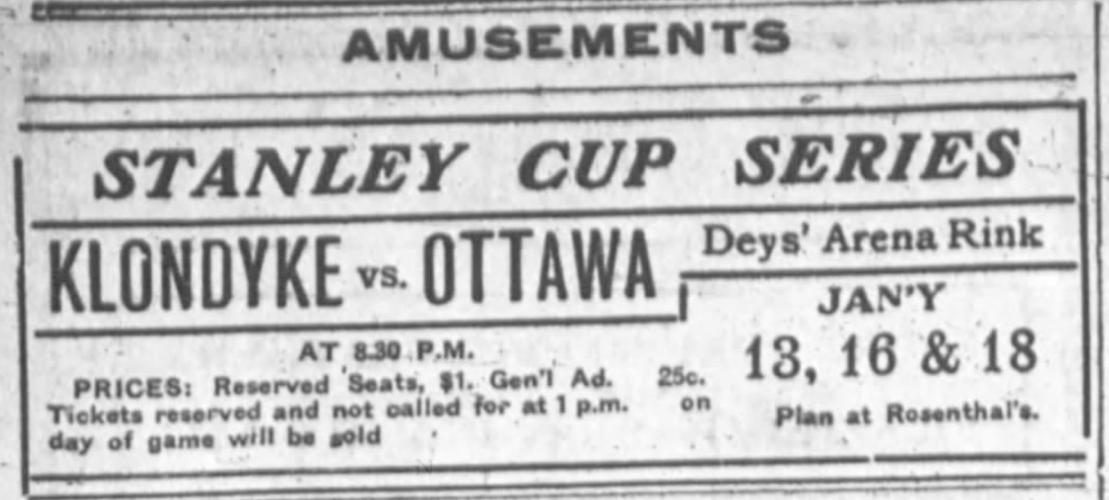
An ad in The Ottawa Journal showing dates and ticket
prices for the 1905 Stanley Cup series with Dawson City.

McGee accomplished all that he did despite having been blinded in one eye when he was struck by a stick (or maybe a puck) in 1900. According to a story in The Ottawa Journal on the twentieth anniversary of his death, the injury had not caused the removal of his eye, but McGee’s vision was impaired to the extent that he could only distinguish between light and darkness with it. It didn’t seem to slow him down on the ice, but it should have been enough to keep him out of the army. So how did he get in?

The most common story that’s told today is that when he was taking his medical exam and was asked to read the chart on the wall, McGee covered his left eye with his left hand and then, when asked to read with his left eye, raised his right hand, crossed his face, and covered the same left eye again.

Eye
However McGee got himself into the army, this medical officer who examined
him later appears to have left the description of the vision in his left eye blank.

But the story being told up until 1936 was quite a bit different then the modern one. Back then, it was generally accepted as authentic that McGee had a friend who looked quite a bit like him take the eye exam for him. But D’Arcy McGee told a very different story to The Ottawa Journal for its anniversary story. D’Arcy admitted that because of his eye, Frank was nervous about his physical … but then the medical officer asked him his name.

“Frank McGee.”

“Not Frank McGee of the Silver Seven?”

“Yes, sir.”

“There can’t be anything wrong with you!”

The doctor laughed, giving McGee an admiring pat on the chest and passing him for the army.

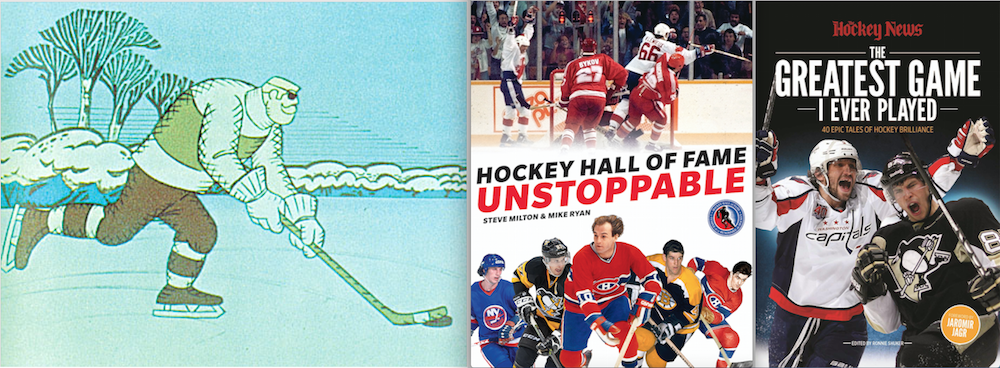
The story of Frank McGee is one of the first tales of early hockey I can remember learning. I’m pretty sure I heard it for the first time on an episode of Peter Puck. This past year, I had the opportunity to tell parts of McGee’s story myself by contributing segments to two new books that are out this fall.

Books
Though he was actually quite small, Frank McGee was depicted as a hulking giant
with an eye patch in the Peter Puck episode. And if you care to, you can check out
the books I contributed to for Firefly and The Hockey News.

Reggie and Me…

I’m sure I’ll get into the World Cup of Hockey when it starts up for real in a few days. But September is for baseball and pennant races! Of course I wish that the Blue Jays were doing better than 3-and-8 this month, but I’m trying to remember that for years (decades!) before last season, all I wanted was meaningful games in September. And, well, we’ve certainly got that now.

I was at the Blue Jays-Red Sox game on Saturday (the good one, that we won 3-2) with my two brothers and my nephew. Jorey is 13 now, and pretty much exactly like his father and uncles were at that age. At one point during the game, he wondered if any of us knew who was likely to be the next player to reach 3,000 career hits early next season. We didn’t.

Us

Once upon a time, I’m sure I would have known that immediately. These days, of course, I could look it up with a few taps and swipes on my phone (which I’ve since done – though on my laptop). It’s funny how, now that it’s so easy to know this stuff if you want to, I don’t know it anymore. Back in the old days, when I had to study the all-time lists in the annual preseason Street & Smith’s Baseball Magazine and then, basically, keep it in my head all season, I pretty much did. Now I don’t.

So, any idea who, as of last night’s game, got his 2,926th hit (and 443 home run, by the way)? I’ll put the answer in at the bottom of this story … and I’ll be curious to hear from anybody who can tell me they honestly knew it without looking it up!

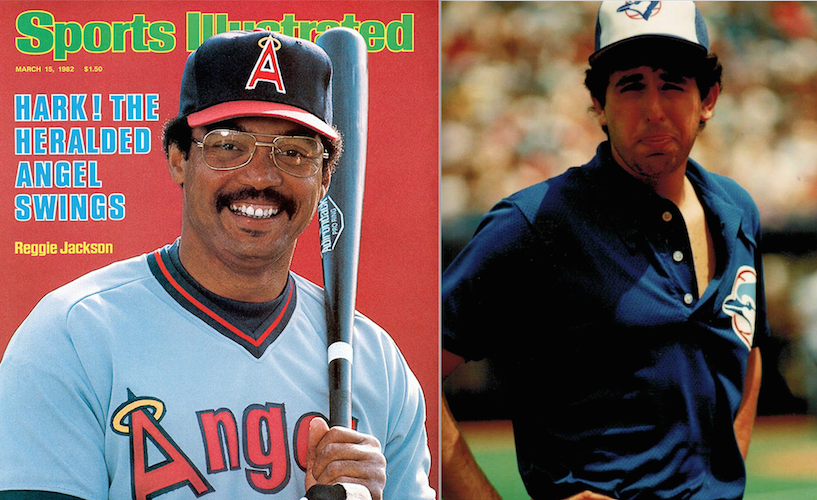
Jorey also asked us who, in 40 seasons as Blue Jays fans, is the greatest player we’ve ever seen. We threw out a lot of names, and then finally decided it was probably Ken Griffey Jr. But good as he was, Griffey never really won anything. So I was wondering if, maybe, given all he did on the largest stage, the greatest player was Reggie Jackson. All those “Mr. October” moments definitely made an impression on me when I was Jorey’s age.

That being said, I never liked Reggie Jackson. (I know I’m not alone there.) He was just too pompous and arrogant. But I do have one good Reggie Jackson story from my days on the Blue Jays ground crew.

During the early summer of 1983, when the Jays were first becoming contenders, the California Angels were in town. On this Saturday (June 18), Jim Clancy had pitched seven strong innings but surrendered our tight, 3-2 lead when he gave up back-to-back doubles leading off the top of the eighth. Joey McLaughlin came in, put a couple more guys on, but got out of trouble. The Jays then took back the lead with three runs in the bottom of the eighth, highlighted by a two-run home run from Lloyd Moseby.

Me

But the Angels weren’t done. Bobby Grich led off the ninth with a homer and then, with two out, Rod Carew and Juan Beniquez singled, bringing Reggie Jackson to the plate. Bobby Cox went to the bullpen for a lefty – rookie Stan Clarke, who’d made his Major League debut just 11 days before. Clarke quickly jumped ahead 0-2.

“I wanted that situation bad,” Clarke told reporters after the game. “I wanted to strike him out. That’s all I wanted to do.”

In my memory, you could literally see Clarke shaking with the excitement of it. Almost laughing that he’d actually gotten Reggie Jackson to foul off a couple of pitches and was going to strike him out and save the game.

“I stepped back off the mound, and I told myself: ‘Relax and throw your best pitch.’ But it didn’t work out that way.”

Reggie slugged the next pitch for a three-run homer, and glared at Clarke as he rounded the bases. He’d seen the young lefty shaking too.

“I just wondered what he was doing when he was pounding his glove and jumping up and down after the first two strikes,” said Reggie after the game.

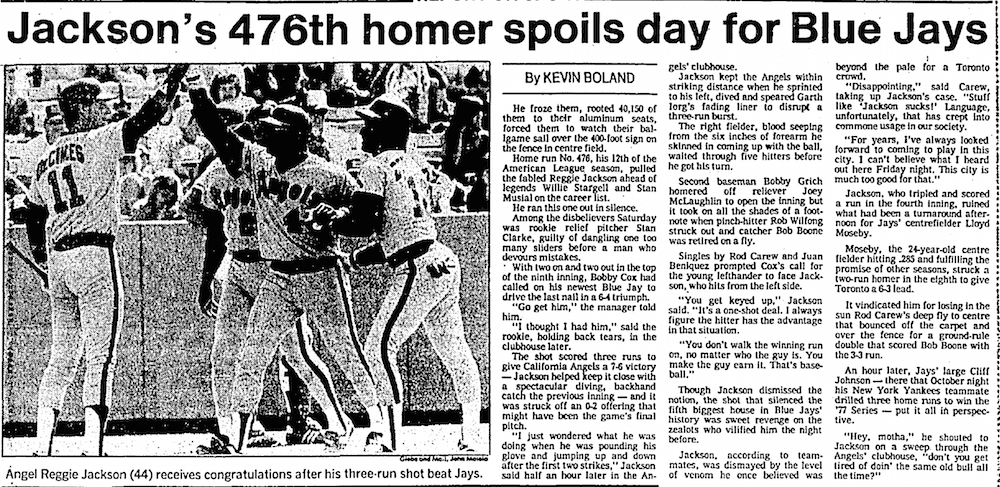
Globe

There was still the bottom of the ninth to come, but you just knew it was over. “The Blue Jays had no chance to recover,” wrote Allison Gordon in The Toronto Star. “It wasn’t meant to be.”

Now it was me who was practically shaking, but with anger. Anybody who knows me (and especially those who knew me then) will have no trouble envisioning me stomping around flailing my arms, muttering, “Stupid Reggie! Stupid Blue Jays! Stupid Game! How Could They Blow It!” Which is what I was doing when I fell down the steep flight of stairs that was practically a ladder after taking down the flags from atop the press box a short time later. (I threw down the flags as I was slipping and managed to grab onto the railing and break my fall.)

Getting back to what is sort of the point of this story, because I knew all the stats in those days, I knew that Reggie’s 476th career homer moved him past Stan Musial and Willie Stargell on the all-time list. So, the next day, when I happened to find myself standing beside the cage before the game while Reggie was awaiting his turn for batting practice, I said to him, “Congratulations on passing Stan and Willie, but I’m sure you understand why I’m mad at you.”

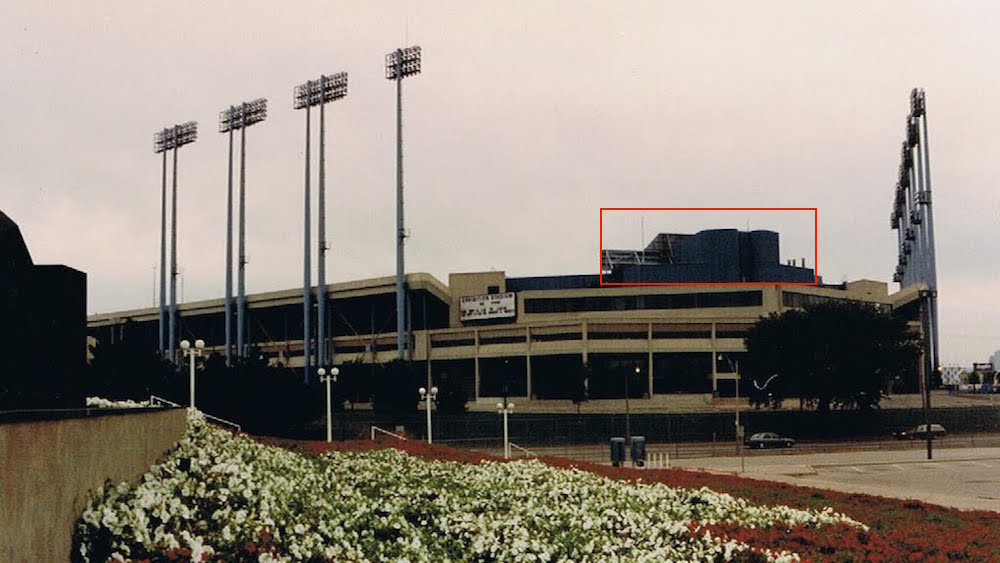
CNE Stadium
I was up there near the lower part of the red square when I fell …
but I would only have fallen as far as the bottom red line.

He didn’t say anything. Just nodded and smiled a self-satisfied smile. Stupid Reggie!

Oh, and the answer to Jorey’s question: It’s Adrian Beltre.

Your Guide to the NHL

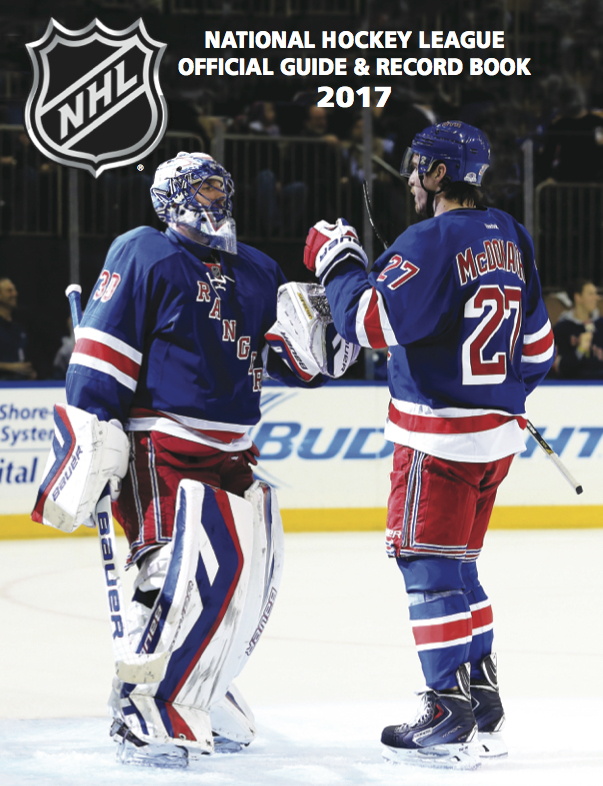
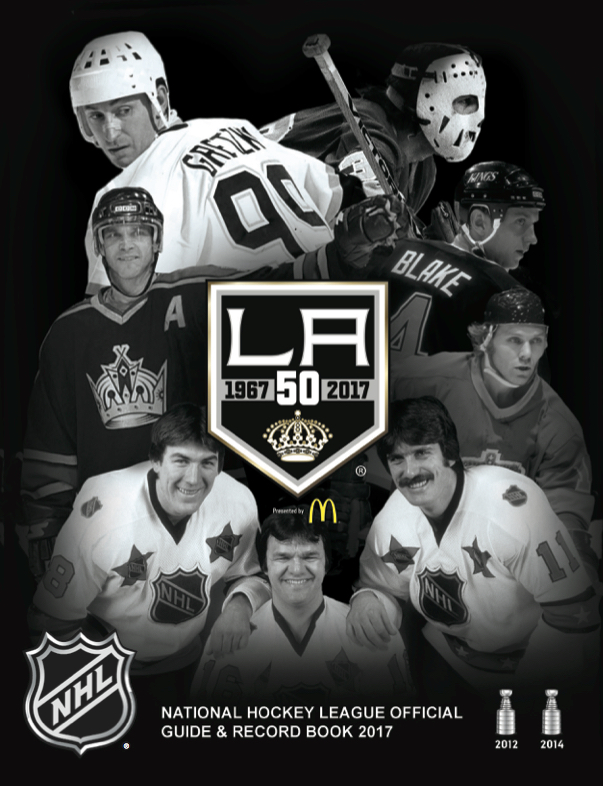
The National Hockey League Official Guide & Record Book will be shipped from the printer’s this week. That means it’ll be showing up in bookstores later this month. (If you’re a customer who prefers to purchase it directly from our office, it’s time to send in your email order or click this link to the dda.nhl eBay site.) If you’re a media person who receives The Guide from the NHL, or from Dan Diamond & Associates, you should be getting your copy soon.

National
The National Cover

This year marks the 85th edition of The Guide & Record Book, which is pretty impressive – especially when you consider that this season marks the NHL’s 99th anniversary. All of us are certainly hoping to have the opportunity next summer of working on The Guide for the NHL’s 100th anniversary. (For something of a “behind the scenes” story, please have a look at Howard Berger’s photo essay and interview with Dan Diamond published yesterday on Howard’s web site Between the Posts. Scroll down from his top story about the Leafs’ quiet summer.)

As I said in my own story about The Guide last year,  we can’t match the up-to-the-minute aspect of the many sports web sites out there these days, but you’ll be hard pressed to find any one site on the Internet that can give you all the information we provide as neatly and concisely as what’s contained in the NHL Official Guide & Record Book. And I dare say you’ll have an even harder time finding one that does so with such attention to detail!

Rangers
New York Rangers custom cover

In my story last year, I provided a brief history of the NHL Guide and my role with it. I also wrote about how Connor McDavid’s father had helped me to make sure we had Connor’s minor hockey stats correct. Nothing quite as impressive as that this year, but as usual, there were some 40+ people I contacted to make sure we got the stats for some 150 or so new North American Draft choices as accurate as possible. Many of these people have helped out year after year. Others I encountered for the first time this summer.

Among my favourite stories this year involves Adam Vay. Vay wasn’t drafted, but was signed as a free agent by the Minnesota Wild in May. He’s from Budapest, Hungary, and is currently the only Hungarian in The Guide. (The Edmonton Oilers drafted Tamas Groschl of Budapest – who was still playing in Europe last year, although he never made it to the NHL – back in 1999).

Calgary
Calgary Flames custom cover

Our International Editor and European expert, Igor Kuperman, was able to confirm the overseas stats for Vay that can be found on many web sites, but I wanted to track down the numbers for the two seasons he spent playing junior hockey – in Texas! – with the El Paso Rhinos of the Western States Hockey League. (Vay, by the way, is one of two players in the Guide to come out of the WSHL; the other being Jeremy Langlois – pronounced LANG-LOYS, not LAN-GWAH because he’s from Tempe, Arizona, not Canada. You’ve probably never heard of Langlois, but he spent the last three seasons in the San Jose Sharks’ system.)

Anyway, the Minnesota Wild did seem to have detailed numbers for Vay in their press release when they announced his signing – but nobody else did. I always like to be able to confirm such things and for whatever reason, a lot of the web sites that are great for minor and junior hockey stats aren’t very good for goalies. They seem to be set up mainly to track goals, assists, points, and penalty minutes, and often only show games and goals-against average for goalies. That was certainly the case with Vay, and the correct Pointstreak site that should have had the full numbers for the Western States Hockey League from past seasons was proving difficult to find.

LA Kings
Los Angeles Kings custom cover

It’s not always easy to get a hold of hockey people in the summer. That’s often a frustration in our job. So, I can’t say I was expecting much when, late on a Monday afternoon in early August, I called the office of the El Paso Rhinos. Much to my surprise, a young woman (who can’t possibly be as young as she sounded!) answered the phone. She’s the team’s Assistant Director of Hockey Operations, and was able to direct me to exactly where I needed to go to find Vay’s complete stats for his two seasons with the team. (The Wild had it right, by the way!)

“How does a kid from Budapest find his way to El Paso?” I asked.

“We have scouts all over Europe,” she said.

Who knew?!?

Adam Vay
Adam Vay in action with the El Paso Rhinos. For more on his story, click here.

Vay’s not likely to make the kind of impact in Minnesota this season that Connor McDavid has made in Edmonton. In fact, after spending last year back in Hungary, he may well find himself with the Wild’s American Hockey League farm club in Des Moines, Iowa, or even their ECHL team in Moline, Illinois. But I’ll certainly be watching to see if and when he makes it to the NHL!

Olympic Memories

I wasn’t that excited this year before the Olympics started. Probably all the negative reports about conditions in Rio. I don’t know. But then, once it got going, there I was, tuning in every night. I’m sure the strong Canadian performance had a lot to do with it. Penny Oleksiak and the rest of the swimmers; Andre De Grasse and the Canadian track team. But it wasn’t just the Canadians. Watching the young Brazilian duel with the French champion in men’s pole vault was amazingly exciting. Who knew?

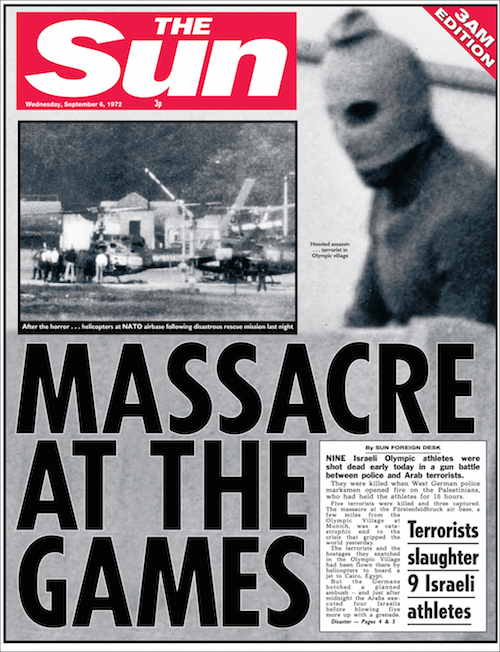
Shatto MunichMy earliest Olympic memories are from Munich in 1972. I was still only eight years old; a little under two months away from my ninth birthday. I can’t really remember how much I saw. I was certainly aware of the hostage-taking and eventual murder of the Israeli athletes. And I knew Mark Spitz won seven gold medals. Pretty sure I saw at least one of his races. Probably on Channel 7, ABC from Buffalo, with Jim McKay hosting.

The Munich Games ran from August 26 to September 11, 1972. My grandfather died that August 26. Team Canada and the Soviets played all four Canadian games of the Summit Series between September 2 and September 8. All three of those incidents seem so separate and distinct to me. Funny how our memories work.

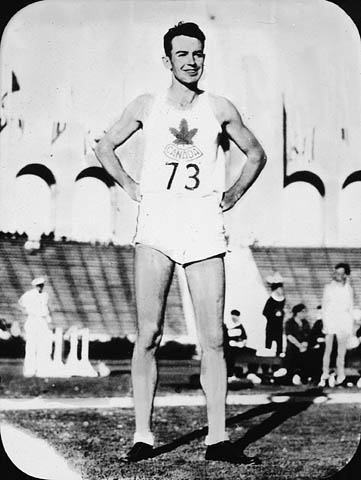
Shatto McNaughtonI used to have an infallible memory. Never forgot a thing! Not so any longer now that I’m on the other side of 50. I’m still pretty good, but there’s just way too much, “You know… That guy… With the thing… We saw him in that movie the other night…” (Strange thing is, when I heard that a Canadian won a gold medal in the high jump at Rio, I knew right away that the last Canadian to win it was Duncan McNaughton in 1932, but without looking it up, I honestly can’t tell you the name of this year’s guy!)

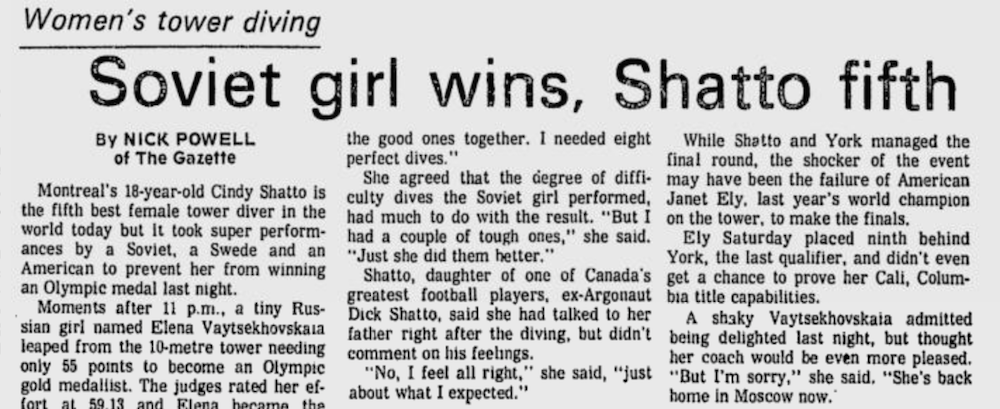
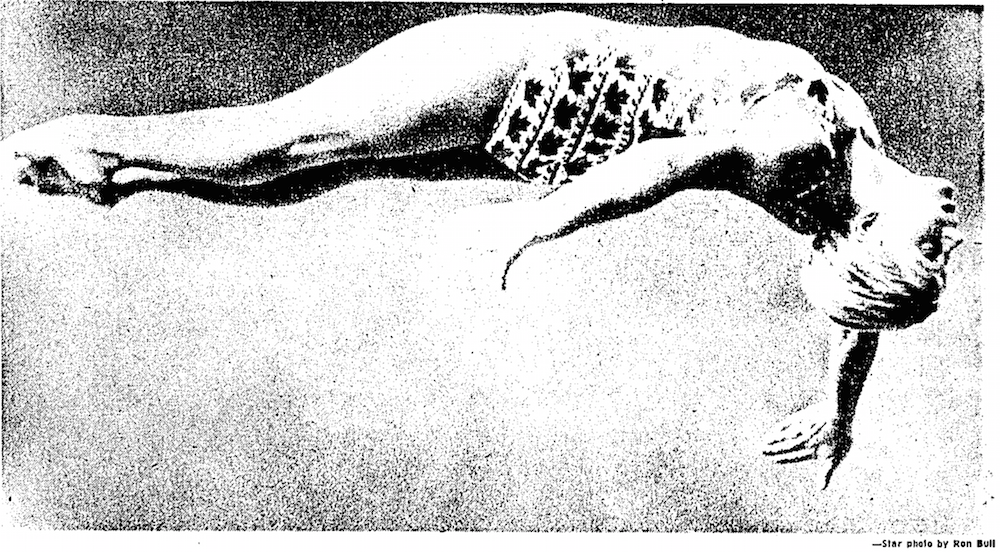
It’s funny what I remember about the 1976 Olympics in Montreal. Yes, I know Nadia Comaneci was the star with those perfect 10s in gymnastics, but I’m not sure I ever saw her perform. Pretty sure I did see Greg Joy win silver in the high jump, but I may be mixing that up with how many times I’ve seen it since! Then again, I have very distinct memories of U.S. gold medalist Dwight Stones, so I must have been watching. I also remember Lasse Viren winning double gold in the 5,000 and 10,000 meters (which he had done previously in Munich). But what I remember best from Montreal in 1976 is Cindy Shatto in platform diving.

Shatto Head ShotI’m not sure why. It may be because she was the daughter of Toronto Argos legend Dick Shatto … but he had retired long before I started watching football. It could be because she was 19 and pretty and I was a 12-year-old boy. (Legendary Vancouver sportswriter Jim Taylor once wrote, “the Canadian diving championships caper was a bonanza for girl-watchers because when Cindy Shatto walked by, you had to book space to fall into the pool.”)

Shatto finished fifth and out of the medals in platform diving at Montreal in 1976. Our whole family was watching (or at least, my dad and I were) and I remember fans booing the judges as she fell out of second place in the second half of the competition. I expected to see a lot more about that when I looked up the stories from that night. The Gazette in Montreal said nothing about the controversy, quoting Shatto as saying: “I feel all right. Just about what I expected.”

Fifth
Montreal Gazette, July 26, 1976.

The Globe and Mail in Toronto had even less to say about it. It was almost enough to make me doubt my memories, but the Toronto Star told it the way I recall. “Shatto had been second at the half-way mark of the eight-dive contest,” wrote Len Coates, “but slipped back on some questionable decisions by judges, who were loudly booed by a crowd estimated at 5,000.

Some of it was good, some was terrible,” said Shatto of the judging. “Some dives I saw got way more than they deserved and some got way less… [but] fifth in the world isn’t too bad. I can’t complain.

Diving

Shatto was more open about her feelings in Paul Patton’s Where Are They Now Column in the Globe and Mail in 1987. Back in 1976, countries with divers in the finals also were allowed to have judges handling the scoring. “There was a lot of controversy about that and they changed the rules after,” Shatto said. “It was won by a Soviet but they say I should have gotten a bronze or a silver. Finishing fifth was a disappointment. I had worked so hard for the Olympics. I was peaking at the right time. This meant everything to me and I had put my whole life into diving.

I didn’t know it until I was writing this story, but Cindy Shatto died of lung cancer back in 2011. She was only 54.

Ben Johnson Owes Me $200

Very exciting to watch the Men’s 100-meter final on Sunday night. Nice to see Andre De Grasse come through on the big stage. Gotta like his chances for gold in 2020 … although a lot can happen in four years.

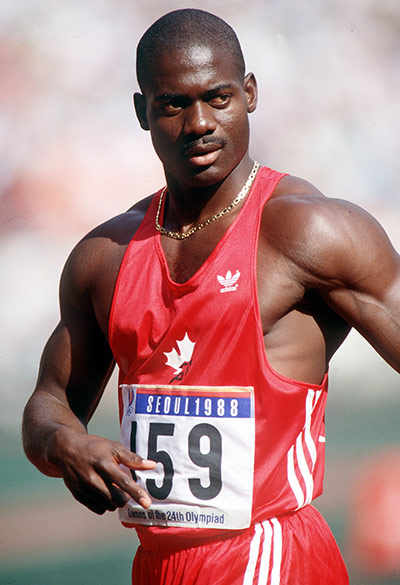
sportExciting as this race was, let’s face it. If you’re old enough to remember, it was nothing like the thrill of Friday night, September 23, 1988. Ben Johnson’s win over Carl Lewis seemed like one of those defining “where were you when” moments we’d always remember. I guess it still is – but not for the right reasons.

I watched the race late that night Friday night in the basement of a friend’s house. When I woke up on Saturday, still buzzing with the excitement of it, I wrote a story about the history of Canadian sprinters (Bobby Kerr, Percy Williams, Harry Jerome) that I then submitted to the Toronto Star.

There was no email in those days, and I wish I could remember for sure, but I must have driven down to the Toronto Star building later that day, or some time on Sunday, to deliver my story. What I do remember for certain was calling Gerry Hall, the Toronto Star sports editor, on Monday. Did he like the story? Was he interested?

Wins
Toronto Star stories on Saturday and Sunday, September 24-25, 1988.

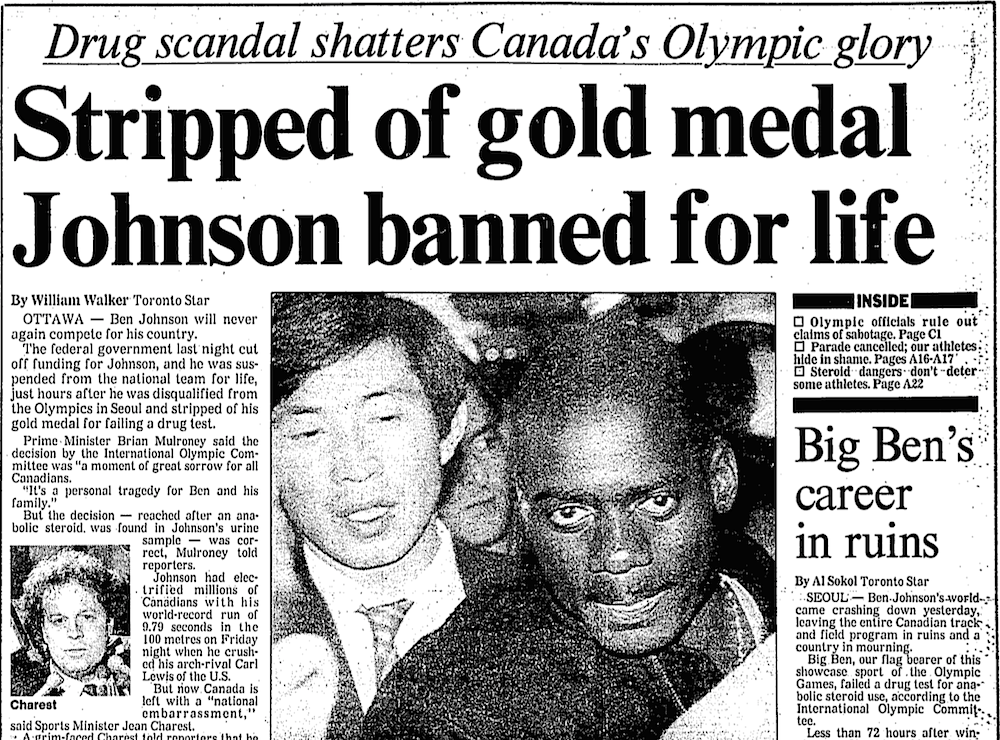
Yes, and yes! But then he told me that they’d just gotten word that someone in Seoul had tested positive for steroids. When it turned out to be Ben Johnson, well … let’s just say there was no longer any interest in my story.

Loses
Front page of the Toronto Star, September 27, 1988.

Upon Further Review … Fastball (2016)

Barbara and I recently watched the documentary Fastball. Loved it! As a review this past spring in the Los Angeles Times noted, “You don’t have to be a baseball fanatic or for that matter a historian or a physicist to appreciate [this] fittingly zippy tribute to the art of the pitch.”

Fastball PosterjpgNarrated by Kevin Costner, filmmaker Jonathan Hock (who directed the ESPN 30 for 30 episode about The Miracle on Ice, among his many credits) uses an impressive cast of baseball Hall of Famers to discuss the fastest pitchers of all time. The film also explains the science of how someone can throw the ball at the very upper limits of human mechanics, and how someone else can still manage to hit a pitch whose speed is at the very edge of how quickly a human being can physically see and react. Fascinating!

Plenty of today’s fastest pitchers are featured, and there’s also the sad story of 1960s minor league phenom Steve Dalkowski, who could never master his control. But the movie goes all the way back to Walter Johnson, who pitched 20 years in the Majors from 1907 to 1927 with the Washington Senators.

Virtually everyone of his era agreed that Walter Johnson was the fastest pitcher they had ever seen. As early as 1912, his speed was measures scientifically by the U.S. Army … who tracked him at 122 feet per second. That was considered astonishing at the time, but it works out to only 83.2 miles per hour – which struck me as pretty disappointing for such a legendary fastballer. But more on that in a bit.

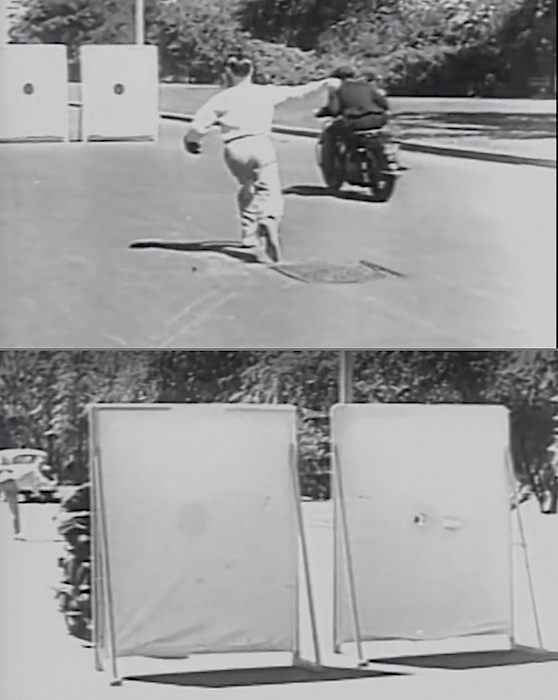
When Bob Feller burst on the scene 80 years ago this summer as a 17-year-old phenom, he quickly became the new fastball king. Could he throw harder than Walter Johnson? Perhaps you’ve seen the old film clips of Feller firing his fastball alongside a speeding motorcycle doing 86 miles per hour, but Feller was also given a more scientific rating by the U.S. Military. In 1946, his speed was determined to be 98.6 miles per hour. Now that’s more like it!

Fastball Feller

Feller had begun his career at about the same time that Jesse Owens won the 100 meters at the 1936 Berlin Olympics in a time of 10.3 seconds. The current world record of 9.58 seconds was set by Usain Bolt in 2009. The film points out that if fastballs had improved at a similar rate, there would be dozens of guys throwing 120 miles per hour these days. But, of course, there aren’t.

In 1974, Nolan Ryan became the first pitcher to be clocked while he was pitching in an actual game. Radar tracked him at 100.8 miles per hour in 1974 — making him the fastest pitcher ever. Aroldis Chapman currently has that distinction, hitting 105.1 mph in 2010 and again just recently on July 18. But here’s where the measurements get interesting.

Back in 1912, Walter Johnson’s 83.2 pitch was clocked about 7.5 feet beyond the 60-foot-6-inch distance from the mound to home plate. Feller’s pitch was timed just in front of home plate, and Ryan’s at about 10 feet in front. Today’s modern radar guns record the speed of a pitch at about 10 feet from the pitcher’s hand … some 40 to 58 feet prior to where Johnson, Feller and Ryan were measured. It might not sound like a lot, but any extra distance allows gravity to slow down the speed of the ball as it moves through the air.

Making adjustments for the different distances (1 mile per hour for every 5.5 feet, says the science guy), Walter Johnson’s fastball jumps from 83.2 to 93.8 miles per hour. That’s a little more like it! Feller’s 98.6 improves to an incredible 107.6 mph. And Nolan Ryan? He clocks in at 108.5.

So take that, modern flamethrowers!

Crosby, Kessel, and the Stanley Cup

Last Friday and Saturday, Sidney Crosby took the Stanley Cup to his hometown of Cole Harbour, Nova Scotia. It was a busy 24 hours in the Halifax area, as Crosby brought the Cup to a local Tim Hortons (being the most famous graduate of the Timbits hockey program), took it to his local hockey school for children and brought it to a Veterans hospital on the Friday. On Saturday, he paraded with the Cup in Cole Harbour.

Crosby
Screen shot taken from the Internet feed of Crosby’s Cole Harbour parade.

Crosby did many of the same things during his 24 hours with the Stanley Cup after Pittsburgh’s victory in 2009. Didn’t seem like anyone was tired of it, though!

After Sidney Crosby’s time in Cole Harbour, the Stanley Cup was flown to Madison, Wisconsin, where Phil Kessel and his family spent some time with it in their hometown on Sunday. On Monday, Kessel brought the Stanley Cup to Toronto. People hadn’t seemed thrilled with the idea when the controversial ex-Leaf said he was thinking about a Toronto visit after Pittsburgh’s victory. Even so, Kessel seems to have won the hearts of his detractors with his unannounced visit to share the Cup with the young patients at the Hospital for Sick Children … a Toronto institution he had quietly supported throughout his time with the Maple Leafs.

Sick Kids
Screen shots taken from Sick Kids video of Phil Kessel’s visit.

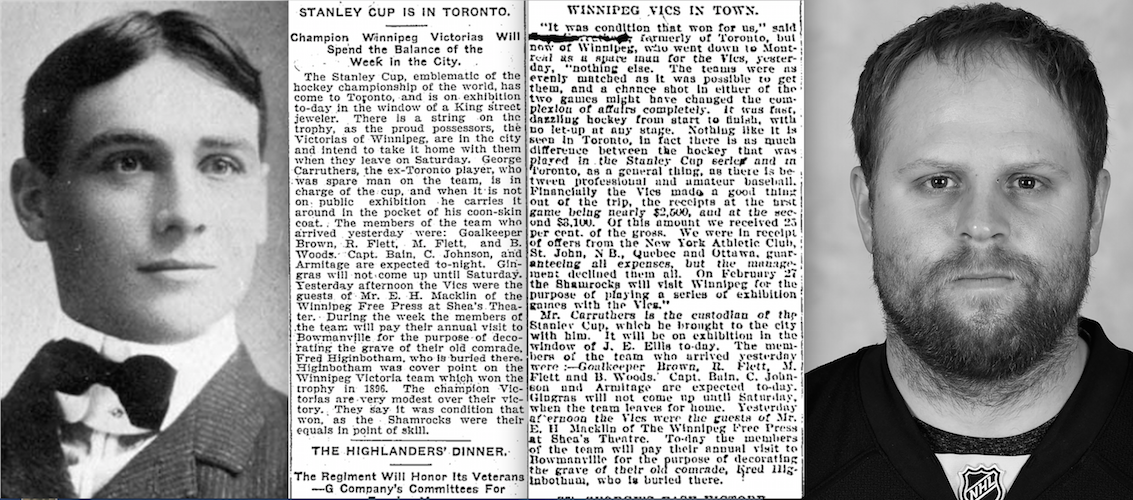
Phil Kessel isn’t the first former Toronto star to bring the Stanley Cup to town after winning it with another team. The very first time the Cup visited Toronto was way back in February of 1901. It came in the care of George Carruthers. Never heard of him? Well, you likely would have if you were a hockey fan in Toronto in the late 1890s. He played with the Toronto Rowing Club and the team from Osgoode Hall, and Toronto newspapers circa 1899 referred to him as the best cover point (defenseman) in the city.

In the fall of 1900, work took Carruthers to Winnipeg. He caught on as a spare player with the Winnipeg Victorias, perennial champions of Manitoba, and was with the team when they defeated the Montreal Shamrocks in a tight series that wrapped up on January 31, 1901. On their way back to Winnipeg with the Stanley Cup, the Victorias stopped off in Toronto to make a pilgrimage to the gravesite of their former teammate Frank Higginbotham, who had died in his hometown of Bowmanville, Ontario, shortly after the Vics’ first Cup win in 1896.

Toronto
Clippings from the Toronto Star and The Globe, February 5, 1901.
Photo of George Carruthers is from the Society for International Hockey Research.

George Carruthers was “The Keeper of the Cup” during its visit to Toronto, and on February 5, 1901, he put Lord Stanley’s prize on display for the citizens of his hometown in the show window of J.E. Ellis, a jeweller with a store on the corner of King Street and Yonge – less than a five-minute walk from the current location of the Hockey Hall of Fame. The clip from the Toronto Star says of Carruthers and the Cup, “when it is not on public exhibition, he carries it around in the pocket of his coon-skin coat.” The Stanley Cup was a lot smaller in those days, but even so that must have been some big coat Carruthers was wearing!

DiMaggio & Williams

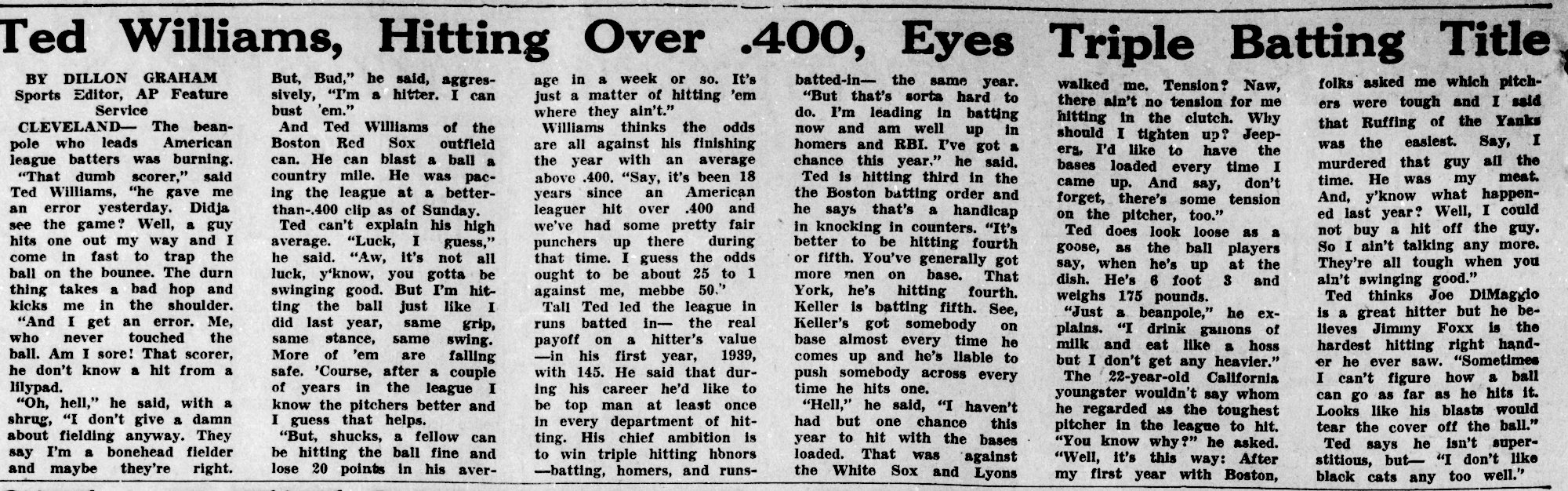
Seventy-five years ago this summer, Major League Baseball witnessed two extraordinary feats. Ted Williams (who was in only his third season, and didn’t turn 23 until August 30) became the last player to hit .400, while Joe DiMaggio (in his sixth season and 26 years old) set a record that is unlikely to be broken with his 56-game hitting streak.

On this day, July 13, 1941, (a Sunday) DiMaggio got hits in both halves of a double header, collecting three hits in the opener and one in the night cap, as the New York Yankees swept the White Sox in Chicago. A crowd of 50,387  – the largest at Comisky Park in six years – saw The Yankee Clipper run his streak to 53 games. He was batting .369 for the season.

DiMag 53

The Red Sox also played a double header that day, but Ted Williams wasn’t in the lineup. He’d injured his ankle in Detroit the day before, and missed the twinbill in Cleveland. Williams was actually slumping at the time.

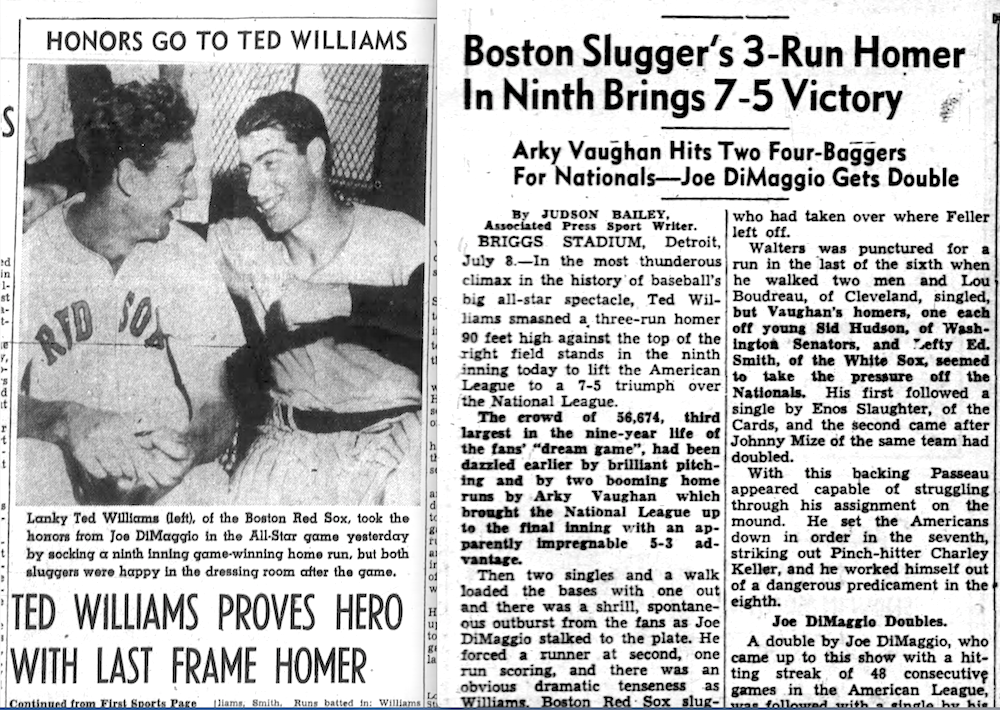
Having gone above .400 on May 25, and reaching a high of .436 on June 6, The Splendid Splinter needed four hits in eight a bats in a doubleheader on July 6 to reach the All-Star break still above .400 at .405. Two days later, he hit a dramatic three-run home run with two out in the bottom of the ninth to give the American League a 7-5 victory over the National League in the All-Star Game at Detroit.

All-Star

Coming off of that high, Williams went 0-for-4 in a 10-2 Red Sox victory over the Tigers when the season resumed on July 11. That dropped his average to .398. He fell to .397 after going 0-for-1 on July 12 … although he did draw three walks in that one.

The ankle injury he suffered that day kept Williams sidelined until July 16, when he went 0-for-1 as a pinch hitter. Then he sat again until July 19, when he pinch hit in both halves of a doubleheader, going 0-for-1 with a walk and watching his average fall to .393. That was as low as he would go. After singling as a pinch hitter on July 20, Williams returned to the Red Sox outfield on July 22. He had seven hits in 15 at-bats over the next four games to get back to .400 on July 25.

400

Williams never fell below .400 again, famously entering the final day of the season on September 28, 1941, with a .39955 average but refusing to sit out to protect a mark that would have rounded up to .400. He had six hits in eight at-bats in a doubleheader against the Philadelphia A’s that day and ended the season at .406.

Ted Williams also led the AL with 37 home runs in 1941, while his 120 RBIs ranked him fourth. DiMaggio finished the season third in batting at .357, fourth in homers with 30, and first in RBIs with 125. The Yankees finished the season in first place with a record of 101-53, which had them 17 games ahead of the Red Sox, who were second at 84-70. DiMaggio edged out Williams in MVP voting (the second of three times he’d win the award in his career), and the Yankees went on to beat the Brooklyn Dodgers to win the World Series.

Reports of His Death…

Ninety-eight years ago today, on July 6, 1918 (a Saturday), sports fans reading their favorite newspaper came across reports that Art Ross had either died, or was dying, as a result of injuries suffered in a motorcycle accident. At the time, Ross had just reached the end of a playing career that had seen him widely recognized as one of the greatest players in hockey.

Cartoon
Art Ross excelled at many sports, as this cartoon panel illustrates.

News of the accident first broke in some evening editions on July 5, 1918. The story claimed that Ross and a nephew, Hugh Ross, had been badly hurt during the evening of Thursday, July 4, and that Hugh died of his injuries at 1:30 am on July 5.

July 5

By July 6, most newspapers reported that Ross was badly injured, although some claimed that he, too, had died. Below are reports from the New York Times, and from the Evening Tribune in Providence, Rhode Island, which put the headlines over the wrong stories, but reported that Ross had been killed.

NYT & Prov

That same day, The Toronto World reported in its sports section on page nine that Ross had died, but the same paper had previously reported on page two that he’d suffered no injuries at all.

TO World

Fortunately, in Montreal, where Ross’s wife, infant son, mother and brother Colin all resided, the news was cleared up fairly quickly. Art Ross was fine, but the sad truth was that Hugh Ross, a few months short of his 25th birthday, had been killed.

Gazette Redo

Even so, two days later, on July 8, the Syracuse Herald had a story on its sports page claiming that Art Ross had died.

Syracuse

And some newspapers still didn’t have the facts straight for several more days.

Lethbridge

As I wrote in Art Ross: The Hockey Legend Who Built the Bruins, even now, when a story breaks suddenly, it can be hard to make sense of the conflicting initial reports on the various all-news networks. This was even truer when newspapers were the only real source of news, and so many of them were competing in the same market.

If the story of Art Ross’s death in 1918 had been true, the game of hockey might look very different today. It’s a certainty that its history would.

Eric Lindros … Yes or No?

All these years later, it seems there are still plenty of people who hate Eric Lindros.

Spoiled and arrogant? A self-entitled jerk? Maybe. (I don’t know him.) And we’re not going to go into the whole Koo Koo Bananas incident. (I wasn’t there, and he’s certainly not the only rich young man – athlete or not – to act like a jerk. Not that that excuses anything!) But here’s my thinking on Lindros and his parents.

Suppose your son is 18 years old. Just out of high school, or maybe finished a year of university. He knows what he want to do … and he’s very good at it. Doesn’t matter if it’s a lawyer or a plumber or what. Say it’s a plumber. He’s drafted by a plumbing firm. It’s based thousands of miles from where you live, and he probably can’t earn as much money there as he could somewhere else. But he HAS to go. Or, at least, everyone believes he’s got to. And later, if the plumbing firm wants, they’ll trade him somewhere else. Or just let him go.

Would we accept that?

NHL Network
Announcement Monday on the NHL Network that Eric Lindros had been elected
to the Hockey Hall of Fame. He’ll be inducted in November with Rogatien Vachon,
Sergei Makarov and Pat Quinn.

The Lindros family certainly rocked the boat when Eric refused to go to Quebec (and Sault Ste. Marie before that). Lindros said the other day that the reasons had nothing to do with the city, the province or its culture, but with personal differences – likely with Marcel Aubut, who was CEO of the Nordiques at the time and recently stepped down as president of the Canadian Olympic Committee over allegations of sexual harassment.

Whether or not that was really the case, or just revisionist thinking, the Lindros family was fortunate to be in a position where they weren’t like the old-time farm boys or miner’s sons looking for their only way out. Eric Lindros and his parents wanted to have a say in his future. I’m pretty sure my parents would have wanted the same with me. As it was, my family certainly did a lot to help when I was getting started in my work. Wouldn’t you do the same for your kids if you were in a position to? And yet people hated the Lindros family for it. Many still do.

But, of course, sports aren’t like being a plumber. Or a lawyer. Or a writer. These athletes should consider themselves lucky that they get paid to play games! They should do what they’re told!

And yet, we all look back at Gordie Howe and we think how terrible it was that such a great athlete was taken advantage of so badly by the people in charge of the game he excelled at. A team jacket as a signing bonus; a thousand dollar raise each year; a salary kept artificially low so that other teams could say to their stars, “how can we pay you more than Gordie Howe?”

It was all about who controlled the money, and who had the power. That’s why guys like Punch Imlach and Jack Adams could walk around with train tickets to minor league towns sticking out of their pockets, terrifying young players into toeing the line.

Yes, things are better now. Players can make tens of millions of dollars. But there’s still no one in management really looking out for their best interests … unless they also serve the best interests of the team. As I’ve said before, I do have a hard time rooting for people half my age making more money per game than I do in a year, but if there really is that much money out there, I’d rather see the players getting their fair share.

Yzerman
In this Associated Press report from Montreal on August 16, 1991 – two months after
that year’s NHL Draft – Steve Yzerman said he didn’t want to play in Quebec either.

All that aside – and you’re certainly free to disagree with me – there’s still the question of whether or not Eric Lindros the player is worthy of induction to the Hockey Hall of Fame.

Love him or hate him, in the early days of his career – before all the concussions –  Lindros was certainly living up to “The Next One” hype. In his first six seasons, from 1992 to 1998, he played 360 games (injuries had already cost him nearly 100 games) and had accumulated 507 points.

In the NHL Official Guide & Record Book, there is a listing for the Highest Points-Per-Game Average, Career (Among Players with 500-Or-More Points). At the time Lindros had reached those 507 points, his points-per-game average was 1.408. If he’d kept that up for his entire career, Lindros would still be a long way behind Wayne Gretzky (1.921) and Mario Lemieux (1.883), who hold down the top two spots, but he would only be slightly behind #3 Mike Bossy (1.497) and would rank ahead of the 1.393 mark of the #4 player … Bobby Orr.

If Lindros had managed to stay healthy enough to play 1,000 games at that scoring pace, he would have had 1,408 points in his career. That would rank him 20th in NHL history despite playing significantly fewer games than anyone else in the top 20 except for Mario Lemieux, who ranks eighth all time with 1,723 points while playing only 915 games.

Even at his final career scoring pace of 1.138 (865 points in 760 games), which was much diminished due to his injuries, if Lindros had managed to reach 1,000 games his 1,138 points would place him 54th in NHL history (two spots ahead of Bossy) despite playing far fewer games than everybody ahead of him except Lemieux and Peter Stastny (1,239 points in 977 games.)

But, of course, those are pretty big ifs!

I’m not sure the Hockey Hall of Fame should be rewarding anybody for the potential of what might have been … but since Peter Forsberg and Pavel Bure are already in with pretty comparable statistics, and Cam Neely is in with much weaker career numbers, it’s hard to make the case for keeping Lindros out.