All posts by Eric Zweig

Hockey Nerd in Canada – Part I

Generally speaking, I find the recent trend of athletes signing one-day contracts so that they can retire with their former team to be kind of dopey. That said, I think that Daniel Alfredsson, the Senators, and Ottawa hockey fans did a real nice job of it last week. Roy MacGregor wrote a fine column about it in the Globe and Mail on Friday.

I’ve enjoyed MacGregor’s writing for a long time, particularly when the topic is hockey or life at the cottage. He and I have met a few times over the years, and exchanged emails on occasion, and he’s always been great to talk to. So, I sent him a note telling him how much I liked his Alfredsson story … but pointing out one historical error.

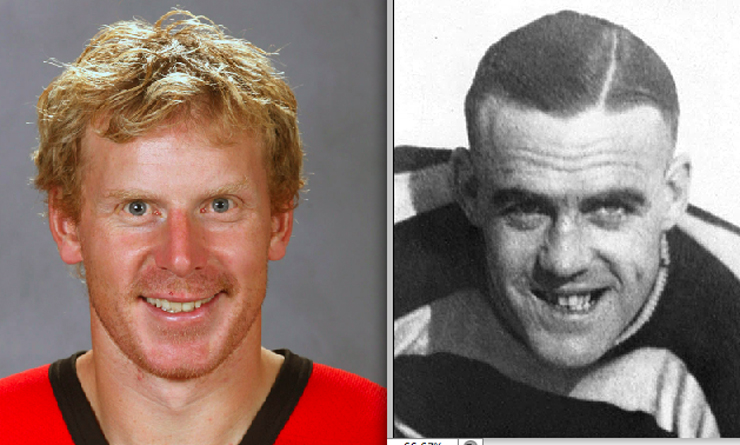
Alfie Clancy

MacGregor had touched on a few of the greatest names in Ottawa’s long hockey history and briefly mentioned King Clancy playing every position including goalie during one Stanley Cup game. I told him that, “it’s in such high circulation these days that everyone believes it’s true, but the evidence is that while King Clancy played every position on the ice during the 1923 Stanley Cup playoffs, he did NOT do so in one single game.”

Roy apologized, and told me that he’d gotten the information from the Hockey Hall of Fame’s web site. “Certainly nothing to apologize about,” I wrote back. “I’m sure you’d find the Clancy story on MANY different web site … and my story only in my book!” (that book being Stanley Cup: 120 Years of Hockey Supremacy.) I added, “It’s like the line from The Man Who Shot Liberty Valance … ‘When the legend becomes fact, print the legend.’ But then there’s always some lonely voice like mine, trying to sort out the facts…” He said that those lonely voices, “matter a great deal to the game and its history.”

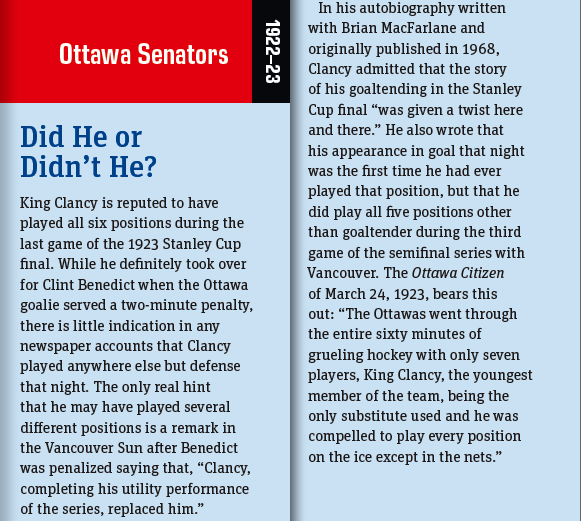
For those who care to know what probably happened all the way back in 1923 (and who probably haven’t committed to memory every word in my G I A N T Stanley Cup opus), here’s what I wrote about King Clancy playing all six positions:

Clancy 1923

But, sadly, nothing is straightforward with this story. Hoping to fine a little more proof, I did some more digging this weekend. Turns out, Basil O’Meara, writing in the Ottawa Journal on April 2, 1923 after the final Stanley Cup game on March 31 had this to say: “Frank Clancy made hockey history,” and proceeds to write that, “the kid with the tousled thatch went in and played goal and tried his hand at every other position on the team.” Still, the game report on the previous page in that day’s Journal only seems to describe Clancy and Lionel Hitchman subbing in on defense, with Harry Helman taking a few turns relieving the forwards. (Maybe O’Meara’s copy editor back in Ottawa transcribed something incorrectly in type-setting the telegraphed story from Vancouver?) The Vancouver World says nothing about it.

So, I still think I’m probably right in what I wrote … but I’m not quite as sure as I once was!

The Late, Great Jean Beliveau

Jean Beliveau died last night. He was 83 years old.

I was only seven when Beliveau retired in the spring of 1971. I never saw him play live, but the 1971 Stanley Cup Final is the first one I really remember, so I know that I at least saw him play on television. I met him once, 22 years later, in 1993, when I was working at the Hockey Hall of Fame. He was every bit the classy gentleman that everybody always said he was! We only spoke for a few minutes, but he made it very warm and personal. I’ve met other players of his era before and since, but this was honestly something special.

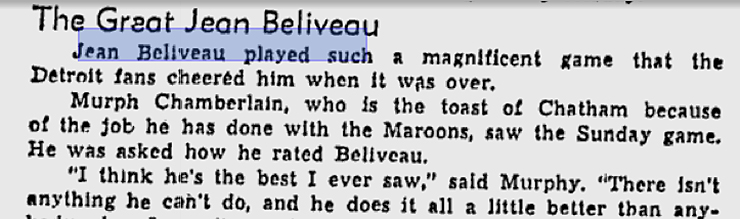
1956 Beliveau

Other people who knew him better, and saw him at his best, will (and already have) written about him in ways that I never could. Still, I thought I’d share some of this story I recently came across, written about him on April 10, 1956. For some context, Beliveau was already a star from his junior hockey days in Quebec City, and probably the most-hyped hockey prospect in history in the early 1950s. In 1955-56, he’d just completed his second full season in the NHL, leading the league with 47 goals and 88 points. On April 8, 1956, he scored two goals in Montreal’s 3-0 win over Detroit to take a three-games-to-one lead in the Stanley Cup Finals. This article appeared in Dink Carroll’s column in the Montreal Gazette:

Jean Beliveau played such a magnificent game that the Detroit fans cheered him when it was over.

Murph Chamberlain, who is the toast of Chatham because of the job he had done with the Maroons, saw the Sunday game. He was asked how he rated Beliveau.

“I think he’s the best I ever saw,” said Murphy. “There isn’t anything he can’t do, and he does it all a little better than anybody else. I won’t say he’s a better finisher than the Rocket. You’d have to wait until he’s been in the league as long as the Rocket has, and he may not last that long.”

Wilfie Cude, the old netminder, was also a spectator. Wilfie is now a scout for the Red Wings. He listened in on the discussion about Beliveau.

“He’s a sweetheart,” Wilfie said. “Give him another three years in the league and I think we’ll be saying he’s the greatest of them all.

“I’m not saying he’s the best stickhandler I ever saw. I can’t forget what a great stickhandler Aurel Joliat was, but Aurel was small and that was a disadvantage. Beliveau is big, strong, and has such a long reach that it’s hard for opposing players to get at the puck.

“He makes great plays, he’s always a step ahead, he’s got hockey sense, he does a lot of forechecking, and he can score. He makes it all look easy, too.”

“How would you compare him with Syl Apps,” one of the reporters in the group asked.

“Apps wouldn’t come up to his ankles,” was the reply. “But Apps resembled him in that he was a gentleman, on or off the ice, and if you love hockey like I do that’s important.”

“A gentleman,” somebody kidded. “Beliveau had over 140 minutes in the penalty box this season. How about that?”

“I don’t care if he spent six years in the penalty box. He’s still a gentleman.”

Nobody Expects the Spanish Royal Family

On October 21, 1928, it was announced that His Royal Highness Infante (Prince) Don Alfonso of Orleans-Bourbon, a first cousin of King Alfonso XIII of Spain, would be making an unofficial visit to the United States in November. His wife, the Infanta (Princess) Beatrice, would accompany him. She was a granddaughter of Queen Victoria and the sister of Queen Marie of Romania. The couple’s eldest son, Alvaro, would also make the trip. The Spanish royals sailed from Southampton, England, aboard the Majestic on November 7. They arrived in New York six days later.

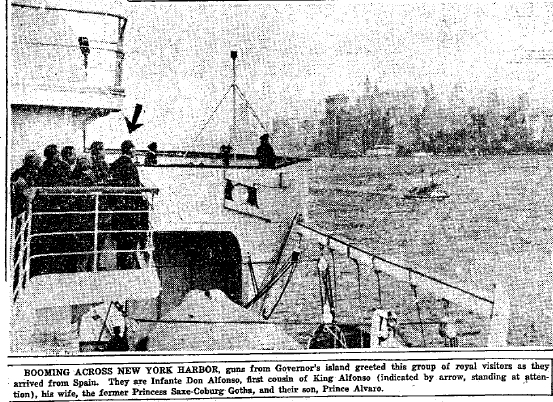
Spanish Ship

The royal entourage spent several days in New York with Cornelius Vanderbilt and his wife. They next made a whirlwind visit to Washington, where their short stay disappointed the society folk, though they did meet President Calvin Coolidge, for whom the Infante carried a personal message from his cousin the King.

Before sailing home on December 7, the Spanish royals visited Philadelphia, Boston, and Detroit. They also made stops at Columbia University, Princeton, and Harvard. Don Alfonso was the Minister of Aviation for Spain and particularly enjoyed speaking with Charles Lindbergh. His meeting with Henry Ford also impressed him.

The family also made a short visit to Niagara Falls and Montreal during their trip. Given all the impressive people they’d met in the United States, how did their Canadian hosts in Montreal choose to entertain Spanish royalty? They took them to a hockey game!

Spanish Royalty

On December 1, 1928, the Infante Don Alfonso, the Infanta Beatrice, and their son Prince Don Alvaro d’Orleans Bourbon, were among 12,000 spectators at the Montreal Forum watching the Montreal Maroons score a 3-0 victory on two goals from Nels Stewart and a shutout by Clint Benedict.

Maroons

“I think your ice hockey is the finest and fastest game I have ever seen in my life,” Don Alfonso told a representative of the Montreal Gazette. “It is wonderful, and we all enjoyed every minute of the game. I have seen ice hockey at St. Moritz [Switzerland] and Chamonix [France], but never like we saw on Saturday evening in Montreal in your match against the New York Rangers.”

Before the Hockey Hall of Fame

The Hockey Hall of Fame officially welcomes six new members on Monday night. In the Players category are Rob Blake, Peter Forsberg, Dominik Hasek and Mike Modano. Coach Pat Burns will be inducted in the Builders category. Referee Bill McCreary rounds out the field.

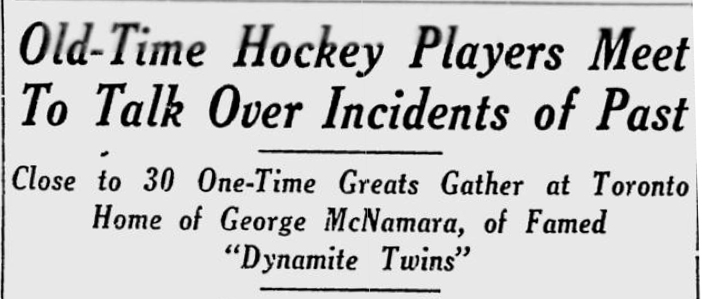
The first Hockey Hall of Fame inductions were made in 1945, but many future Hall of Famers were already getting together in the late 1930s at informal parties hosted by future member George McNamara.

Oldtimers 1939

For more, check out my story for the Society for International Hockey Research which is posted on the SIHR Blog.

Remembrance Day

Today, Canadians all across the country gathered in communities large and small to remember the men and women who have served us in war. This year’s ceremonies took on added meaning, given both recent events and the 100th anniversary of World War I.

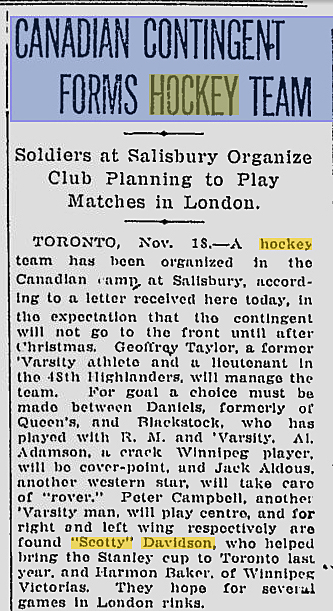
One hundred years ago today, Canadians had not yet seen action during the First World War, but thousands of them were stationed at Salisbury Plain in England, receiving further military training after shipping out from Canada early in October. Then as now, wherever Canadians travelled in large enough numbers, hockey wasn’t far from their minds!

WWI article

The news story above appeared in papers all across Canada on November 19, 1914. It outlines plans for a hockey team in the Canadian camp. It’s unclear as yet if they ever actually played any games, though sports competitions took place regularly during training. Among those listed as taking part is future Hockey Hall of Famer Scotty Davidson.

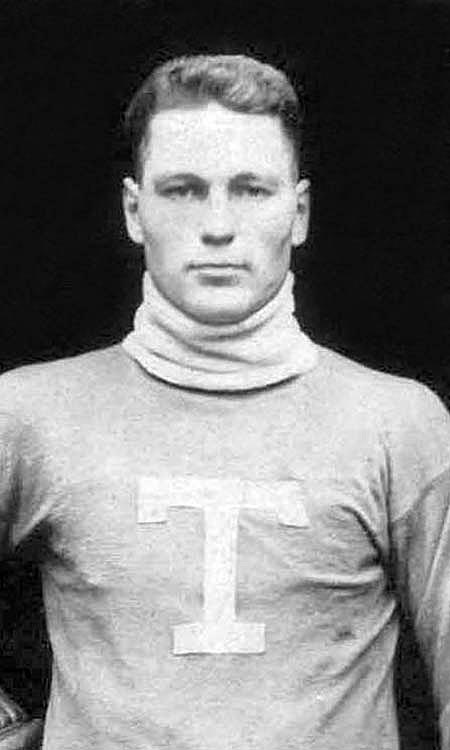
Scotty Davidson

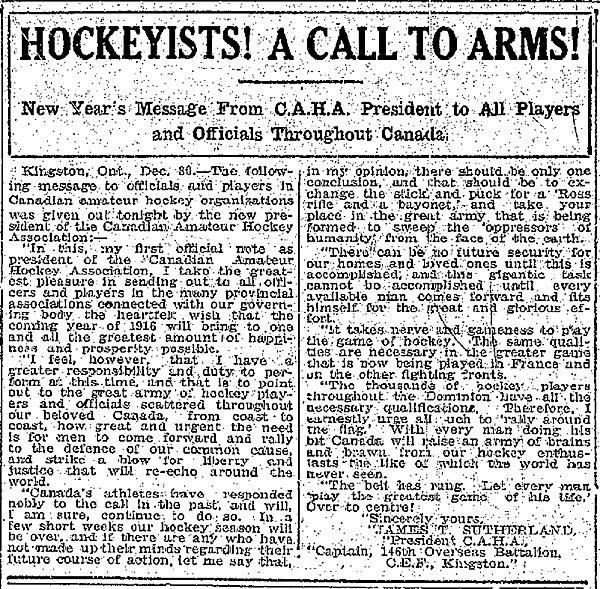
Scotty Davidson had captained the Toronto Blue Shirts to the Stanley Cup in March of 1914 before becoming the first pro hockey player to enlist in the Canadian Expeditionary Force in August. If you’re interested in more on Davidson’s war story, and those of other future Hockey Hall of Famers, click here for the original text of a story I wrote that is currently appearing in the Hockey Hall of Fame’s Legend’s magazine.

Hockeyists article

Who’s Number One?

So, the Leafs are waiting (again!) for someone to step up and claim their number-one goaltending position. It seems that neither Jonathan Bernier nor James Reimer has taken (or been given!) the opportunity to run with the starting job. You’ve got to think coach Randy Carlyle and the rest of the team brass are getting a little bit desperate … but chances are they won’t resort to something Conn Smythe tried back on March 9, 1929.

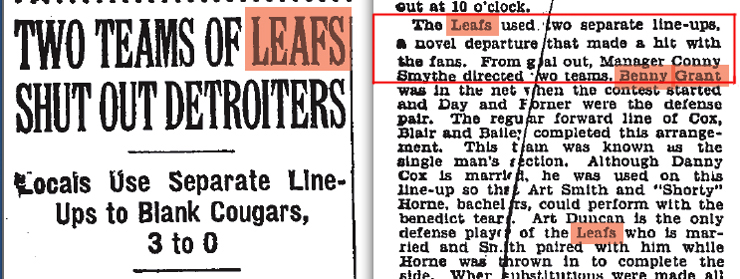
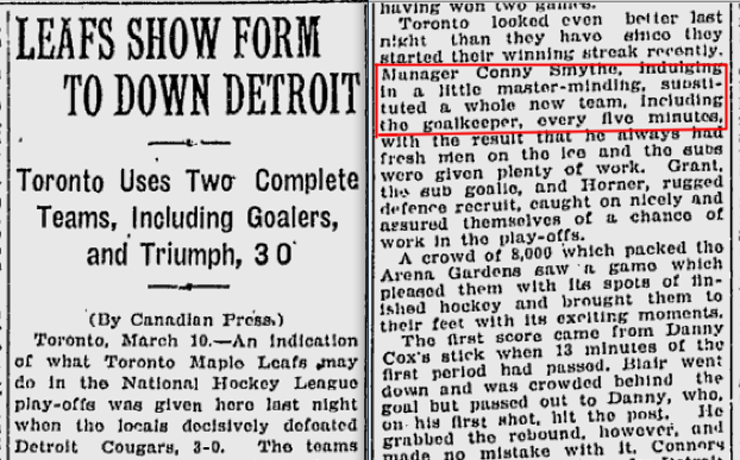
The 1928-29 season was the lowest scoring in NHL history. Teams combined to score only 2.9 goals per game that season, meaning the average score of any game was 2-1 in overtime. George Hainsworth of the Canadiens posted a record 22 shutouts during the 44-game season and had a goals against average of 0.92! Toronto’s Lorne Chabot posted a 1.52 average but that was only good enough to rank him eighth among the starters on the 10 NHL teams that season. So Conn Smythe had every reason to see what the young Benny Grant (who’d led his hometown Owen Sound Greys to the Memorial Cup as a junior in 1926–27 before going pro in 1927–28) could do.

Chabot Grant 2

This was an era when the game’s top stars – especially defensemen – often still played the full 60 minutes, or very close to it. But in Toronto’s game against Detroit on March 9, 1929, Smythe chose to “roll” two full lines … including his goaltenders! Smythe made changes approximately every five minutes (presumably at whistles, not on the go) and the fans seemed pleased with the results in a 3-0 victory.

Chabot Grant 1

Smythe continued to use both Chabot and Grant for the final three games of the season, but he rotated them somewhat more traditionally by switching them up between periods. Over the next few seasons, the Leafs occasionally tried to work Grant into a regular rotation, but it never really panned out. Grant play professionally through the 1943-44 season, but only saw action in 52 NHL games in all those years. Because of the way the Leafs used him, his record is somewhat difficult to determine, but was either 17-27-4 or 18-27-4.

Chabot Grant 3

So, why were the Leafs so determined to try Benny Grant when they had a goalie like Lorne Chabot, who still ranks highly among the all-time shutout leaders? And why is Chabot – who has numbers comparable to all the great goalies of his era that have been enshrined – not a member of the Hockey Hall of Fame?

I obviously never saw Chabot play, so I can’t say for sure, but I once asked 1930s NHL defenseman Alex Levinsky what he thought about it. Levinsky was a teammate of Chabot in Toronto and Chicago and a relative by marriage of the former wife of a cousin of mine. (Jewish Geography … or, actually Jewish Genealogy!) “He wasn’t that good,” Levinsky told me.

That seems hard to believe, but then again, there must be a reason why Chabot was traded five times in his 11-year career, including each of the final four seasons he played.

Recently, I came across a story in the Montreal Gazette from April 15, 1958 in which columnist Vern DeGeer discussed the athleticism of various NHL netminders. “One of the poorer skaters of the goalie fraternity was the late Lorne Chabot,” he writes. “He operated on shaky legs and often had to grab a goal-post to steady himself.” Still, DeGeer notes: “He was remarkably successful despite his blade weakness.”

Frank Selke once said his teammates all liked him, but you’ve got to think that if Chabot was playing today, fans and media (and probably the analytics crowd) would be all over him!

Chabot

Better Than Nothing?

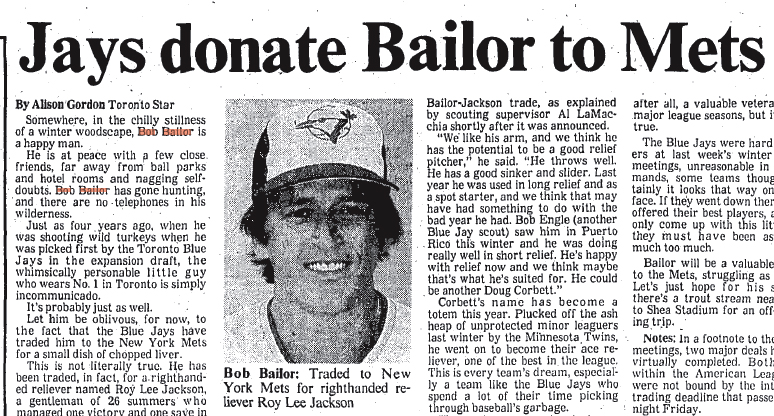
Perhaps it’ll all work out for the best. Perhaps the money saved by trading Adam Lind, the player with the highest batting average in the Majors against righthanded pitching, for Marco Estrada, the pitcher who gave up the most home runs in the National League, makes sense. Perhaps the .202-hitting Justin Smoak is ready to bust out. Or, maybe, these are just the earliest moves in an offseason (hopefully!) filled with better ones to come. Still, the Lind trade put me immediately in mind of one of the greatest headlines in Blue Jays history:

Donate headline

This story appeared in the Toronto Star on Sunday, December 13, 1980, the day after the Blue Jays sent Bob Bailor to the Mets for Roy Lee Jackson. Bailor put up some decent numbers with the Mets and Dodgers after leaving Toronto, but the Jays didn’t really miss him. As for, Roy Lee Jackson, he’s probably best remembered as a pretty fine National Anthem singer, but he did have better stats than people might recall.

Still, an awful lot of Jackson’s wins came from Jays rallies after he’d blown leads … so much so that where other people might refer to those types of pitchers as “vultures” in my family, we referred to those types of situations as “Roy Lee wins.”

Here’s hoping the donation of Lind works out better!

A 1935 Hockey Vision of Baseball’s Future

Congratulations to the 2014 World Series champion San Francisco Giants, and to MVP Madison Bumgarner. He was pretty amazing! Historically speaking, three championships in five years is quite an accomplishment … but somehow, the Giants just don’t feel like a dynasty to me. It’s not like there’s been that overwhelming feeling going into any season that there’s just no way to beat them. To me, that’s as much a part of being a dynasty as the winning.

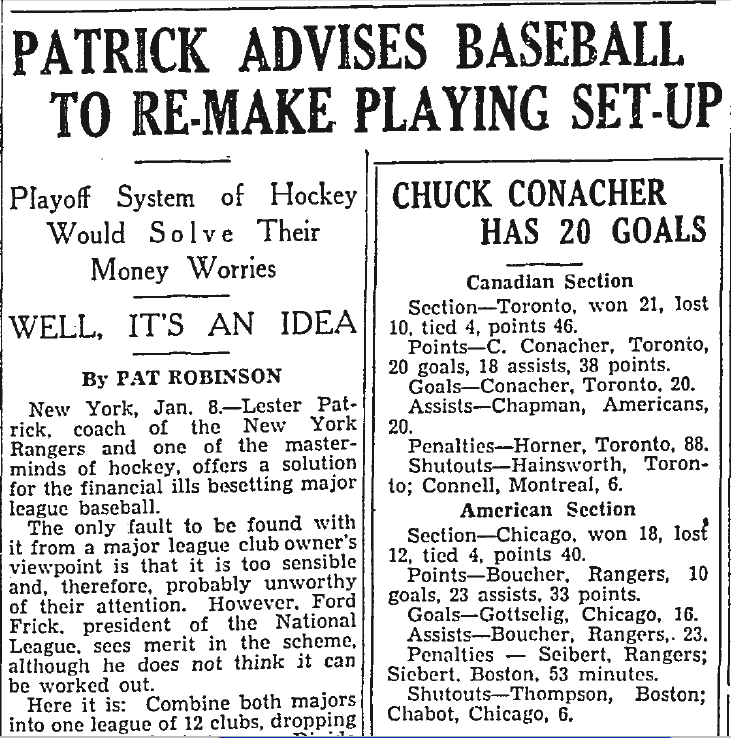
This was the last World Series to be overseen by baseball commissioner Bud Selig. People seem to be well past saying that his legacy will be the canceled World Series of 1994, and are instead praising his developments of interleague play, the expanded playoffs with first one and now two wild card teams in each league, and the huge expansion of revenue those two ideas helped to create. But even though I truly do believe you might see something you’ve never seen before any time you watch a baseball game, it really seems that there are very few ideas in sports that someone hasn’t thought of before! Many of Bud Selig’s innovations for baseball – and even his ill-fated plans for contraction – were all advanced back in 1935 … by Hockey Hall of Famer Lester Patrick.

LP 1935 story

Lester Patrick was a big baseball fan, and a pretty good ballplayer in his younger days.
A couple of years ago, I wrote a story for The Hockey News making the case that the World Series of 1912 inspired Patrick to push for hockey to change the Stanley Cup playoffs away from the one-, two-, or three-game challenge series the Stanley Cup trustees had always favored toward the best-of-seven format used in baseball.

By 1934, Major League Baseball was a money-losing proposition in many cities because of The Great Depression, but Patrick had a few ideas to fix that. His plan, reported in newspapers in January of 1935, was to take the eight-team American League and eight-team National league and combine them into one 12-team circuit with two divisions of six teams each. They would play an interlocking schedule, and then – instead of only the pennant winners advancing directly into the World Series, as baseball had always done – the top three teams in each division would qualify for the playoffs. In the NHL, finances weren’t exactly booming at this time either, and American sportswriters loved to mock the league’s playoffs for being needlessly complicated and giving less worthy teams a chance to win. Still, Patrick said:

“If we had two major hockey leagues we’d lose money like the baseball people do. Our race would be over right now and we wouldn’t draw files playing out the schedule. Instead, interest is sustained for the playoffs, the crowds keep coming, and we make money. And we play to standing room only in the playoffs. But in baseball all too often one or two teams have the race sewed up long before the season is over and attendance fades to nothing. Under my plan, interest would be sustained throughout the year.”

As for interleague play:

“Imagine how towns like Pittsburgh and Brooklyn would turn out to see Babe Ruth, Jimmy Foxx and other stars playing the Pirates or Dodgers. Or how Washington and Cleveland would go for Dizzy Dean and other stars they never see. You may think Babe Ruth has been over exploited but, really, the baseball people have been dumb. They haven’t exploited him half enough. Think of the millions they could have made with him under a set-up as I have outlined.”

National League president (and future Major League commissioner) Ford Frick saw merit in Patrick’s plan but wasn’t sure how it could be carried out … particularly the contraction part. “Granting that it would work out well in baseball,” Frick said, “what towns could be dropped? No town would want to be deprived of its baseball.

To Patrick, the answer was obvious. “Drop the four weakest towns financially.” His plan was to cut the St. Louis Browns, the Boston Braves, and the Philadelphia Phillies, all of whom already had other teams in the same cities (the Cardinals, Red Sox, and the Philadelphia Athletics) who were doing much better. The fourth team Patrick planned to drop was the Reds. “Only Cincinnati would be deprived of a major league club and judging by the box office receipts, that isn’t a major league town anyway.

In the long run, Lester Patrick and Bud Selig were probably wrong about contraction, but the rest of Patrick’s plan looks an awful lot like the makeup of baseball Selig has given us today … although without the drug testing and instant replays!

Season’s (Ticket) Greetings

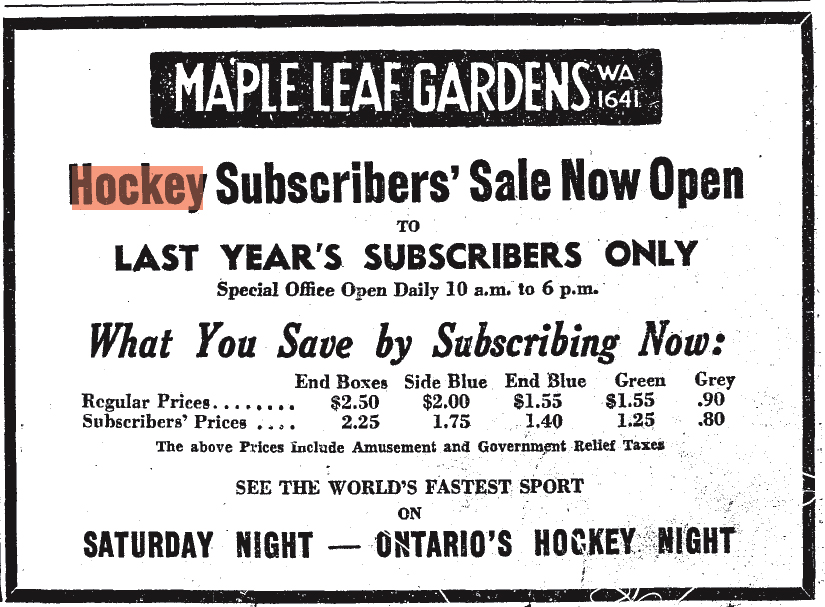
Okay, Leafs fans. It’s October of 1935. The new season still doesn’t start for another ten days, but your team wants you to renew your tickets.

The Good News: They’re a powerhouse, who reach the Finals nearly every season.

The Bad News: They never seem to win it … and it’s the depths of the Great Depression!

Brother, can you spare a dime?

Leafs tickets

Hockey Stamps

Canada Post has recently issued new stamps honouring former star NHL defensemen Bobby Orr, Harry Howell, Doug Harvey, Tim Horton, Red Kelly and Pierre Pilote. They’re really quite attractive.

Stamps 2014

A friend of mine who works for Canada Post suggested I write something about this, so I tried to find a little bit of history. It seems that several countries have issued hockey-themed stamps (usually around the Olympics or World Championships) for many years. Looks like the first time Canada did so was on January 23, 1956. An announcement about it appeared in Canadian newspapers on December 9, 1955.

Stamp Headline

The story claimed that former Liberal Member of Parliament for Toronto Trinity Lionel Conacher (who had died of a heart attack during a House of Commons-Parliamentary Press Gallery baseball game in the spring of 1954) gave “strong sponsorship” to the hockey stamp. Conacher, of course, played in the NHL from 1925 to 1937, and also starred in football, lacrosse and several other sports. He was named Canada’s Athlete of the Half-Century in 1950.

Here’s a look at that 1956 stamp.

Stamp 1956