All posts by Eric Zweig

Upon Further Review…

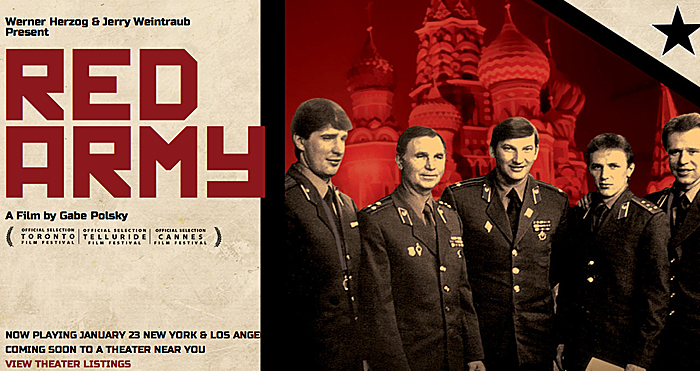
Last week, on the night before it opened in Toronto, I attended a screening of Red Army – a documentary about the Soviet national hockey team. It was followed by a question-and-answer session with the director, Gabe Polsky, and Roy MacGregor of the Globe and Mail. I’m not sure how widely available this film is yet, but I known that it’s already playing in New York and Los Angeles and now Vancouver too. If it’s playing anywhere near you, go and see it!

Red Army

I won’t be the first one to say it’s not really a film about hockey. The director (who is an American) willingly admits it’s a movie that was made to show Americans about life in the Soviet Union by using hockey – and the story of Viacheslav Fetisov’s desire to escape the oppressive regime of coach Viktor Tikhonov.

I think most Canadian hockey fans of a certain age always knew that the Soviets trained 10 or 11 months of the year, and believed that they could be sent to Siberia if they failed – which seems to be true! – but I don’t think very many of us ever thought about how tough that actually was on the players and their families. Fetisov clearly loved his country, and loved being part of a spectacular hockey dynasty, but the story of how he eventually came to fight the Soviet system is fascinating … as is all of the vintage footage of life and hockey in Russia from the 1960s, ’70s and ’80s.

As a Canadian, my biggest complaint would be that if you watch this movie, you’d never know that we ever beat them! But that’s not really the point. As a writer, I hate when critics complain about what’s NOT in a book, so I hate to do the same about a film. Still, it could have included something about the 1987 Canada Cup – not because we beat the Soviets in probably the greatest set of hockey games ever played, but because that tournament is said to have been a real eye-opening experience for some of the key Soviet players who wanted the chance to leave their homeland to play in the NHL – which is what a great deal of Fetisov’s story is about. Perhaps this is something that could have been addressed by Igor Larionov, but Polsky told the audience in our Q&A that Larionov (and Sergei Makarov) would not speak with him.

Falcons 2

Also last week, I saw on TV the new Canadian heritage minute featuring the Winnipeg Falcons. Apparently, it’s been out since Remembrance Day (which makes sense!) but this was the first I knew about it. I’m a big fan of the Falcons’ story … which is, in a nutshell, about how the players overcame the prejudice against them in Winnipeg as immigrants from Icelandic families to become Canada’s first gold medalists in Olympic hockey. (My book Long Shot tells their story for young readers.) The heritage minute tells the story in 60 seconds. It plays with some facts and compresses others, but it does a great job of covering a lot of information so quickly. My one beef with it is pretty nerdy, but what can you do?

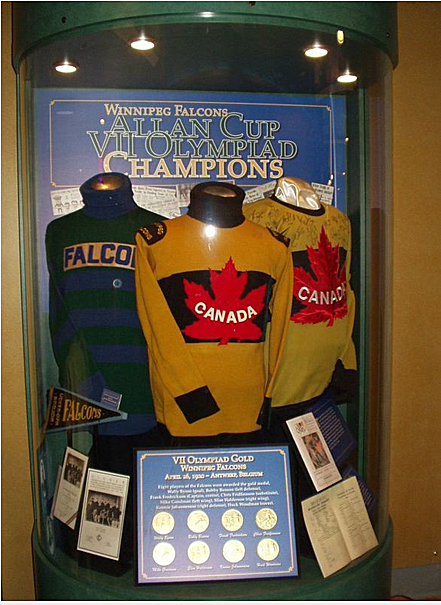
The Falcons are depicted in their dressing room prior to a game at the Olympics and are shown wearing pretty good replicas of the mustard yellow jerseys they wore for the tournament in Antwerp, Belgium. (These were not the team’s regular uniforms, but were specially designed for whichever team represented Canada at the Olympics.) Two other green-and-blue Falcons sweaters are shown on the wall in the dressing room, representing a couple of former players who died while serving their country in World War I. (All of the Falcons who were of age signed up.) The sweaters are a nice, artistic touch, and my complaint is not that these dead players probably never wore them (as I believe they were new for the 1919-20 season), but that it’s highly unlikely they were green and blue!

Falcons 1

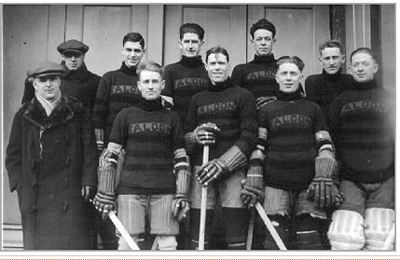
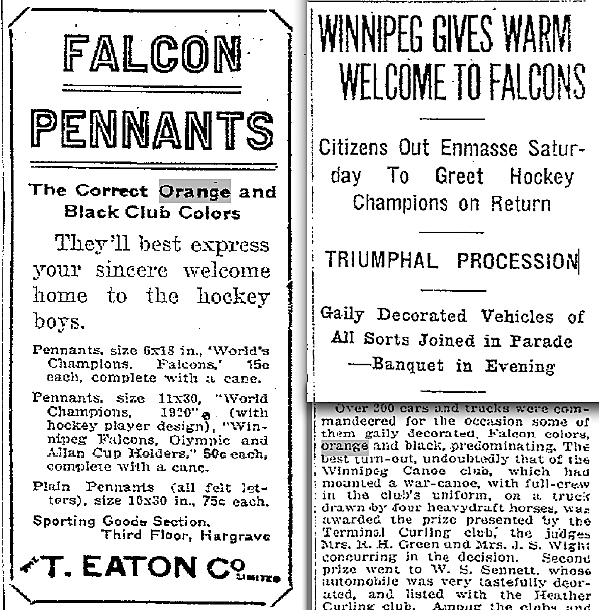
The fault (though that’s probably too strong a word) most certainly lies with the display honoring the Falcons that’s been at the MTS Center (and is shown above) in Winnipeg for several years. I’m not sure how they came up with those green and blue colors. All my research indicates that the Falcons pre-Olympic sweaters were actually orange with black stripes and collars … which I also happen to think is a much better match if you try to imagine the colors from the black-and-white team photograph.

Falcons 3

Like I said, a pretty nerdy complaint – but given all the research I’ve done on this team over the years, it would be nice if my reputation ever got to the point where more people think to call on me for things like this…

Hockey Stars Join Baseball’s Maple Leafs

Well, the big blizzard sort of skipped New York, though it hit pretty hard elsewhere. And it’s supposed to warm up – albeit briefly! – around here today. It is only the 28th of January, but pitchers and catchers begin to report for spring training in three weeks, so summer can’t be too far away! Hockey may be where my head is much of the year, but baseball is where my heart is … and, sometimes, you get to tell one story that combines both sports!

In late January of 1926, the Toronto Maple Leafs baseball club was already hard at work preparing for the International League season. This would be a big year for Toronto baseball. The team was leaving its old park on Hanlan’s Point and moving into the brand new Maple Leaf Stadium at the foot of Bathurst, near Fleet Street. (Behind what is now the Tip Top Tailor lofts near the Canadian National Exhibition grounds.) With a seating capacity of 20,000 the new stadium was considered the most modern facility in the minor leagues. Baltimore had won the International League pennant every year from 1919 to 1925, but in 1926, Toronto had a record of 109-57 to take the league title. They then swept five straight games from Louisville of the American Association to win the best-of-nine Junior World Series.

But all of this was still nine months into the future on January 29, 1926, when Maple Leafs manager Dan Howley signed a couple of locals boys for his team. Both also happened to be NHL stars: Cecil “Babe” Dye and Lionel Conacher.

Conny Dye

Babe Dye was one of the top scorers in the NHL during the 1920s and a future Hall of Famer, but he was also a minor league baseball star with a couple of offers from Major League teams over the years. He had his best baseball seasons with the Buffalo Bisons from 1922 to 1925, but injuries suffered in the NHL seemed to take their toll and he had a poor season with the baseball Maple Leafs in 1926. Released halfway through the schedule, he finished the year with Baltimore and never played baseball again.

Lionel Conacher was a great all-around athlete who was best known as a lacrosse and football player when he was younger, but willed himself to become a Hall of Fame hockey player because that’s where the money was in Canadian sports. Conacher also boxed and wrestled, but baseball was only a sport he’d dabbled in around the Toronto sandlots.

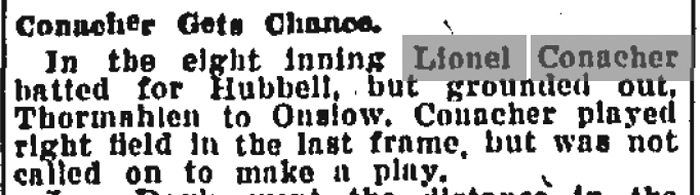
Still, according to the Toronto Star, Conacher’s contract with the Maple Leafs stipulated that he had to be carried for the entire season and could not be traded or sold. Having him on the roster meant added publicity, but Manager Howley was said to be sure that Conacher would make good. Given that Toronto had a working relationship with the Detroit Tigers and shared a spring training facility with them in Augusta, Georgia, it was hoped that Ty Cobb would help to make a star ballplayer out of Canada’s future Athlete of the Half-Century. Conacher saw action in the Maple Leafs outfield with Dye during spring training, but was pretty much glued to the bench once the season got under way. What statistics there are show him batting only three times all year. (In a quick search, I could only find him batting once, grounding out as a pinch hitter for future Hall of Fame pitcher Carl Hubbell in the eighth inning of a game on June 27.)

Conny

It seems unlikely that Conacher actually spent the entire season with the Maple Leafs, as a Toronto Star story on August 14 discusses him being on a trip to Sudbury with his wife and a brother and fishing with future Hockey Hall of Famer Shorty Green. Later, Conacher was playing lacrosse in St. Catharines on September 19 during the final weekend of the International League season.

Both Conacher and Dye made their biggest splash of the baseball season on June 19, 1926, when the Maple Leafs were on the road but they were allowed to return to Toronto for an exhibition game at Maple Leaf Stadium between the Toronto Semi Pros and Buffalo’s Pullman Colored Giants. The Semi Pros featured a third future Hockey Hall of Famer in Conacher’s buddy and longtime teammate Roy Worters. The baseball team also had two other Conacher-Worters hockey teammates in Duke McCurry and Jess Spring and another hockey player in Chris Speyer. Conacher had a single and a triple in this game, and made two sensational catches in the outfield, but the Colored Giants rallied for an 11-10 victory.

Toronto’s First Stanley Cup Challenge

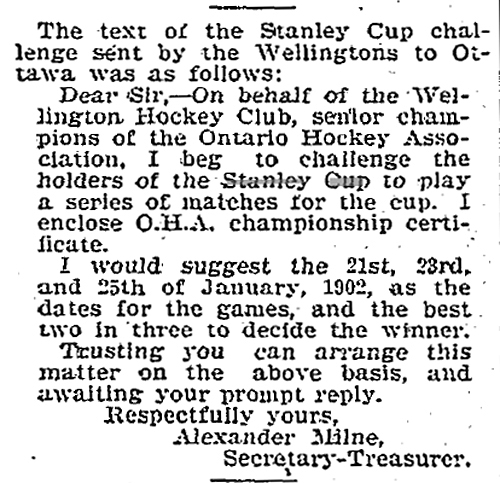
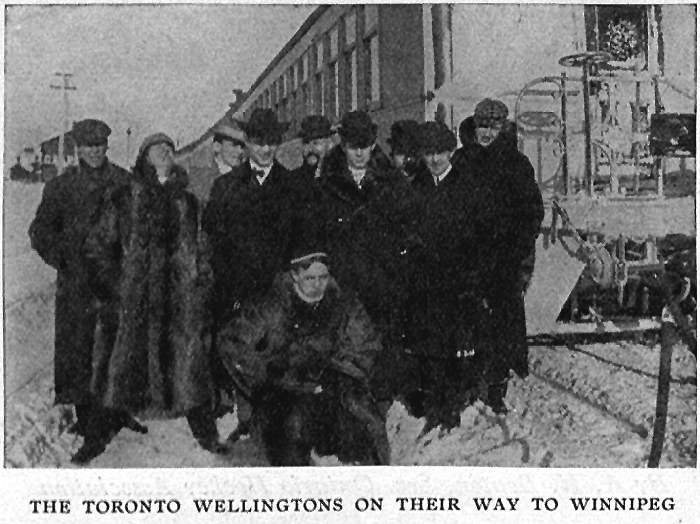
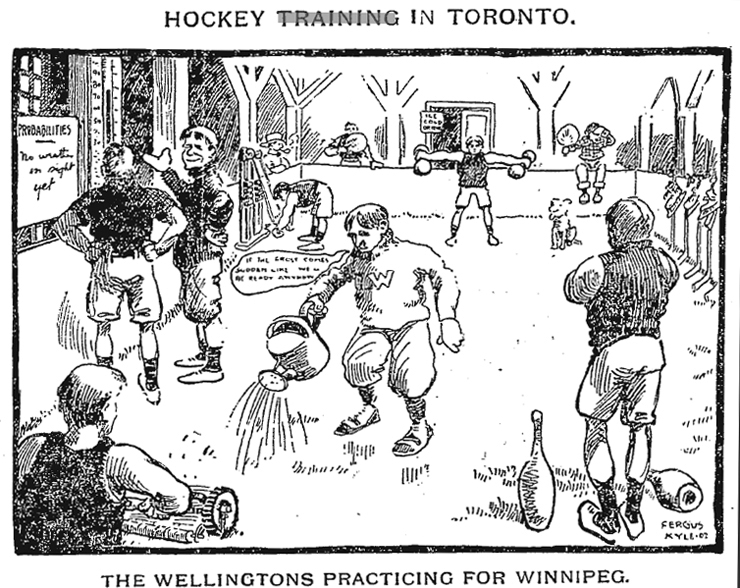
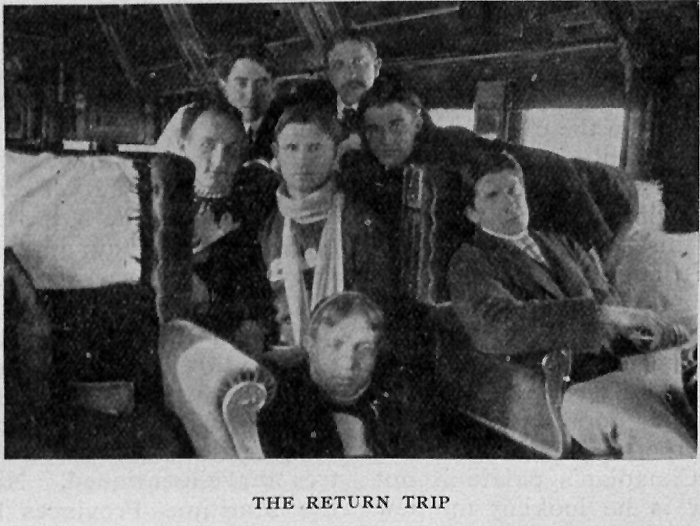
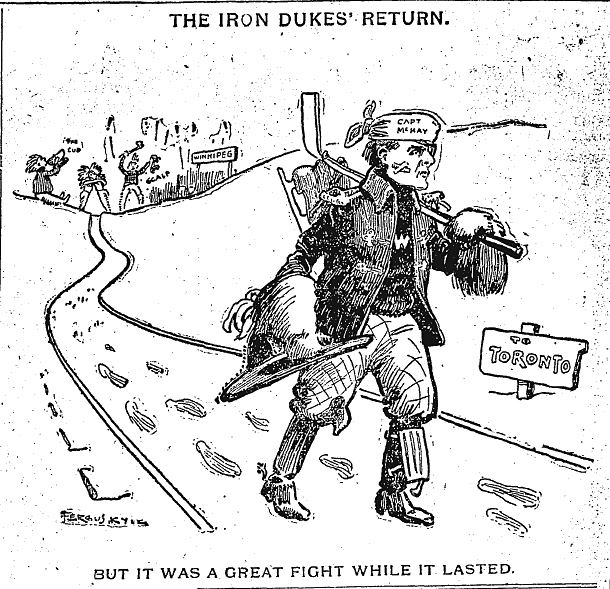
I hadn’t planned to write on this subject, but last week I came across the two old photographs shown below. (I already had the cartoons from years ago.) I found the pictures online in the March 1902 edition of The Canadian Magazine. I LOVE pictures like these, and the timing was perfect, so here we go…

On this very day, way back in 1902, the first team from Toronto to play for the Stanley Cup opened a best-of-three series in Winnipeg. The Wellington Hockey Club of Toronto (known as the Wellingtons, and often called the Iron Dukes after the first Duke of Wellington for whom they were named) had been formed around 1895 as a juvenile team for youngsters in the Jarvis Street area of downtown Toronto. Soon, they entered the Junior division Ontario Hockey Association and in 1896-97 the Wellingtons won the provincial championship. Moving up to Intermediate, and then to Senior, the Wellingtons won the OHA Senior title in 1900 and 1901. (They would also win it in 1902 and 1903 before withdrawing from hockey suddenly and surprisingly just prior to the 1903-04 season.) As champions of 1900-01, they sent word to the Stanley Cup trustees in Ottawa saying they wished to challenge the Winnipeg Victorias for the prized trophy at the start of the 1901-02 season.

Welly 1

In this era, the Stanley Cup was a challenge trophy. Because of the need for natural ice, the hockey season only stretched from late December to mid March. Train travel meant leagues had to be fairly local, so in order to make the Stanley Cup available to teams all across Canada, the senior champions of any recognized provincial association were able to challenge the current Cup champion. Games could take place before the season, after the season, and even right in the middle of a season.

Welly 3b

Hockey in Canada was considered strictly amateur at this time. The Ontario Hockey Association was the largest hockey league in the country and rigidly enforced the amateur code. The Wellingtons were fairly typical of Ontario hockey teams in that their players generally came from well-off families. Most of them worked in banks or for insurance companies. In fact, when the Winnipeg Victorias requested that the Stanley Cup series be played later in January, the Wellingtons objected because most of their players had to get back to Toronto in time to balance their books for the first of February!

The Wellingtons were considered huge underdogs in their series with the Victorias. Outside of Ottawa (whose top team played in the Canadian Amateur Hockey League, which was considered a Quebec circuit), hockey in Ontario was not believed to be on a par with the game as it was played in Quebec and Manitoba. Many senior hockey players across the country were from the same types of background as the Wellingtons, but the OHA seemed much more determined than other leagues to maintain a gentlemanly style of play, which, sadly, didn’t help from a competitive standpoint. Compounding the problem in Toronto, the city had no first-class arena, with even the main rink on Mutual Street having an undersized ice surface and small seating capacity. Nor did Toronto have the same cold weather as Ottawa, Montreal, Quebec City or Winnipeg. In fact, during January of 1902, the weather in Toronto was unusually warm which hurt the Wellingtons’ ability to practice and hampered the quality of the few games they got in before leaving for Winnipeg on January 18.

Welly 2

Even so, the Wellingtons surprised most critics by keeping the games close and playing pretty good hockey against the Victorias. Still, they lost the January 21 game 5-3 and dropped the second game by the same score two nights later, giving the Winnipeg team a sweep of the series. “We played as hard as we ever played in our lives,” said Wellingtons captain George McKay, “but the checking … was much harder than we were accustomed to. It was fierce.” The Victorias were also said to be faster skaters.

Welly 4b

Despite the loss, Toronto hockey fans were proud of the team’s showing in Winnipeg. The Wellingtons arrived back in the city at 9 pm on January 28. Even though their train was seven hours behind schedule, there was still a big crowd to greet them at Union Station. “Captain McKay has his left arm in a sling,” according to the Toronto Star report. “Chummy Hill’s bad eye is cut again, Frank McLaren walks with difficulty, and George Chadwick is completely done up. Irvine Ardagh, Dutchy Morrison, Worts Smart and Jimmy Worts, are all in good shape.” The Wellingtons were taken from the train station to Shea’s Theater and were given a great reception.

Welly 5

Going Down in History

An important date in NHL history passed last Friday without anyone I’m aware of noting it. Okay, admittedly, the 97th anniversary of anything is a clunky number to celebrate, but just three weeks after the league played its first games the NHL made a very significant rule change. Without this change, the Buffalo Sabres probably wouldn’t have been honoring Dominik Hasek last night by retiring his number…

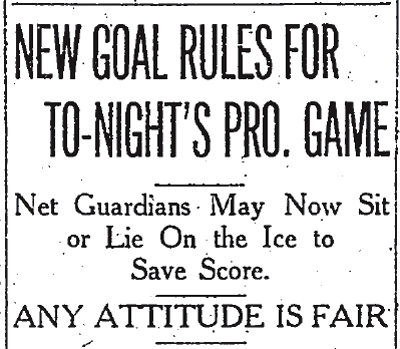
As the Toronto Star reported on January 9, 1918, “When Canadiens meet Torontos tonight in the NHL game at the Arena the hockey public may see Harry Holmes, the Toronto net guardian, standing on his left ear and nonchalantly booting high ones over into the corner, or Vezina, the French-Canadian wizard, sitting on the top of a goal post and batting them out like Larry Lajoie hammering out a two-sacker at the Island last summer. Anything but murder and an Ostermoor mattress goes in the nets in the pro league from now on.”

Goalie rule

Until that day, professional goalies in eastern Canada had been required to remain standing in front of their nets at all times. They faced a penalty if they flopped to the ice to make a save. On January 9, 1918, NHL president Frank Calder sent a telegram to referees Lou Marsh and Steve Vair prior to the Toronto-Montreal game advising them that, “Section 13 and that portion of section 9 dealing with the goalkeeper are hereby deleted, thus permitting the goalkeeper to adopt any attitude he pleases in stopping shots.”

Out west, in the Pacific Coast Hockey Association, brothers Frank and Lester Patrick had already dealt with this injustice. “A goalkeeper should be allowed to make any move he wants,” said Lester Patrick, “just like the rest of us. He should be allowed to make the most of his physical abilities.” In his biography of the Patricks, Eric Whitehead indicates that this rule change was made during the first PCHA season of 1911-12, but Craig Bowlsby (who has meticulous research to back it up) writes in his 2012 book Empire of Ice that the Patricks didn’t actually introduce the rule officially allowing a goalie to stop a shot any way he pleased, except by throwing his stick, until the 1916-17 season.

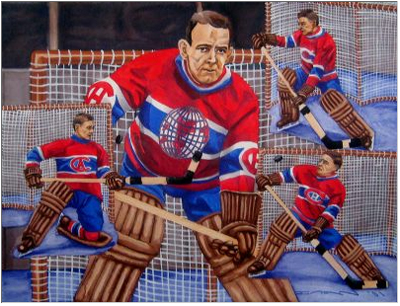
Benedict picture
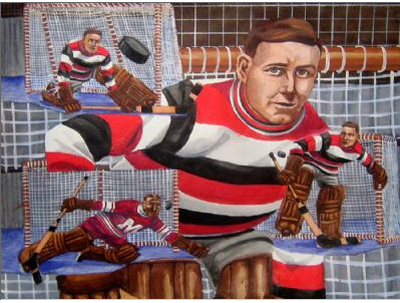
Paintings by Darrin Egan. Visit him on Facebook.

Clint Benedict, star goalie of the Ottawa Senators, who’d perfected the knack of “accidentally” falling to the ice to make a save, is usually credited as the inspiration behind the rule change in the NHL. However, in the Toronto Star on January 10, an unnamed columnist (perhaps Star sports editor William Hewitt, father of Foster) had a different opinion.

Montrealers certainly run this NHL to suit their own sweet selves. Yesterday they calmly announced a change in the playing rules allowing the goalkeeper to assume any attitude in goal to stop a shot, yet the first paragraph of the constitution says that the playing rules may only be amended at the annual meeting. Did somebody say National Hockey League? They should call it George Kennedy’s league [Kennedy owned the Canadiens] and be done with it. The French-Canadian mogul gets everything he wants from soup to nuts.

Vezina picture
Contact Darrin at: inthebluepaint@gmail.com

Georges Vezina, it’s been said, was never much of a flopper, but whoever it was that pushed for the rule change undoubtedly made the right call!

Sir John A.’s Son

It’s easy to be cynical about politicians and sports. After all, cheering for the home team is an easy way for them to try and show they’ve got the common touch. But some times, it’s for real.

Pierre Trudeau once joked that: “Canada is a country whose main exports are hockey players and cold fronts.” He was front and center at the opening of the 1972 Summit Series, and weighed in with his belief that Bobby Hull should have been on the team despite his jumping to the WHA. Trudeau may have been using the series for politcal gain, but Brian Mulroney could often be seen in seats just behind the Canadiens bench at the Montreal Forum long before he ever became Prime Minister. Well before that, Lester Pearson played hockey in England and Europe while he was a student at the University of Oxford in the 1920s. Later, he worked for the NHL Players Association in 1970.

In the acknowledgments to his book A Great Game, Stephen Harper writes that his love of hockey history developed as a way to compensate for the fact he wasn’t much of a player. If you ever get the chance to speak to him about hockey, you’ll find a very different man from the one you see on the news.

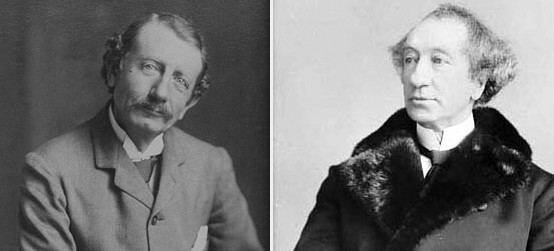
This coming weekend marks the 200th birthday of Canada’s first Prime Minister, Sir John A. MacDonald. Other than the fact that Lord Stanley of Preston began his term as Governor-General while MacDonald was Prime Minister, there aren’t many real connections between John A. and hockey … but his son, Hugh John MacDonald, had a fairly significant one.

MacDonalds

Hugh John MacDonald was born in 1850 but when his mother died in 1857 after many years of failing health, he was raised mainly by his father’s sister and her husband. Hugh John graduated from the University of Toronto in 1869, and was called to the bar as a lawyer in 1872. After the death of his first wife, he moved to Winnipeg in 1882, were he somewhat reluctantly entered politics. Hugh John was elected to the House of Commons in 1891 during his father’s last election campaign (John A. would die later that year) and later served as a cabinet minister under Sir Charles Tupper in 1896. He became leader of the Manitoba Conservative Party in 1897 and was briefly the Premier in 1899 before resigning to take on popular Liberal cabinet minister Clifford Sifton in the 1900 Federal Election. MacDonald lost, and returned to his law practice, though he remained active on the Manitoba and Winnipeg political scene.

By the mid 1890s, Hugh John MacDonald was a patron of the Winnipeg Victorias, the greatest hockey team in Western Canada. (He was also involved with cricket in Winnipeg.) When the Winnipeg Victorias defeated the Montreal Victorias to win the Stanley Cup for the first time on February 14, 1896, Hugh John was among the large group of Winnipeggers that met the team’s train to welcome them home ten days later. He took part in the very first Stanley Cup parade and made a short speech at a civic reception held at the Manitoba hotel. Afterwards, Hugh John was among those who filled the Stanley Cup with champagne and drank toasts from it.

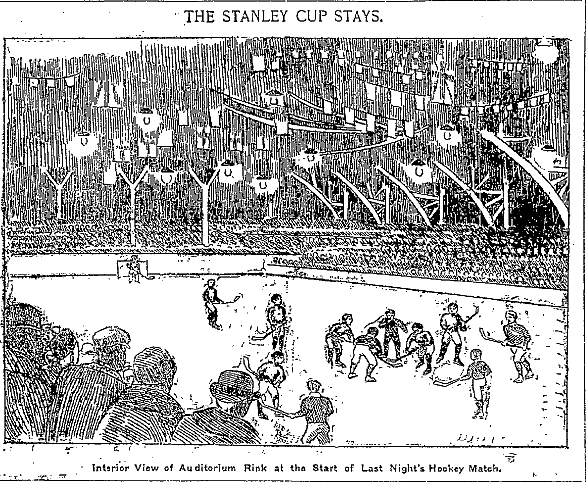
1902 Arena

In this early era of hockey history, the Stanley Cup was a challenge trophy, and the Victorias’ reign as champions proved short-lived. Before the next season even got under way, the Montreal Victorias travelled to Winnipeg for a rematch. The sudden death playoff on December 30, 1896, was a thriller, with the Montreal Vics scoring a late goal to defeat the Winnipeg Vics 6-5. At a dinner held for both teams after the game, the duty of officially congratulating the new champions and presenting the Stanley Cup to Montreal captain Mike Grant fell upon Hugh John MacDonald.

1896 lose

After a couple of unsuccessful attempts, the Winnipeg Victorias won the Stanley Cup again on January 31, 1901, when their captain and biggest star, Dan Bain, scored the first overtime goal in Stanley Cup history to cap a sweep of a best-of-three series with a 2-1 victory over the Montreal Shamrocks in game two. In the civic reception at the Claredon hotel upon the team’s return to Winnipeg on February 11, Hugh John MacDonald once again gave a speech. This excerpt from it is both typical of the time it was made, and a classic example of the hold hockey has had on Canadians for well over 100 years:

“As patron of the hockey club it is my duty to express to you my pleasure at your return from the east and to congratulate you on the victory you have won. The English language, copious as it is, is not sufficient so to enable me to express the warmth of the welcome we wish to extend to you. This may seem to you an exaggeration, but I can assure you that if you had been in Winnipeg and seen the intense eagerness with which every word [telegraphed live from rink side in Montreal] was seized upon – an interest so intense that it became painful at times, and if you had heard the shout of triumph when the news was flashed across the wire that the winning goal had been scored by our own Dan Bain, you would have realized to some extent at least that I am keeping quite within the mark when I speak of the warmth which the [citizens of Winnipeg] wish to extend you.

Hugh John MacDonald had one last chance to speak at a Stanley Cup victory banquet when the Winnipeg Victorias defeated the Toronto Wellingtons in January of 1902, but he appears to have been too busy with provincial government affairs to be on hand when the Victoria lost the Stanley Cup to the Montreal AAA that March.

Hometown Hockey in Owen Sound

I’ve been watching Ron MacLean on television for more than 25 years. A couple of years ago, I got in touch with him for a segment I was doing for my book The Big Book of Hockey for Kids. He was very friendly and extremely helpful, not to mention very complimentary of my past work!

When I found out in October that Owen Sound would be a host city for one of the Sunday night broadcasts of Hometown Hockey, I got in touch with Ron, and while it was already too late to produce a full segment for the broadcast, I have stayed in contact and he and producer Travis Formosa invited me to come on the air for a very quick discussion of the 1924 Memorial Cup champion Owen Sound Greys, which took place during the second-period intermission of last night’s game.

EZ on TV
(Thank you to James Milks for the photograph.)

I had never actually met Ron in person until last night, and I must say that he could not have been nicer. As I said to him (and I hope this doesn’t embarrass him), it’s always a treat when the people you admire turn out to be even nicer in “real life” than you imagined they would be.

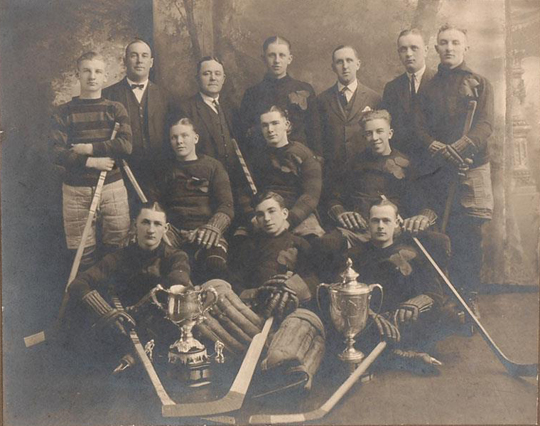
The story I had originally pitched to Ron was about the fact that so many of the 1924 Greys had actually grown up in Owen Sound. Three of them (future NHLers Butch Keeling and Teddy Graham, plus star goalie Hedley Smith, who was just 16 years old in 1924) grew up within a few blocks of each other on the same street. All three attended the Victoria School (which was also on the same street), and were all coached by Henry Kelso (for whom Kelso beach in Owen Sound is named … and who also lived on the same street!).

Greys 1924
(Butch Keeling is in the center of the back row; Teddy Graham is seated to the left in the middle; Hedley Smith has the pads on in front; Cooney Weiland is to Smith’s left as you look at the photo.)

But watching the broadcast before I arrived at the “truck” it was obvious that the story we had to tell was just how ravenously the fans of Owen Sound had supported the Greys back in 1924. Huge crowds turned out in the streets during the playoffs to get the scores of the game by telegraph outside the local newspaper office, and a crowd of 8,000 (in a town of 12,000) turned out to greet the team in a parade from the CNR train station a few blocks to the Market Square. The old newspaper reports are quite remarkable.

Those who saw the broadcast last night know that I had to talk pretty fast to get the story in! So, here are some things I did not get to discuss:

– The Greys were 22-2-2 during the 1923-24 season.
– one of their losses and both of their ties came in the second game of total-goal series when they already had big leads after the first game.
– The Greys were the only team in their division in the 64-team OHA junior circuit in 1923-24, and played exhibition games against other OHA teams all season before embarking on the regional playoffs.
Ralph “Cooney” Weiland was one of the few non-locals on the team, coming to Owen Sound in 1922 to attend school. He led the team with 68 goals in 25 games!
– Butch Keeling had 62 goals in 26 games.
-The Greys outscored their opponents 204-69 during the season.
– They defeated the Calgary Canadians to win the Memorial Cup in a two-game series played in Winnipeg, winning the first 5-3 and tying the second 2-2 to take the series 7-5.
– Hedley Smith faced 49 shots in the second game, stopping all 24 he faced in the third period alone to preserve the victory. (I mentioned that last night, but it’s worth repeating!)

The First Game on Christmas

The NHL hasn’t scheduled a game on Christmas day since 1971. The last games played on Christmas eve were in 1972. Since then, there’s always been a break from December 23 through December 25. In recent years, teams have had the 26th off as well. But before 1971 and 1972, playing on Christmas was a regular part of the NHL schedule, almost from the very beginning.

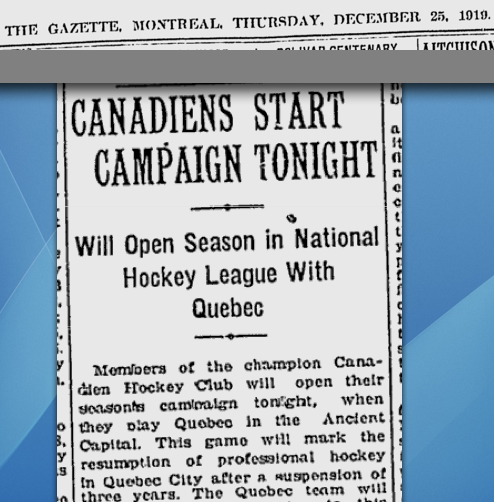
In the earliest days of the NHL, the season didn’t start until the latter part of December. The league’s third season of 1919–20 kicked off on December 23, 1919, with Toronto losing 3-0 in Ottawa. Two nights later, Montreal played its opener in Quebec City in the league’s first game to be played on Christmas.

Xmas 1919 1

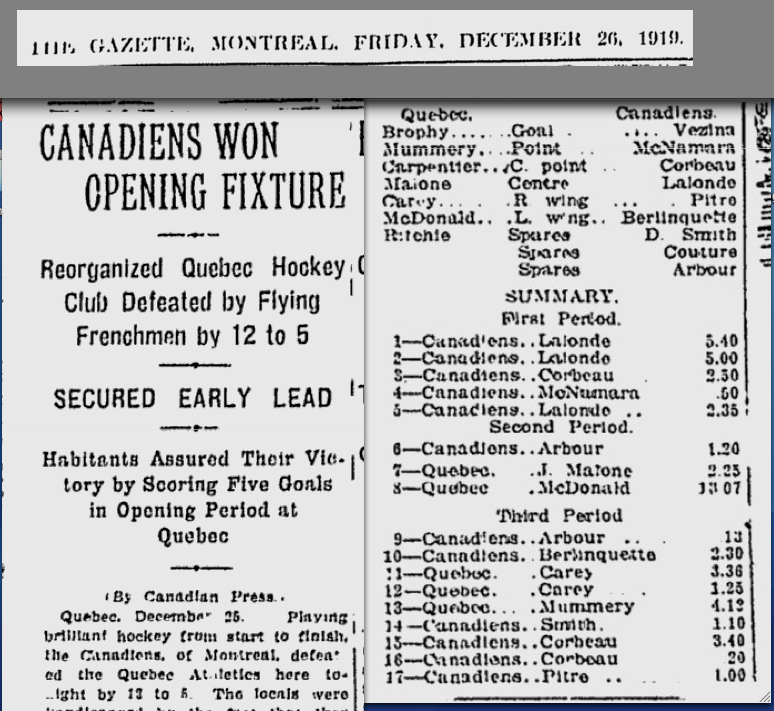
The Canadiens held a practice on the evening of December 24 and caught a morning train to Quebec City early on the 25th. (Happy Holidays!) Apparently not in a giving mood, Montreal jumped out to a 5–0 lead after one period paced by three goals from star center Newsy Lalonde. The Canadiens upped their lead to 6–0 early in the second, and after letting Quebec close the gap to 8–5 midway through the third, added four late goals for a 12–5 victory. Georges Vezina got the win.

Xmas 1919 2

This was Quebec’s first game in the NHL after the club had withdrawn from the league two years earlier during the meeting that formed the NHL back on November 26, 1917. The lopsided loss on Christmas day set the stage for a season that would see the team win just four of 24 games and withdraw once again.

Of added note to hockey historians, the Montreal Gazette in describing the Christmas day game refers to Quebec as the Athletics, not the Bulldogs as the team was known throughout its days in the National Hockey Association. It seems pretty clear that the Quebec Athletic Club operated the hockey team during its lone season in the NHL (as opposed to the old Quebec Hockey Club), but the name Bulldogs can certainly be found in plenty of references throughout the 1919-20 season, plus the team wore the same colors as the Bulldogs, was run by the same people, and employed many of the same old players.

Gordie Who?

The latest news over the weekend about Gordie Howe is encouraging as he battles back from a stroke. So encouraging, in fact, that his family is hoping he’ll be healthy enough to attend an event with Wayne Gretzky in Saskatoon in February.

A lot has already been, and will continue to be, written and said about Howe, but here’s a story you may not know. The history of hockey – certainly the history of hockey in Detroit – would have been very different if this story had come to pass.

Some of you are already thinking that this is going to be the story of how Howe could have been with the New York Rangers. And yes, he attended a tryout camp with the Rangers as a 15-year-old in 1943. But this is the story of how Gordie Howe might have ended up with the Boston Bruins.

Howe Trade

According to Harold Kaese, writing in the Boston Globe on December 27, 1956, Art Ross tried to get Jack Adams to throw in Howe to sweeten a deal the two were working on in the summer of 1946. If Kaese was recalling all this correctly – which is certainly up for debate! – Howe would have just completed his one and only minor league season with the Omaha Knights of the USHL.

Art Ross was trying to make a deal with the Detroit Red Wings some 10 years ago. Like a good trader, he was hoping to get the edge over Jack Adams. And like a good kidder, he was determined to get a rise out of the irritable Adams even though he did not get the edge.

“I think you ought to throw in a little extra, just to make it more even,” suggested Ross.

“Yeah? What extra?” snapped Adams.

“Well, how about that big dumb kid you have for right wing?” asked Ross. “I can’t remember his name. Powell. Howell. Something like that.”

“Not Howell. Howe!” shouted Adams. “Why you–you–you…”

Kaese writes that when the trade was made, “Detroit, I think, got Roy Conacher. The Bruins got Joe Carveth.[NOTE: that trade certainly did take place during the summer of 1946] But they did not get Gordon Howe.”

Wishing all the best to Mr. Hockey … and to everyone during this Holiday season.

Blue Lines

A couple of years ago, we received a copy of an old letter in the offices of the NHL Official Guide & Record Book. It was a letter that referee Lou Marsh wrote to league president Frank Calder detailing events of a game played in Ottawa on February 1, 1922. (Some of you reading this will have seen that letter, and no doubt remember it!)

Sprague&Odie

Sprague Cleghorn (on the right) and his brother Odie (left) – but particularly Sprague – were talented but dirty players. They seemed to go out of their way to injure Ottawa players that night. (Sprague was a former Senators star playing in his first season with the Montreal Canadiens.) Marsh wrote of the injuries they inflicted, but also of the profane language Sprague used.

It’s sometimes difficult to think of people we only know from black and white photos, and from the literature of the times, ever uttering swear words. When HBO airs a program like Boardwalk Empire it’s easy to think the sex, violence, and swearing is exaggerated to appeal to modern audiences. But no.

Cleghorn Headline

Since children may read this, I’ll only hint at the worst language Marsh describes in his letter. About the tamest thing he says Cleghorn called him is, “a goddamn robber.” He also accused Marsh’s mother of being a female dog, and – most surprisingly! – there was repeated usage of the word that fans of the movie Bull Durham will recall got Kevin Costner’s Crash Davis character ejected from a game. (That was definitely not a word I’d have expected to hear in 1922!)

I don’t have a copy of the letter with me, so I might have the details of this part slightly wrong, but I believe Marsh noted that all of this foul language was used in close proximity to women in the crowd that night, and to a box where the Governor-General and a party from Rideau Hall were seated.

Hockey profanity

Just the other day, I came across this story of an Ottawa priest condemning so much use of profanity in public places. Interestingly, it appeared in the Ottawa Journal on January 16, 1922, a short time before Cleghorn’s spree. In addition to what you can see here, Father Fitzgerald went on to declare that:

Profanity was particularly noticeable at hockey matches, among players as well as spectators. Players who could not take part in games without swearing should withdraw from sport.

So it would seem that Sprague Cleghorn likely wasn’t alone with his blue lines on the ice.