All posts by Eric Zweig

Blue Jays & Babe Ruth

I attended the Blue Jays’ home opener on Monday, running my streak to 39-for-39 in franchise history. (Even when they were rained out in 1980, I skipped my last class to attend the 4 pm first game two days later.) Of all the books I’ve worked on, my favorite would be when we did the Toronto Blue Jays Official 25th Anniversary Commemorative Book at Dan Diamond & Associates. It’s hard to believe it was so long ago.

Our book came out about the same time that HBO released 61*, which was directed by Billy Crystal. He talked a lot about what a thrill it was for him to tell this story of his childhood heroes. Well, Billy Crystal got to worship Mickey Mantle, and Roger Maris, and Whitey Ford when he was a kid … but I’ve been watching for the ENTIRE HISTORY of the team I cheer for. Still, for this story, I’m borrowing from Billy’s team … though from a lot earlier than he remembers.

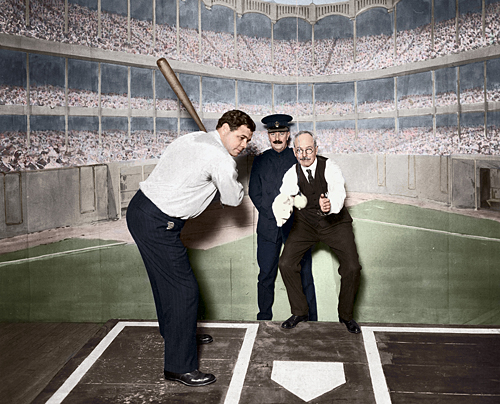
Recently, I came across Mark Truelove’s web site candiancolour.ca which displays digitally colourized historical Canadian photographs. It’s AMAZING. My only criticism is there aren’t enough pictures! (I imagine that’s because it takes time for him to do them so well.) The picture below is one of two on Mark’s site featuring Babe Ruth, and it got me wondering what he was doing on stage at the Pantages Theater in Vancouver on November 29, 1926.

Babe Pantages
On stage with Babe Ruth in Vancouver is mayor L.D. Taylor as catcher and
Chief of Police Long as umpire. For a larger image, see Mark’s web site.
For another original shot of Ruth on stage, see the Vancouver Archives
.

Babe Ruth had had a terrible season by his standards in 1925. That was the year of “The Bellyache Heard ’Round the World” when he arrived at spring training horribly overweight and eventually spent several weeks in hospital with a stomach ailment that has never really been explained. Back in shape for 1926, Ruth rebounded to hit .372 with 47 homers and 146 RBIs.

The Yankees won the American League pennant in 1926, but Ruth made the final out in game seven of the World Series against St. Louis when he was caught trying to steal second base. At the time, this actually seemed to increase his popularity! (Ruth also hit four home runs in the series, including three in game four alone, when he may or may not have promised to hit one for hospitalized 11-year-old Johnny Sylvester, which didn’t hurt his popularity either!) After the series, Ruth went on a short barnstorming baseball tour before hitting the western vaudeville circuit.

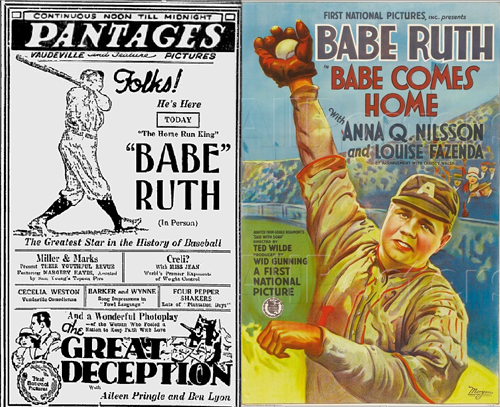
On August 31, 1926, Ruth had signed a $100,000 contract with Alexander Pantages. Others had been bidding for his services too, but Pantages, via a long-distance telephone call from Los Angeles, blew them all away with the largest offer in the history of vaudeville. It was generally reported, then and now, that the deal was for 12 weeks, though some stories that fall claimed it was a 15-week tour. Either way, it was a ton of money for a player who’d just earned $52,500 for the six-month baseball season. (Ruth would hold out for $100,000 a year for two years prior to the 1927 campaign, and eventually signed for $70,000.)

Medicine Hat

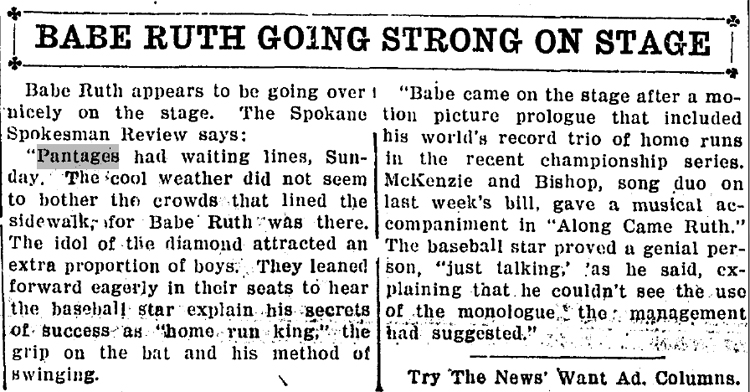
Ruth’s Pantages tour opened in Minneapolis on October 30, 1926 and made its way west, winding up in California in February of 1927. He seems to have spent several days in most of the cities he visited. Basically, Ruth went on stage, recited a somewhat fictionalized story of his life, talked baseball, demonstrated his swing, and invited boys up with him for autographs. Bill Oram, writing in The Salt Lake City Tribune on July 11, 2011, quotes some of Ruth’s patter from his visit to the Utah capital in late January:

“Mr. Dunn made a pitcher out of me,” Babe Ruth relayed to his hungry audience. He was baseball’s best left-hander early in his career, and that started with the minor-league Baltimore Orioles under the watchful eye of manager Jack Dunn.

“Then he traded me the same day to another club for a batboy,” he embellished. “I was feeling pretty bad in the clubhouse that day when I thought it over. But I figured I could do Mr. Dunn a favor. I went to him and told him the ceiling was leaking in his clubhouse.”

The audience sat rapt.

Ruth paused for the punchline to his tale. “[Dunn] said, ‘You darn boob, that ain’t a leak. That’s the shower bath!’”

In an era when most people could only expect to see him in newsreels, Ruth charmed the crowds everywhere he went. In Vancouver, he had lunch with orphans at a Children’s Aid Society home and visited a disabled boy in hospital. This seems typical of most of his stops, and in some cities he even wrote a column (or, likely had it ghost-written) in local newspapers. Not everyone was enamored of his stage performance, however. Yankee biographers Jonathan Eig and Harvey Frommer both quote Ruth’s teammate Mark Koenig as calling his set, “boring as hell.” Sixteen-year-old Doris Bailey of Portland, Oregon (whose “Doris Diaries” have been published and appear online) thought Ruth was “not so much to rave about. Terribly conceited.”

Babe Posters

Towards the end of the tour, Ruth was arrested in San Diego on January 23 because it was said that by calling up boys on stage with him so that he could sign autographs he had violated California’s Child Labor Laws! Regardless, kids stormed the stage in Long Beach the following night, and Ruth was later acquitted of the charges.

Before leaving California, Ruth lingered a little longer to film the movie Babe Comes Home, in which he plays a ballplayer whose love of a woman is threatened by his addiction to chewing tobacco. Soon after filming, Ruth signed his new contract with the Yankees, and though he got off to a slow start in 1927, he went on to hit .356 with 60 home runs and 164 RBIs (Lou Gehrig hit .373 / 47 / 175 and was named MVP) as the “Murders Row” team went 110-44 en route to winning the World Series.

Shore vs. Orr

As many of you reading this are already aware, I have a biography called Art Ross: The Hockey Legend who Built the Bruins due out this fall with Dundurn. Several stories that have appeared on my web site already have been the result of items I came across while researching Art Ross. More will be coming in the months leading up to the release in September, but this is the first real “commercial” for the book.

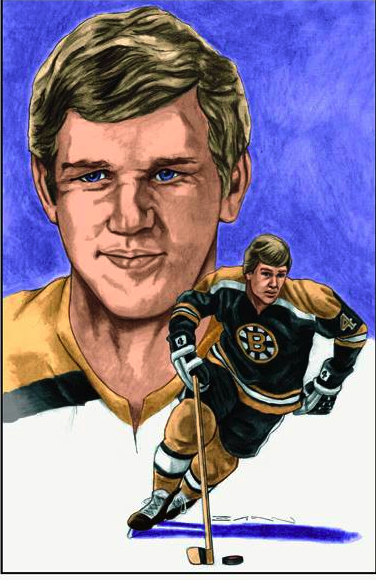
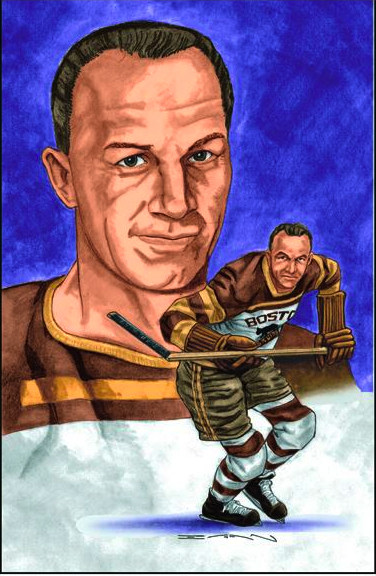
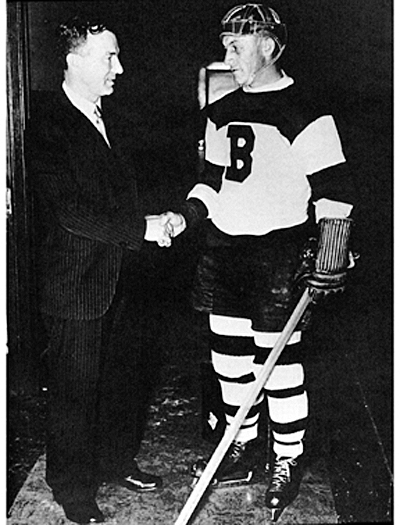
In March of 1970, Eddie Shore was in New York to receive the Lester Patrick Trophy for his contributions to hockey in the United States. He was presented with the award at Toots Shor’s Restaurant on the evening of March 9, 1970, but had held court with reporters at the Madison Square Garden press lounge during the afternoon. Shore was asked about the current star of the Bruins defense, Bobby Orr.

Orr painting
Paintings by Darrin Egan. Visit him on Facebook.

I haven’t had that much chance to see Orr play,” Shore admitted. “But when I first watched him as a junior, I said he would be outstanding. He’s obviously a fine skater but I think the best thing about him is his ability to adjust his own speed to anticipate the speed of the players whom he is giving a pass.

Those present wondered how Orr would have fared in Shore’s era, and somebody wondered if Shore had ever thought that a defenseman might win the NHL scoring title, as Orr was en route to doing.

Yes, I believe one might have,” Shore said with a sly grin. “But maybe I shouldn’t really be specific.” Tom Fitzgerald, writing in the Boston Globe, noted that it didn’t take much urging for Shore to elaborate.

Shore painting
Contact Darrin at: inthebluepaint@gmail.com

Sure, I think I might have done it myself at least one year, but it would have cost me money. You see, when I carried the puck in, if I shot instead of passing, Art Ross had a standing fine of $500. It would have been too expensive.

Ross had been dead for nearly six years at this time, so he wasn’t there to comment. Still, he’d told a very different type of story to Lester Patrick’s sons, Lynn and Muzz, back in 1958, which was reported by Dave Anderson, then of the New York Journal-American:

When Leo Dandurand owned the Canadiens,” Ross explained, “he was in Chicago one night and we were there. So I invited him to sit down on the bench with me. After a while, I said to him: ‘Leo, would you like to see Shore score a goal?’ And he said: ‘What?’ So I asked him again. ‘Do you want to see Shore score a goal? I’ve got a signal.’ Without waiting for him to answer, I caught Shore’s eye and gave him the signal.

Ross pointed his right forefinger, then rotated it clockwise; all the time holding his hand near his hip so as not to be conspicuous. Then he continued:

“Shore got the puck, took off, and wham! Goal! So Dandurand looked at me and said: ‘Can you do that anytime you want?’ ‘Sure,’ I told him, ‘and not only that, he’ll keep doing it until I tell him to stop.’ So, I caught Eddie’s eye again and give him a wave. That was the signal to stop. I didn’t want to overdo a good thing.

AHR & Shore
Photo courtesy of Art Ross III

Could either Shore’s or Ross’s tale be true? It’s difficult to say. Sportswriters for a long time rarely let the facts get in the way of a good story, and there’s little reason to believe the subjects of those yarns were any better!

Canucks Go For Pucks at Gonzaga

During the late 1980s, when I was at my most interested in NCAA basketball, I had a fondness for Gonzaga University. Partly that was because Gonzaga grad John Stockton was starring alongside Karl Malone with the NBA’s Utah Jazz, whom I also liked at the time. Admittedly, though, a big part of it was that I just liked to say, “Gonzaga!”

A couple of years ago, Canadian star Kelly Olynyk (now with the Boston Celtics) led Gonzaga to the top seed in the West Region at the NCAA tournament. Sadly, after a 31-2 regular season, the Zags (their actual nickname is the Bulldogs) went out in the second round. This year, with Canadians Kevin Pangos and Kyle Wiltjer, Gonzaga was 32-2 and were seeded second in the South. The Zags reached the “Elite Eight” for just the second time in school history, but were eliminated this past weekend by top-ranked Duke in the South Region Final and so failed to reach this weekend’s Final Four.

More than 75 years ago, Gonzaga used a Canadian connection to briefly become a West Coast hockey power. Coach and promoter Denny Edge ran Gonzaga’s hockey team. He was born in England, but raised in Regina, where he played junior hockey from 1918 to 1922, helping the Regina Pats reach the finals of the 1922 Memorial Cup. Edge played pro hockey in Los Angeles in 1926-27 and then managed the rink in Portland, Oregon until 1936 before moving to Spokane, Washington, to coach at Gonzaga.

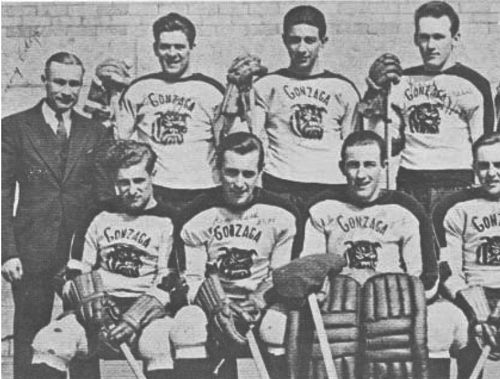
Gonzaga
Denny Edge wears the suit, Frank McCool wears the pads,
and Jerry Pettigrew stands on the right.

Edge tapped his home province of Saskatchewan for hockey players to take to Gonzaga – particularly the town of North Battleford. Future NHL goalie and executive Emile Francis was a young boy in North Battleford at the time and remembers the exodus of local talent. Jerry Pettigrew had led the North Battleford Beavers to the Allan Cup (Canadian amateur championship) Finals against Sudbury in the spring of 1937 before being recruited to Gonzaga that fall. Several other local boys made the trip with him and Gonzaga won the West Coast Amateur Hockey title in 1937–38. In their final game of the season they defeated the Big Ten champion University of Minnesota 5-1.

Edge added goalie Frank McCool of Calgary to the Gonzaga roster in 1938-39. McCool, later known as “Ulcers,” would famously win the Calder Trophy and the Stanley Cup with the Toronto Maple Leafs as an NHL rookie in 1944–45 while guzzling milk between periods to calm his roiling stomach. In his first of two seasons at Gonzaga, McCool led the team to the Pacific Northwest Amateur championship, a second straight West Coast Amateur title, and the Pacific Coast Collegiate championship.

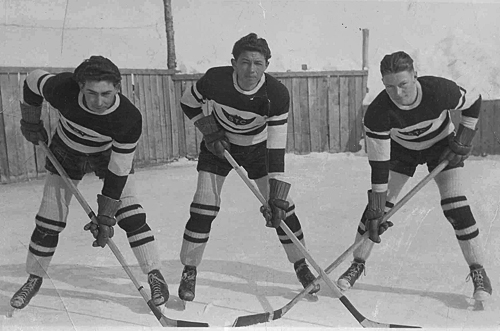
James “Stocky” Edwards of Battleford, Saskatchewan isn’t a name most hockey fans will know. He was one of Canada’s leading air aces of World War II, but before that, Edwards played hockey at St. Thomas College, a Catholic high school in Battleford. He was small, but determined and very competitive. Barbara and I have visited with Stocky and his wife Toni several times before and after she wrote The Desert Hawk. He and I have talked hockey a bit, and I also had the chance to speak with Emile Francis about him.

Stocky
Jim Edwards is on the right with brothers Paul (center) and Edd Ballandine.

It had been decades since Francis faced Stocky (or had even seen him) when Stocky was finishing up at St. Thomas and Francis was a freshman at North Battleford Collegiate. Still, he remembered him as an excellent shooter who would cut hard for the net from the right wing. “He didn’t take the ‘overland route,’” said Francis, who added that the first time he played against Howie Meeker of the Toronto Maple Leafs he thought, “This guy reminds me of Jimmy Edwards.”

Edwards was good enough that Johnny Gottselig of the Chicago Blackhawks arranged for him to have a tryout with the team. He also attracted the interest of Denny Edge, who recruited him for Gonzaga. Excited as he was by the NHL attention, Edwards planned to further his education at the Spokane University … but decided to join the RCAF instead. Edwards went on to a career in the Air Force, while Denny Edge’s powerhouse hockey program at Gonzaga University became a forgotten casualty of the Second World War.

Net Results…

Are bigger nets the answer to more scoring in the NHL?

The debate has come up from time to time since the end of the lockout that wiped out the entire 2004-05 season. Goalies these days are bigger than ever, and the NHL has made an effort to reduce the size of the equipment they use. Still, there seems to be little appetite for increasing the size of the nets from the 6-feet-by-4-feet they’ve always been since netting was first draped over metal posts in 1899. Tradition is often given as a reason in the arguments against enlarging the nets, but surprisingly, such talk dates back a lot further than people probably think.

Early Net

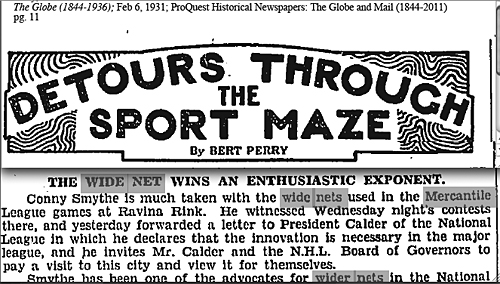
With scoring in the NHL down considerably in 1926-27, sports editor Frederick Wilson of The Globe in Toronto noted in his column on February 21, 1927, a suggestion made in New York to widen the nets to seven feet. Nothing come of it, and scoring continued to drop, reaching an all-time low in 1928-29. Only 2.8 goals per game were scored on average that season by both teams combined, meaning the typical score was 2-1 in overtime. This is the year that George Hainsworth set records with 22 shutouts during the 44-game schedule and an average of 0.92. Every one of the NHL’s 10 starting goaltender had an average of 1.85 or better, and eight of them had at least 10 shutouts. More modern passing and offside rules were introduced in 1929-30, and offense jumped to over six goals per game. However, scoring dropped dramatically again in 1930-31, although it wasn’t nearly as low as it had been at its worst.

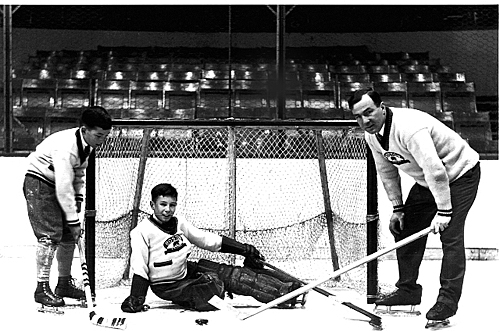
Even so, the Mercantile League in Toronto (which played out of the Ravina Rink, near Keele and Annette) was given permission by the Ontario Hockey Association and the Canadian Amateur Hockey Association to experiment with nets that measured 7½ feet wide from January 28, 1931, until the end of its regular-season schedule in March. The new nets resulted in a few games with scores as wild as 10-5, but most were still 3-1 and 2-0.

Smythe Nets

Maple Leafs boss Conn Smythe loved the wide nets. He wrote letters to NHL president Frank Calder and his fellow governors inviting them to Toronto to see for themselves. Smythe, Calder and Leo Dandurand attended a Mercantile league doubleheader on February 18, but Mike Rodden, writing in The Globe the next day, noted that the teams “proceeded to give their worst displays of the season.” (The games were 3-3 and 3-1, Rodden worked both as referee, and elsewhere in The Globe it was noted that they were marked by “exceptional goalkeeping.”) Calder and Dandurand were unimpressed, though the NHL president noted that the nets didn’t strike him as alarmingly wide.

Given the animosity between them, it’s entirely possible that Conn Smythe supported the wider nets simply because Art Ross had designed the ones the NHL had been using since 1927-28. (The Art Ross net would be used without change through the 1983–84 season, and all the new nets used since then are still just a variation of his original design.) The 6-by-4 size had been well established long before then, but Ross still became the go-to guy whenever talk of the nets came up. It’s unlikely he saw any of the wide-net games in Toronto in 1931, but he did give his thoughts on the experiment to Boston Traveler hockey editor Ralph Clifford. “Adhere to the rules,” Ross said. “Have them strictly enforced … and you will have a game that is wide open enough to satisfy the most exacting fan.”

AHR Net
Art Ross with sons Arthur (the goalie) and John. Courtesy of Art Ross III.

People don’t think of the heyday of Gordie Howe and Maurice Richard as a low-scoring era, but the 1952-53 season saw only 4.8 goals scored per game. Once again, people wondered about widening the nets. “Somebody brings that up every time the defense gets ahead of the offense for a while as it is right now,” Tom Fitzgerald quoted Ross as saying in the Boston Globe on November 28, 1953. “We’ve gone through a lot of different phases like this, and certainly the hockey has been interesting this season, even if fewer goals are being scored… Increasing the width of the nets a little wouldn’t boost scoring to any great extent.”

Speaking about scoring again a few days later, Ross said: “It’s pretty simple. The more you keep shooting at the net, the more chances you have to score. There are a lot of factors that are going to help if you pour enough shots at a goalie – deflections, funny bounces and the like. If you just keep shooting away the percentages will work out for you.”

But chances are, Art Ross never envisioned a game where players blocked shots like they do today, or one where goalies were so large, agile and well padded. He’d been involved with the game at its highest levels since 1905 as a star player and then an executive, but Ross never seemed to be bound by tradition. It would be interesting to see where he’d stand on enlarging the nets if he were alive today.

Would 4-on-4 Mean More Goals Get Scored?

With a little more than three weeks to go in the NHL season, the race for the Art Ross Trophy is incredibly tight. And yet there doesn’t seem to be much buzz about it. Perhaps that’s because whether the winner is John Tavares, Alex Ovechkin, Sidney Crosby, or one of the others in the bunch, he’s likely to end up with no more than 86 points. If so, that’ll be the lowest total in a non-strike season since Gordie Howe led the league with 86 points in 1962-63. But, of course, the NHL season was just 70 games long then.

Tavares

Howe’s points-per-game average of 1.2285 in 1962-63 works out to about 101 points in an 82 game season, whereas 86 points in 82 games translates to only 73 points in a 70-game schedule. Nobody has led the NHL with fewer than 73 points since Max Bentley led the way with 72 in 1946-47. But the season was just 60 games long at that time, so even Bentley’s total would work out 84 points in a 70-game season, or 98 points in 82 games.

Given that no one has led the NHL with less than a-point-per game total since Toe Blake topped the league with 47 points in a 48-game season back in 1938-39, (comparable to 80 points in an 82-game schedule), we’re looking at a fairly historic lack of scoring in the NHL this season.

David Feschuk, writing in the Toronto Star on March 13, noted that the decline in scoring can be traced directly to power-play offense, with man-advantage chances at the lowest level in 50 years. Feschuk quotes St. Louis Blues coach Ken Hitchcock and Nashville Predators’ GM David Poile as saying that everyone seems to be on board these days with what is and what isn’t a penalty and that coaches are happy with the way games are being called.

Hockey Cards 1

Yet Feschuk also quotes former referee Kerry Fraser as saying that the current, younger, referees have been insufficiently trained, and that they’re calling minors instead of majors, or sometimes nothing at all, because they’d rather let plays go knowing that anything they missed will be flagged for additional suspensions, if warranted, by the NHL’s video review. Fewer power-plays means fewer power-play goals, and, even worse, calling fewer penalties makes it that much easier to clog things up for the skilled players. The game may be faster than ever before, but that doesn’t mean much if there’s no room to move and no time to think.

Of course, there’s also the argument that scoring – briefly on the rise after the “Dead Puck Era” by the tweaks to the rules introduced in 2005–06 after the season-long lockout ended – is once again on the decline because goalies today are better than they’ve ever been. They may well be. They’re certainly better-trained than they’ve ever been and physically larger too (even if their oversized equipment has been reined in somewhat).

Hockey Cards

So, if scoring chances have more-or-less remained the same, but goalies (based on their save percentages) are stopping more shots, then what’s the answer? People aren’t saying it as much as they were a few years ago, but is it larger nets? (We’ll look at that next week.) But if there really isn’t enough time and space on the ice, then maybe the answer is fewer players.

Talks are moving forward on some form of 3-on-3 overtime to break more ties before going to a shootout, but there’s little if any talk these days of going to 4-on-4 in regulation time. I’m not saying that 4-on-4 is the answer (and you’ve got to wonder how much the NHL Players Association would support it), but there did used to be a rover in the early days of hockey and the decision to eliminate that extra position (which was first made in 1911-12) worked out pretty well! Not everybody was on board with that in the beginning either. I think it was future Hall of Famer Marty Walsh of the old Ottawa Senators who said that playing hockey without a rover was like playing baseball without a shortstop.

Newsy clip

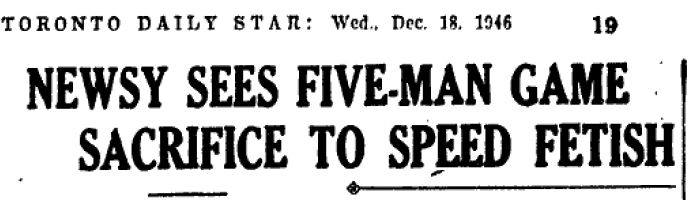
Yet as early as 1946, another early era Hall of Famer, Newsy Lalonde (who survived and thrived after the change from 6-on-6 skaters to 5-on-5) already believed that the best way to allow speed and skill to flourish in the coming years would be to eventually reduce the game to just four skaters and a goalie per side. Future Hall of Famers Ebbie Goodfellow, Joe Primeau and Charlie Conacher shared Newsy’s view, as did Hooly Smith. “There’s no more stickhandling,” Smith complained, “and 90 percent of the goals are scored by passouts from behind the net or from scrambles in front of the goal.”

That’s a complaint that’s pretty familiar!

About Face

A month ago, I entitled my story about early hockey radio broadcasts, Hockey Nerd – Part II. This could easily be Part III, but I’ve decided I’m going to try not to refer to myself that way any longer. It was my friend and colleague Roger Godin who set me straight. In my recent story reviewing the film Red Army and discussing the Winnipeg Falcons heritage moment, I referred to my criticism of the Falcons jersey color as being “pretty nerdy.” Roger left a comment, saying: “Let’s rid ourselves of that description ‘nerd.’ Those of us in this business just want to get things right and frequently find ourselves up against a wall of indifference…”

Often times, the problem isn’t the indifference of others but the mountains of misinformation already out there. For example, if you ask people, “who was the first goalie to wear a mask?” most of those who’ll offer an answer will say, “Jacques Plante.” Plante was my first favorite hockey player when I was a boy and he was starring with the Maple Leafs. He had certainly popularized the use of goalie masks, but he wasn’t the first to wear one … even in an NHL game.

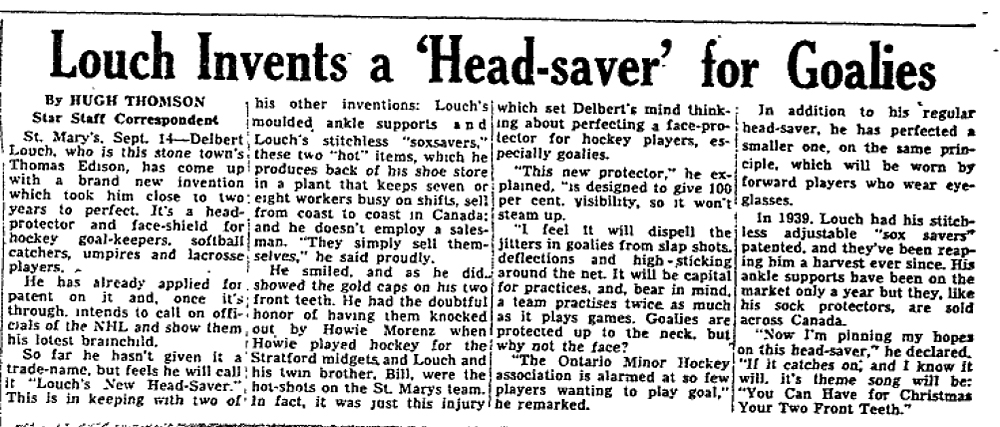
Before he wore one in game action for the first time on November 1, 1959, Plante had been one of many goalies (most of the others at the amateur level) experimenting with masks in the late 1950s. In September of 1957, Delbert Louch of St. Mary’s, Ontario, unveiled a “head-protector and face-shield” that caught on with many NHL goalies for practice, but proved impractical for games.

Louch mask

Long before then, a handful of goalies wore wire masks (like baseball catcher’s masks) in international competition in the 1930s, and many people know that Clint Benedict wore a mask with the Montreal Maroons in February and March of 1930 during his final season in the NHL. Benedict’s was a leather face shield he wore after being sidelined for several weeks following a couple of shots to the face that January.

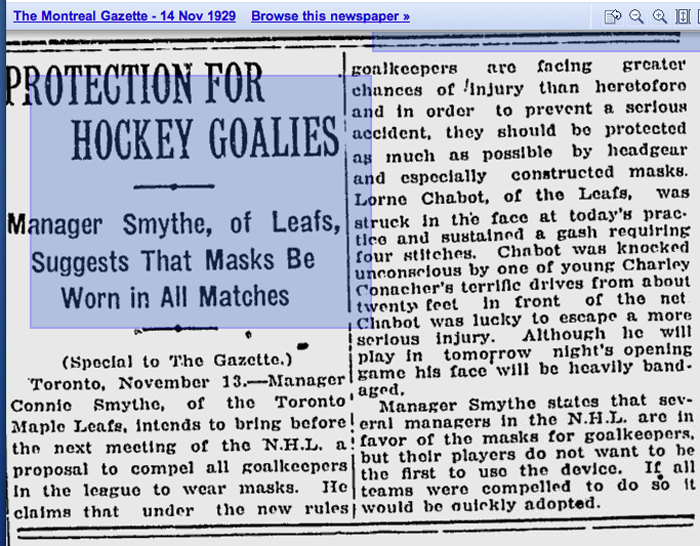
The NHL had modernized its forward passing rules for the 1929–30 season, and just as the schedule was getting under way, Conn Smythe of the Toronto Maple Leafs stated that he planned to introduce a proposal at the next league meeting making it mandatory for all NHL goalies to wear masks. Smythe stated that there were several NHL managers in favor of the move, but no goalie wanted to be the first, so a rule should be adopted to compel them all to do so.

Smythe Masks

Apparently, the Ontario Hockey Association had passed such a rule for the 1921-22 season saying that goalies may wear a mask for protection though nobody appears to have done so. Despite what Smythe said in 1929, it would be many years before the NHL adopted similar legislation. Amazingly, even as late as 2009–10, the NHL rule book only said that: Protective masks of a design approved by the League may be worn by goalkeepers. The wording was not changed to say must be worn until 2010-11!

These days, the trendy answer to the question who wore the first goalie mask is Elizabeth Graham, who donned a fencing mask while playing net for the Queen’s University women’s team in 1927 … reportedly under pressure from her father who had recently paid for some expensive dental work. However, others had already worn masks before Ms. Graham. The earliest story I’ve come across about a goalie wearing a mask in a hockey game is from the New York Times on February 24, 1916. The Union Club defeated the Knickerbocker Club 14-0 the night before as part of a Charity Ice Carnival for the Belgian Relief Fund during World War I. Knickerbockers goalie J.G. Milburn Jr. was replaced after the first period by J.J. Higginson, who, the Times noted, “wore a baseball mask.”

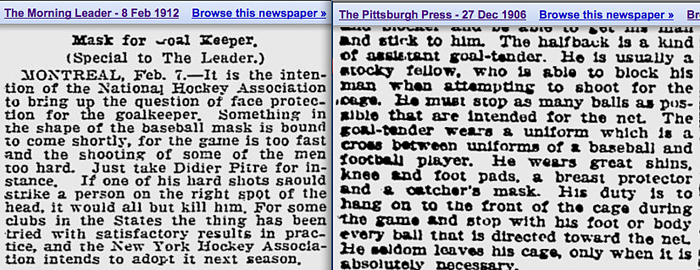
Interestingly, in a story reported in the Regina Leader on February 8, 1912, the National Hockey Association (forerunner to the NHL) was said to be considering the use of face protection for goalkeepers “in the shape of a baseball mask,” which some clubs in the United States were already said to be using in practice. A story about roller polo – essentially hockey played on roller skates – in Pittsburgh in 1906 describes the goalie as looking much like a modern-day lacrosse goalie, and wearing a catcher’s mask. (Perhaps the fact that hockey was not nearly as widely popular in the United States as it was in Canada, and was played mainly at elite schools and swank athletic clubs, meant Americans were less hung up on the “manly” aspects of the game?)

Early Masks

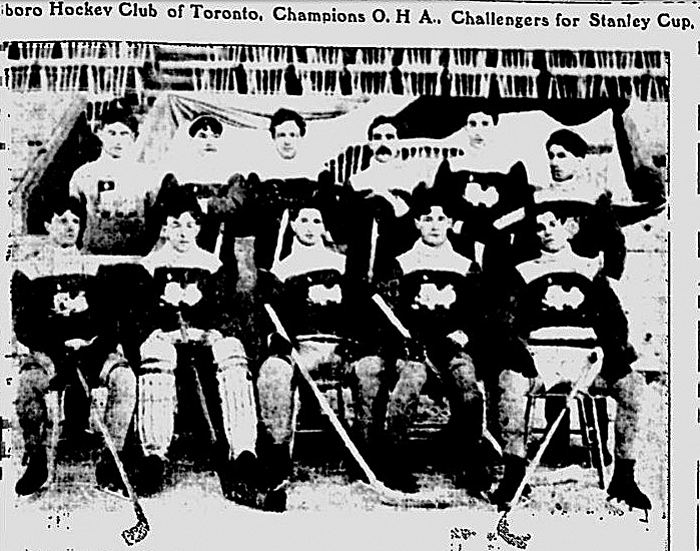
Still, the earliest example I’ve come across of a goalie using a catcher’s mask and/or a leather face shield is from Canada in 1903. Eddie Giroux (often misspelled as Geroux in newspapers) was hurt in preseason practice with the Toronto Marlboros on a shot by teammate Tommy Phillips on December 9, 1903. When Giroux returned to the ice a few days later he was wearing some sort of facial protection. Here’s a quick summary of the newspaper accounts:

• sustained “a nasty cut” in practice – Toronto Globe: Dec. 10, 1903
• skips practice, will return with baseball mask – Toronto Globe: Dec. 12, 1903
• practiced wearing a “padded hood” – Ottawa Citizen: Dec. 16, 1903
• discarded his baseball mask – Toronto Globe: Dec. 17, 1903
• experimented with baseball mask; discarded it – Montreal Gazette: Dec. 18, 1903
• discarded baseball mask, using leather headgear – Winnipeg Telegram reporting from Toronto News: Dec. 21, 1903

Whatever it was Giroux was wearing, he does not appear to have used it when the Marlboros played their first exhibition game in Barrie on December 18, nor in any games that followed during the 1903-04 season. He was said to be having trouble locating shots from the side while wearing it. Baseball catcher’s masks date back to the 1880s, and hockey goalies were quick to adopt cricket pads for added protection during the 1890s, but for now, Giroux’s brief experiment is the oldest usage of a mask by a goalie that I’m aware of.

Marlboros
Giroux wears the pads (but no mask) while seated second from the left with the Marlboros in 1904. Tommy Phillips is seated second from the right. Giroux followed Phillips to the Kenora Thistles in 1905. They won the Stanley Cup in 1907.

Glowing Pucks From Hockey’s Past

The NHL recently added many “enhanced” analytic stats to its web site NHL.com. More are likely to come. This year, at the recent NHL All-Star Game, the league introduced sensors in the pucks and uniforms that allow for the tracking of speed, positioning, ice time, and other data that – it’s said – will revolutionize the way we watch and understand hockey. The general buzz around all this has all been positive. VERY different from the much-maligned innovation introduced at the All-Star Game back in 1996 … the Fox Trax glow puck!

It’s not quite the same concept, but take a look at this story I recently came across from the Montreal Gazette back in 1941:

Glowing Puck

Rebuilding in Toronto

Monday, March 2nd at 3 pm Eastern marks the NHL trade deadline. Everyone seems to be in agreement that the Toronto Maple Leafs are now fully committed to rebuilding around youth, although the general consensus is that they’ll be better off waiting until this summer if they plan to trade players such as Phil Kessel or Dion Phaneuf. We shall see…

Everyone also seems to be in agreement that this is the first time the Maple Leafs have fully committed to a youth movement. That’s not entirely accurate. Though this does appear to be the beginning of the first true rebuild since the introduction of the NHL Entry Draft (originally the Amateur Draft) in 1963, it’s certainly not the first one in team history.

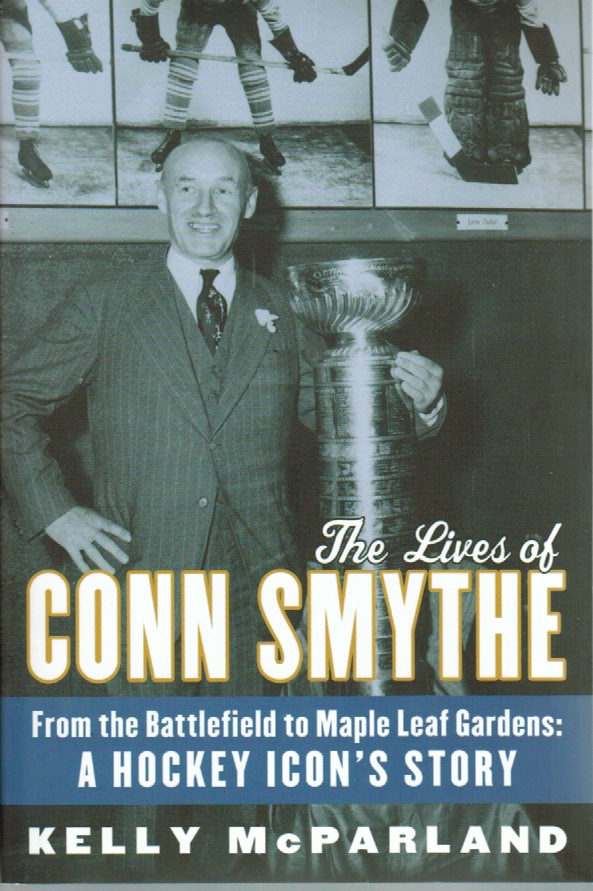
After giving up day-to-day control of the Maple Leafs while serving in the Canadian army during World War II, Conn Smythe resumed full charge of the team for the 1946–47 season. Toronto had won the Stanley Cup in 1945 only to fall out of the playoffs the following season, so Smythe and coach Hap Day decided a complete overhaul was necessary. Seven of 21 Leafs players from 1945-46 were traded, released or encouraged to retire. Another four were sent to the minors. The team would go with youth, and though Smythe couldn’t guarantee success, he promised that no team in the NHL would work harder than the new crew he assembled.

Smythe

Unlike today, how to find and properly develop this new young talent wasn’t much of a concern for Conn Smythe. With no draft and only six NHL teams, it was easy enough for him to rebuild around youth because of the sponsorship of junior and minor league teams that allowed NHL clubs – particularly the wealthier ones; Toronto, Montreal and Detroit – to stockpile young players. (Boston tried the same thing after World War II, but Art Ross didn’t have the financial resources that Smythe did.)

Conn Smythe admitted that he was critical of the 1945–46 version of the Maple Leafs not because they’d missed the playoffs a year after winning the Stanley Cup, but because they had the fewest penalty minutes in the NHL. He vowed that would never happen again under his watch. In his 1980 autobiography, Smythe wrote that he couldn’t remember when he first uttered his famous motto, “If you can’t beat ’em in the alley, you can’t beat ’em on the ice.” He also wrote that his motto was often misunderstood, stating that he didn’t want his players to be bullies, he simply wanted them to refuse to be bullied. Still, while no newspapers appear to quote him using the “alley” expression during the rebuild in 1946, it became pretty obvious that Smythe wanted tough guys in his youth movement.

Smythe “told his players he wanted a fighting team filled with the desire to mix it with anyone,” wrote Jim Vipond in the Globe and Mail on September 27, 1946 as training camp got under way. “He further stressed the importance of team spirit and co-operation.” Gordon Walker of the Toronto Star wrote that same day of Smythe’s “brief, forceful address on club policy,” quoting Smythe directly: “If they start shoving you around, I expect you to shove them right back, harder. If one of our players should get injured by illegal tactics of the enemy, I expect the players on our team to see that the man responsible doesn’t get away with it.”

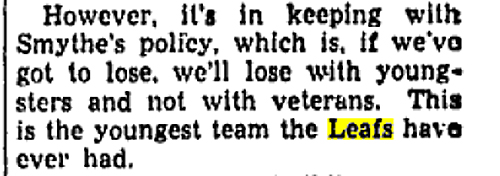
To reshape his team in the image he wanted, Smythe turned to the young players he already had in his farm system, which had been built by Frank Selke, who was now in Montreal after falling out with his longtime boss. Smythe reasoned that if the Leafs had to lose he’d rather lose with youngsters than with veterans and so on September 20, 1946, a week before training camp opened in St. Catharines, Ontario, the Leafs held what would now be called a “prospects camp.” The best from that group were invited to the main camp and were there when Smythe delivered his forceful address.

Young

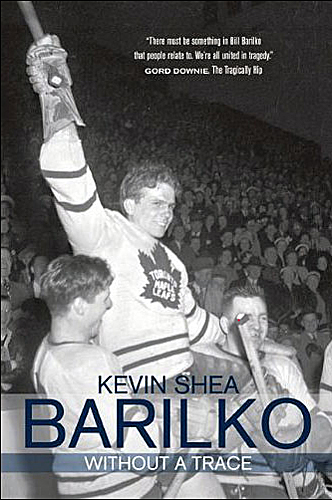
From that prospects camp emerged Bill Barilko (though he would begin the season in the minors), Gus Mortson and Howie Meeker, who would all be a part of four Stanley Cup–winning teams in Toronto over the next five years. Jimmy Thomson’s brief appearance with the Maple Leafs in 1945–46 had already earned him a spot at the main camp, where he too made the team and won four titles in the next five years. Three-time Cup-winners Garth Boesch and Vic Lynn also came out of the prospects camp, as did Tod Sloan although he needed a few more years to develop into the star he would become in 1950–51. Sid Smith hadn’t been there, but did make a brief debut in the NHL in 1946–47 before breaking out as a star a few years later. (There was, in fact, so much young talent in Toronto that Smythe would deal five players to Chicago the following season to land veteran Max Bentley.)

Barilko

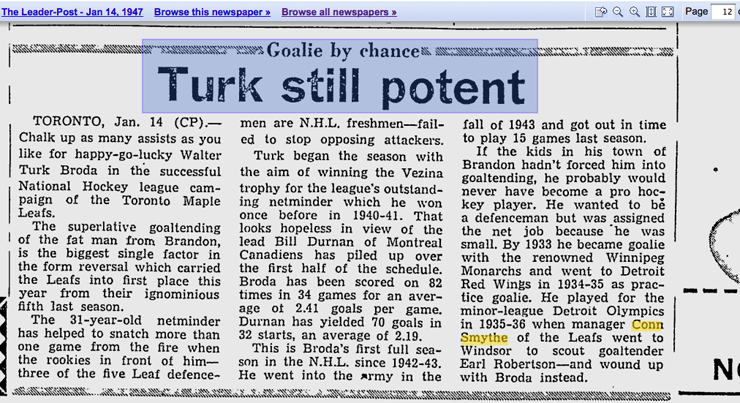
Smythe was confident entering the 1946-47 season that he’d put together a team he might win with a year or two down the road. Having Syl Apps and Turk Broda back in pre-War form, and with twenty-one year old Teeder Kennedy already entering his fourth season, certainly helped, but with six rookies among 12 new faces on the 18-man roster, Smythe down-played his expectations. “The Maple Leafs will suffer plenty of defeats this season,” he admitted. But he couldn’t completely hide his optimism: “We’ll win plenty, too!”

Broda

With a team that refused to back down from anyone, the Maple Leafs finished a surprising second behind the Canadiens in the regular-season standings. Frank Selke was critical of Toronto’s style all season, and early in the year he accused Maple Leafs defensemen of using “wrestling tactics.” There was plenty of rough stuff when the two teams met in the Stanley Cup Finals … which Toronto won to launch the club’s first dynasty.

It’s unlikely the rebuild will go quite as quickly this time!

The Odds on Pete Rose

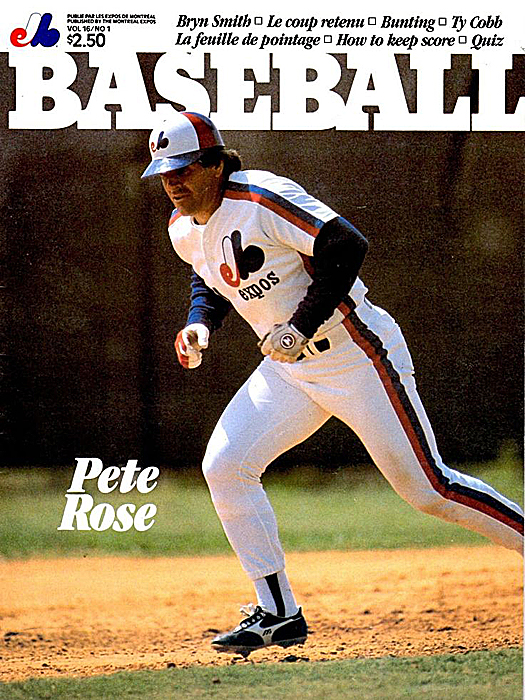
Last week, USA Today reported that Pete Rose is hopeful the new Major League commissioner will meet with him to discuss his ban from baseball. Rose has already been cleared to take part in some of the All-Star festivities in Cincinnati this summer.

I came across the story below from the January 11, 1984 edition of the Montreal Gazette a little while back and found it very interesting. Particularly now. (Coincidentally, given my story two weeks ago about about the new Red Army film, the Gazette was also reporting that day that Canadiens GM Serge Savard was preparing for an upcoming trip to the Sarajevo Winter Olympics and was hopeful that Vladislav Tretiak would return to Montreal with him to play in the NHL after the Games. Tretiak, of course, never received the permission he needed from Soviet officials to join the Canadiens.)

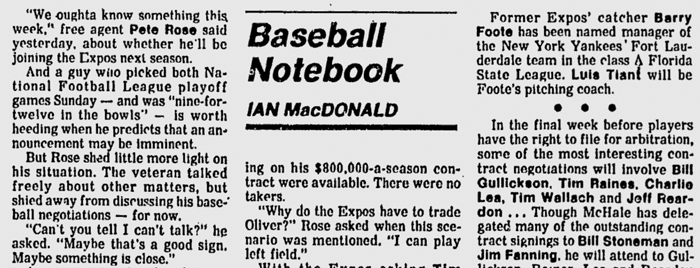
Back in 1984, Pete Rose was a free agent after five years with the Philadelphia Phillies, which had followed his 16 seasons with the Cincinnati Reds. Rose would turn 43 that April, and his batting average had dropped from .325 in 1981 to .271 in 1982 to .245 in 1983. Still, with 3,990 career hits, he was just 201 behind Ty Cobb’s all-time record at the time and there was little doubt he was going to sign with someone. The Expos and the Seattle Mariners were the only teams on record as showing any interest. Ian MacDonald wrote that Rose expected to know if he had a deal to come to Montreal within the week. (He signed with the Expos on January 20.) What I found most interesting is what MacDonald wrote next:

And a guy who picked both National Football League playoff games Sunday – and was “nine-for-twelve in the bowls” is worth heeding when he predicts that an announcement may be imminent.

Rose clip

Obviously, nobody had a problem with Rose’s gambling at this point! To insiders (though certainly not to fans like my 20-year-old self) Rose was known to be a big gambler, and was often seen at horse races.

Rose got his 4,000th hit with the Expos early in the season, but was traded to Cincinnati in August and became the Reds’ player-manager. He broke Cobb’s record the following year, on September 11, 1985. Rose gave up playing after 1986 but was still managing the Reds in 1989 when his gambling problem became known to all. That August, he was banned from baseball for life for gambling on the game. He denied for years that he’d bet on baseball, but Rose finally came clean in 2004 … though he says he only ever bet on his own team to win.

Despite the many records he holds (some of which are listed below), Rose remains ineligible for election to the Baseball Hall of Fame. There is no indication yet that Commissioner Rob Manfred plans to change this. For more on whether or not Rose should be in Cooperstown, you can read a couple of interesting stories that appeared in The Atlantic in March and August of 2014.
Rose pic

Major League Records
• Most Career Hits 4,256
• Most Games Played 3,562
• Most AB’s 14,053
• Most Singles 3,315
• Most Total Bases Switch Hitter 5,752
• Most Season 200 or more hits 10
• Most Season 600 or more AB’s 17
• Most Season 150 or more games played 17
• Only Major League Player in History to Play 500 Games at 5 Positions

National League Records
• Most Doubles 746
• Longest Consecutive Game Hitting Steak (44 Games) 1978
• Batting Champ 1968-1969-1973

Hockey Nerd – Part II: Radio Active

Back in December, I titled a story Hockey Nerd in Canada – Part I. One of my nerdiest hockey nerd interests is the early history of hockey broadcasts on the radio – which I pursue as if someone’s going to give me a prize if I finally push it right back to the beginning!

For me, this pursuit began several years ago with confusion over the date of Foster Hewitt’s first game. Hewitt himself had long claimed that his first broadcast was a senior OHA semifinal playoff at Toronto’s Mutual Street Arena. He said the game was between Kitchener and the Parkdale Canoe Club to determine who would face the Toronto Granites for the Eastern championship. He said the date was March 22, 1923 … but on March 22, 1923, the Toronto Granites defeated the University of Saskatchewan in Winnipeg to claim the Allan Cup as the senior amateur champions of all of Canada. So, how could Hewitt have called the game he said he did on that day?

Obviously, Hewitt was wrong. Turns out, his first broadcast was actually made on February 16, 1923, on Toronto radio station CFCA (which was owned by the Toronto Star, where Hewitt was employed). It was a game between the Kitchener Greenshirts and the Toronto Argonauts. Hewitt never flat out claimed (at least I don’t think he did) that his broadcast had been the very first, but he certainly didn’t discourage people from thinking that either! In truth, CFCA had actually been on the air eight nights earlier, on February 8, 1923, with Norman Albert of the Toronto Star handling the play-by-play. (For more on all this, see the story I did for the Star on the 90th anniversary of that game.)

Star Broadcast

Given that several other radio stations in several different Canadian cities (Winnipeg, Regina, and Edmonton for certain) were on the air with their own broadcasts within a very short time of the ones in Toronto, I’ve often wondered if anyone, anywhere else, had actually broadcast a game before Norman Albert. The earliest stories I’ve found saying anything about hockey on the radio are from December of 1921 and January of 1922, but they only claim that Westinghouse radio stations (KDKA in Pittsburgh, WJZ in Newark, WBZ in Springfield, Mass. and KYW in Chicago) would transmit the scores of games played in those cities.

I’ve yet to find any earlier live hockey broadcasts then the ones in Toronto, but in March of 1922, the radio station owned by the Vancouver Sun was reading on the air the telegraphed reports they were receiving of the Stanley Cup games in progress between the NHL’s Toronto St. Patricks and the Vancouver Millionaires of the Pacific Coast Hockey Association at the Mutual Street Arena. The station operated by the Vancouver World was broadcasting score updates as they were received. Neither was actually providing live play-by-play, but people certainly seemed pleased … particularly with the Sun‘s coverage.

Van Sun 1922

Eight months later, on November 28, 1922, the Stanley Cup champion St. Pats were in Winnipeg to kick off a preseason western exhibition trip with a game against the Edmonton Eskimos of the Western Canada Hockey League. As had been done in Vancouver, the Winnipeg Tribune promised that its station, CJNC, would broadcast the results from the game “as fast as reports are received.” Again, not live play-by-play, but certainly comprehensive hockey coverage for the time.

Just recently, I came across another interesting hockey broadcasting story from Winnipeg two months prior to this game, from September 23, 1922, about Lester Patrick appearing on CJNC the day before.

LP 1922

The story states:

A pleasing surprise was given to hockey enthusiasts by the appearance before The Tribune’s radiophone of Lester Patrick, manager of the Victoria Pacific Coast hockey team, and part owner of the Pacific Coast hockey league, who was passing through the city on his way west, and who delivered a short address on hockey prospects for the coming season. Sporting fans expressed their appreciation of this addition to the program.

Though I’ve yet to check every other city with radio stations at this time, Patrick’s broadcast in Winnipeg may just be the first example of sports talk radio in Canada!

Connecting all this directly to modern times … In March of 1923 the radio stations owned by the Winnipeg Tribune and the Winnipeg Free Press both agreed to go out of business (they were likely losing money!) to clear the way for a new station in Winnipeg operated by the Manitoba Telephone System, which would later become Manitoba Telecom Services. Known both then and now as MTS, this is the same company that currently holds the naming rights on the MTS Centre in Winnipeg where the Jets play.