All posts by Eric Zweig

Mixed Memories…

With the launch of my new book Art Ross: The Hockey Legend Who Built the Bruins this Saturday, and with the Blue Jays in the heat of a pennant race for the first time since 1993, I’m a little bit torn over what to write about this week. Hockey history? Blue Jays nostalgia? Fortunately, I have one memory that combines both nicely.

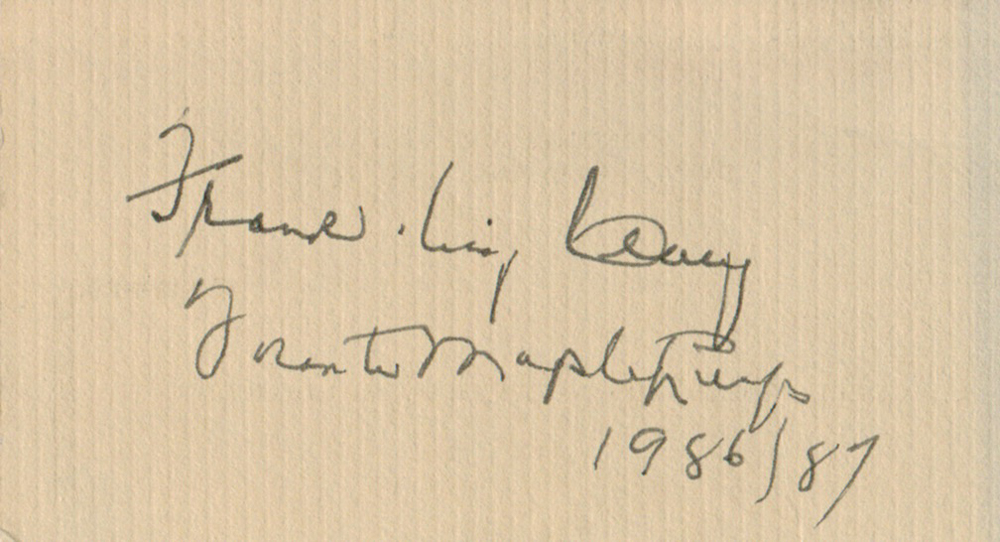
I don’t recall the exact date, but it was mid September in 1986. (Looking it up, it was either September 9, 1986 or the doubleheader on September 11 after a rainout the night before. It was definitely a wet night.) The Jays were playing the Yankees at Exhibition Stadium, and I was there with my Dad. Soon, an elderly gentleman sat down next to us. To any sports fan from Toronto at the time, he was instantly recognizable. It was King Clancy.

Clancy Auto

He couldn’t have been any nicer. He signed the autograph above for me that night, and really seemed to enjoy talking baseball with the people around us. Turned out, Clancy was a big fan of the Yankees’ Dave Winfield, but we were all trying to convince him that Jesse Barfield had the better arm.

On Facebook last week, after the Blue Jays swept the Yankees in New York, I posted a story about the August 2, 1983 Blue Jays doubleheader sweep of the Yankees at Exhibition Stadium. There was a record-setting crowd that night, and the joint was jumpin’! It’s one of my best memories from my Ground Crew days. As I pointed out on Facebook, the game the next night was a great one too, featuring Jesse Barfield nailing Ken Griffey at the plate on what I remember as the greatest throw I’ve ever seen.

Barfield

The other day, I found a YouTube clip that shows the throw. Looking at the grainy footage (the play begins at the 17-second mark), it’s a little hard to appreciate just how great that throw really was. But coming as it did in the summer of the Blue Jays’ very first pennant race, just after the Jays had gone out in front 5-1, but with the Yankees immediately threatening to get right back in the game (have a look at the Baseball-Reference summary), I’ll stick with my memory!

Oh, and by the way, it was the very next night that Dave Winfield killed that seagull. I don’t remember what King Clancy had to say about that…

A Brief History of the Hockey Phenom

So far, the NHL’s “Next One” has handled it all beautifully. Of course, the hard part hasn’t really started yet for Connor McDavid. Then again, maybe getting out there on the ice against real NHL competition, even at the age of 18, will be the easy part for McDavid. How good is he? “This guy is a special kid,” said NHL superstar Steven Stamkos the other day. “I think he’s better than me right now.”

McDavid (who trained with Stamkos for much of the summer) respectfully disagrees. “That’s obviously one of the nicest compliments,” he said, “but I don’t think that’s really true.”

McDavid

“He’s definitely way ahead of where I was at 18,” Stamkos insisted. Sidney Crosby, who met McDavid briefly this summer and entered the NHL in 2005 with similar hype, says: “I think he’s got things figured out pretty early on. I understand that the expectations are high, but he looks like a guy who is going to be able to deliver on them.”

What follows is an admittedly hit-and-miss history of hockey phenoms in headlines…

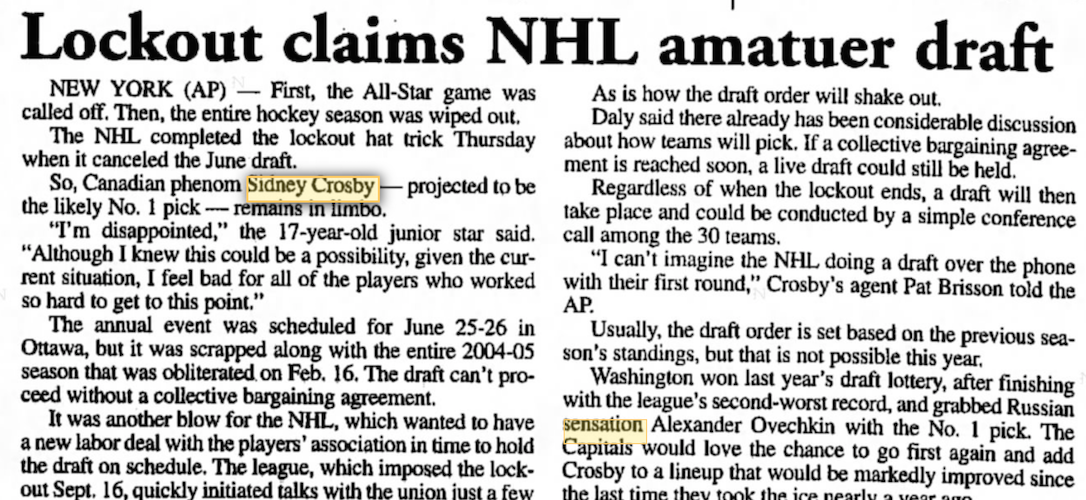
Tyrone Daily Herald (Tyrone, PA). March 25, 2005.
Crosby

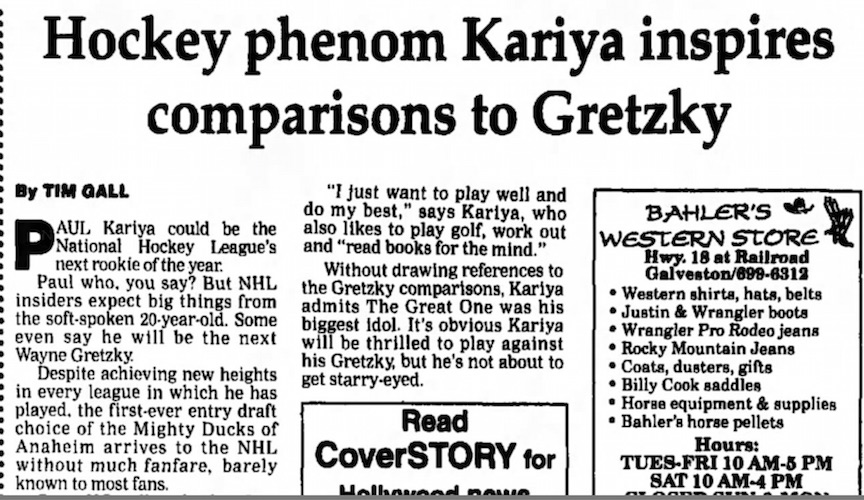
The Kokomo Tribune (Kokomo, IN). December 15, 1994.
Kariya

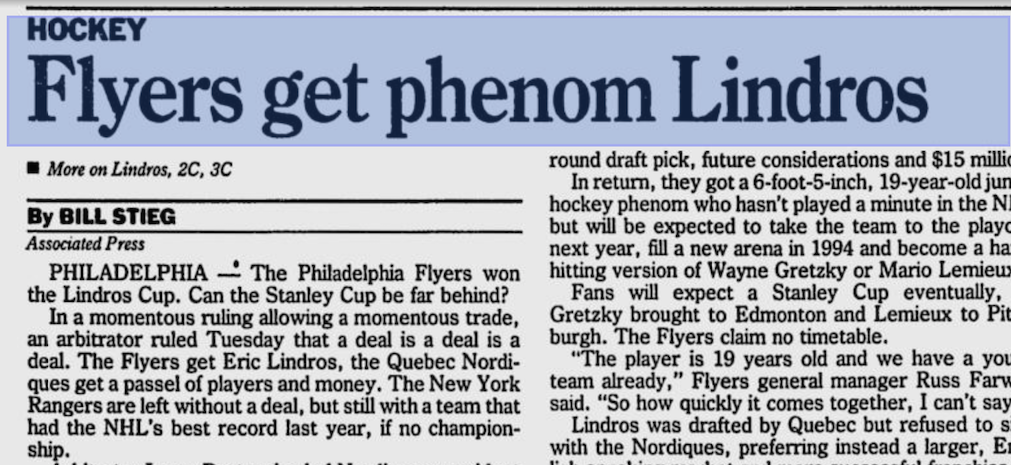
Morning Star (Wilmington, NC). July 1, 1992.
Lindros

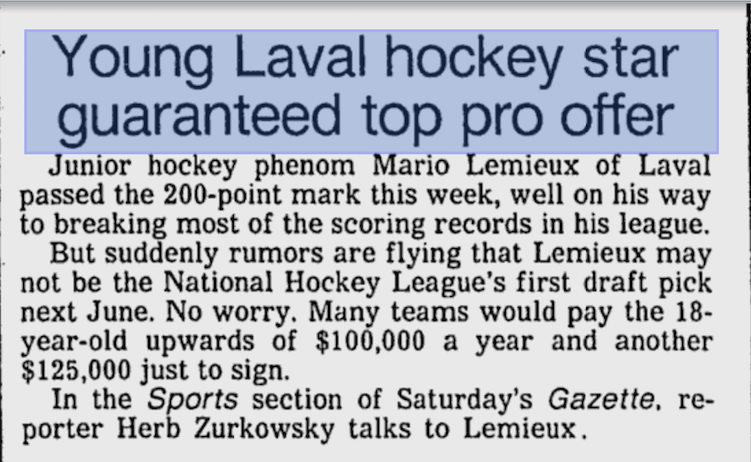
Montreal Gazette. February 3, 1984.
Lemieux

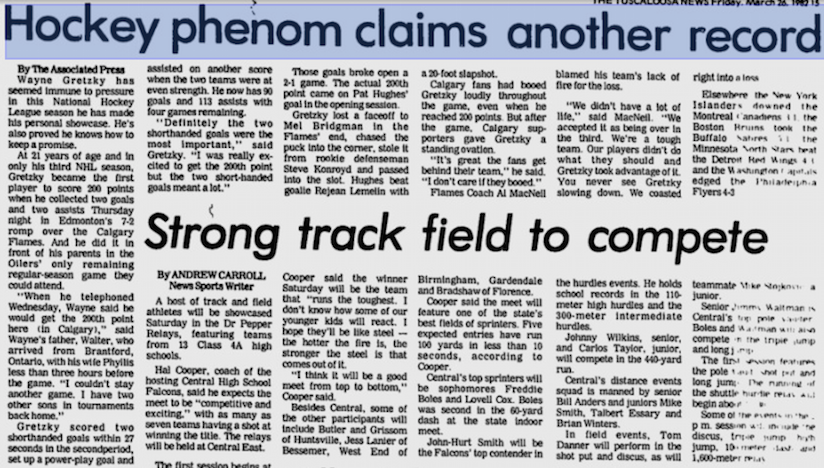
The Tuscaloosa News. March 26, 1982
Gretzky

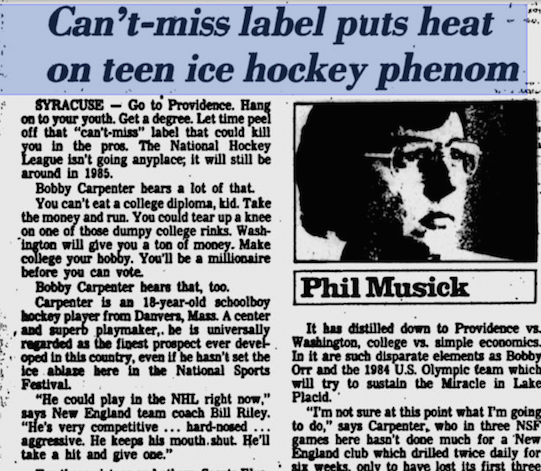
Pittsburgh Post-Gazette. July 29, 1981
Carpy

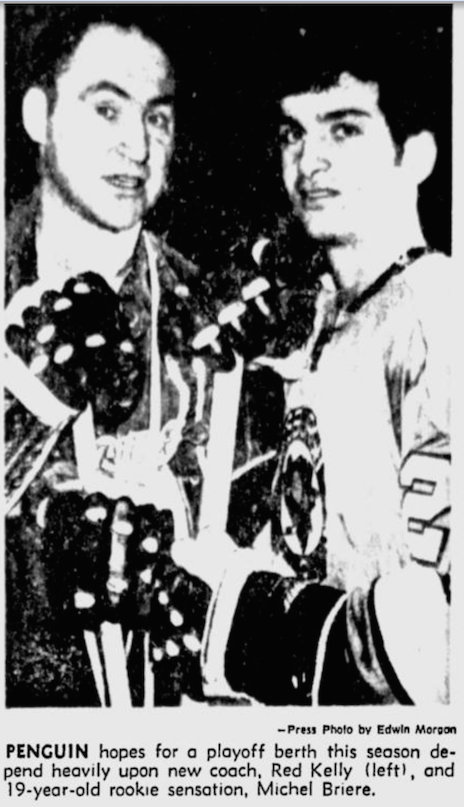
The Pittsburgh Press. October 9, 1969.
Briere

Ottawa Citizen. September 14, 1957.
Hull

The Milwaukee Journal. February 1, 1946.
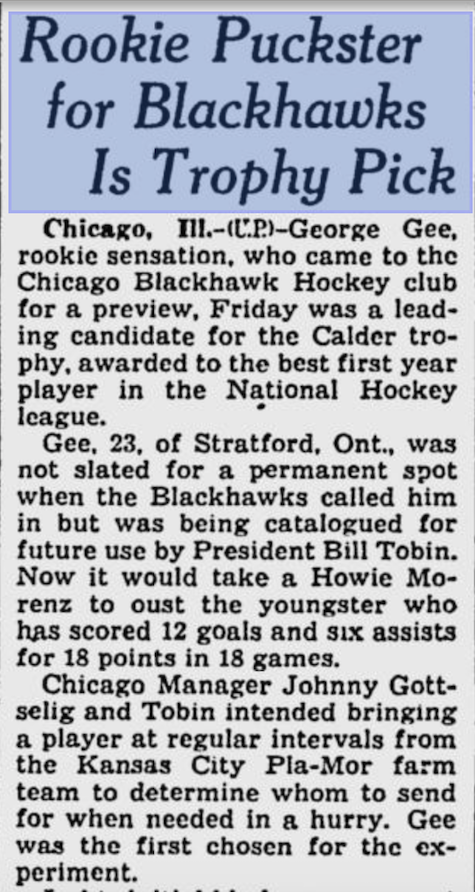
Gee

Montreal Gazette, November 9, 1942
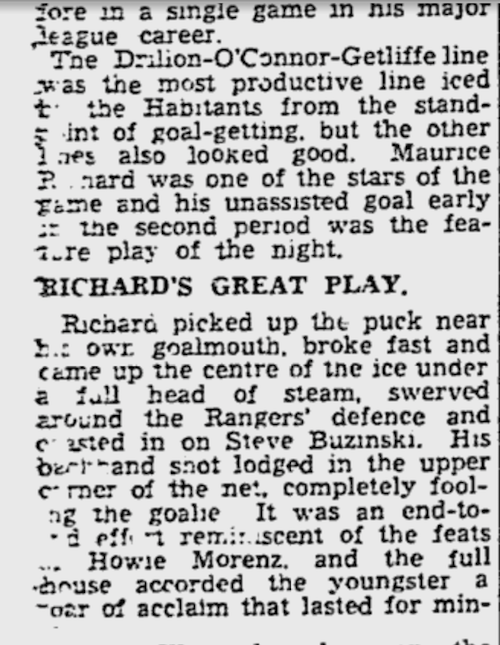
Richard

The Winnipeg Free Press. October 14, 1935.
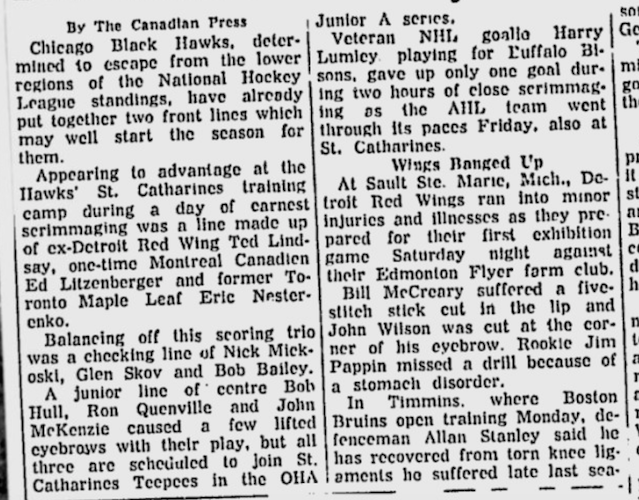
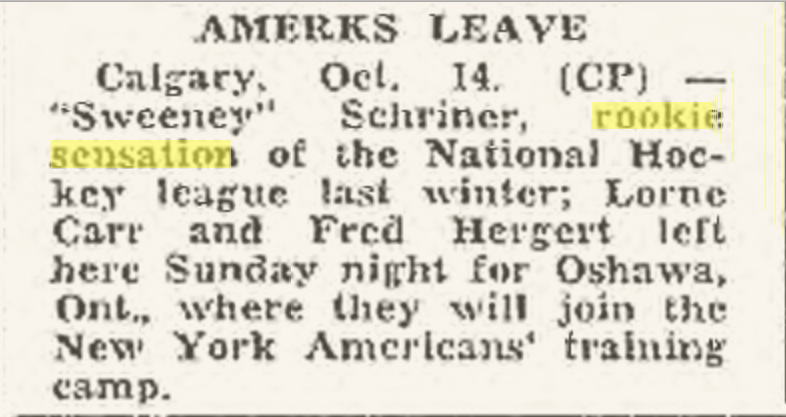
Sweeney

The Ottawa Journal. March 14, 1906.
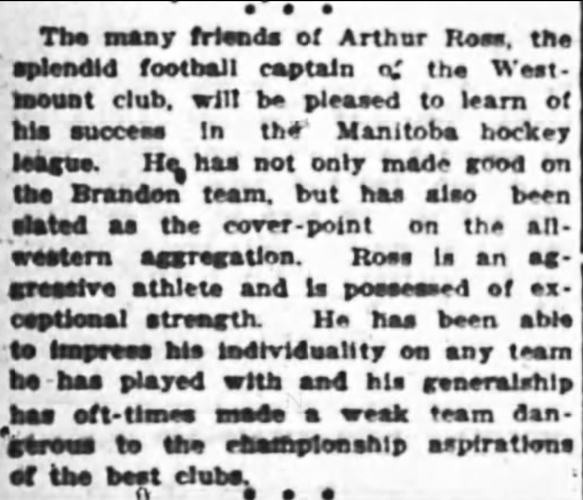
Ross

And if you haven’t already seen it, please have look at my August 20 web story about The NHL Official Guide & Record Book and Connor McDavid. The Guide will be shipped by the printer’s this week and should be in stores very soon.

A Trophy By Any Other Name

Back to hockey history this week. And, let’s be honest, a bit of book promotion too.

When I was pitching my new biography of Art Ross, I kept saying to publishing people that Ross’s name was one that every hockey fan already knew … even if they didn’t know why. That’s because, ever since the 1947-48 season, the player that leads the NHL in scoring has been rewarded with the Art Ross Trophy. As I say very early in my book, Art Ross was so much more than just a name on a trophy. But what if the NHL scoring trophy had a different name?

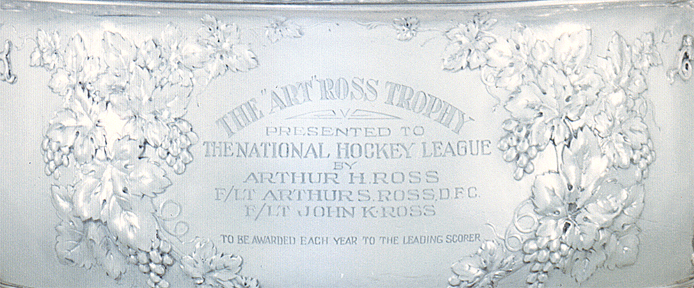
My experience has been that most people think the Art Ross Trophy was created by the NHL to honour Art Ross. That’s not true. None of the NHL’s early trophies were actually created by the league. Each piece of silverware was purchased independently by an individual donor who wished to turn it over to the NHL. Even the Vezina Trophy, which WAS named for Canadiens goaltender Georges Vezina, was purchased by the owners of the Canadiens and donated to the league in 1926 to honour Vezina after his career, and then his life, was cut short by tuberculosis. Previously, the Hart and Lady Byng, and later the Calder, were all originally named for the men and women who purchased those trophies and donated them to the NHL. Like those trophies, the Art Ross Trophy was actually purchased by Art Ross, along with his sons Arthur Stuart Ross and John Ross, and that’s why it bears his name to this day.

Ross engraving

Still, it’s unclear why the NHL went more than 20 years after the donation of a trophy to recognize the league’s best goaltender before someone finally chose to honour the league’s best scorer. Charlie Conacher, a two-time NHL scoring champion (and five-time goal-scoring champion), certainly thought it was odd.

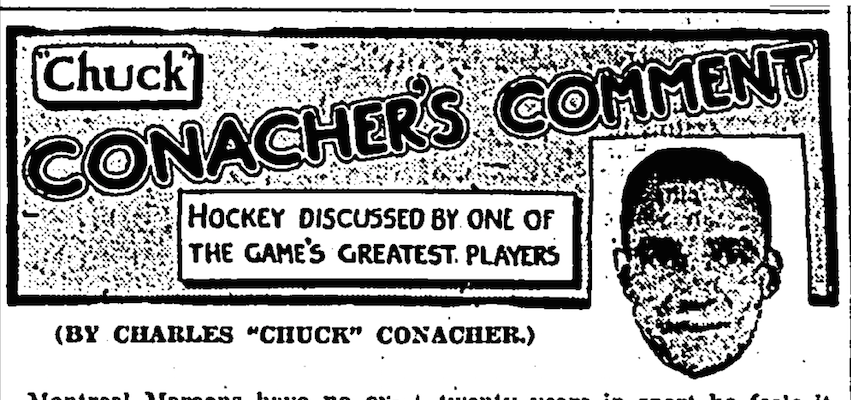
In a daily column he wrote for Toronto’s Globe and Mail newspaper during the 1936-37 season, Conacher noted on February 12, 1937: “It is the ambition of every forward to make his goals and assists reach a larger total than that of any of his rivals. I know I was always under the impression that there was a trophy for realizing this ambition until I finally was successful. Then, the year I led the league I found that with the honour went no prize that I could keep for later years.” In his column a day later – while admitting that the NHL’s maximum salary of $7,000 was a lot of money (!!!) – Conacher added that, in addition to a trophy, a cash bonus for winning the scoring title would be nice too.

Conacher

Over the next few weeks, Conacher responded to many letters he received commenting on his trophy and bonus suggestion. Most fans were against it. Some felt it would encourage selfish play (to which Conacher replied that assists were worth as many points as goals). Others felt players deserved no extra award or incentive for doing what they were already paid to do (but “winners of the Vezina, Hart and Lady Byng Trophies are only doing their duty too,” countered Conacher in his February 18 column). There were those who supported Conacher’s idea, but felt that such a trophy should be awarded to the top-scoring line, or the top-scoring team, instead of an individual player.

Nearly a month later, in his March 16, column, Conacher printed the contents of a letter he received from a Toronto man named Bob Mitchell: “I have read a great deal about your thoughts toward having a trophy for the leading scorer of the NHL…. Wouldn’t it be a fitting tribute to the late Howie Morenz if the NHL Governors donated a trophy called the Morenz Cup to be presented to the leading scorer of the NHL each season.

Morenz had passed away on March 8, 1937, several weeks after suffering a career-ending broken leg in a game on January 28. Conacher had been advocating for a benefit game for Morenz (and a players injury fund too) since his February 15 column and was pleased to report before noting Mitchell’s suggestion that the Governors had committed themselves to such a game – though it would not take place until November. None of the NHL Governors, however, ever stepped forward with a Morenz Cup. It would take until the 1946-47 season before the NHL finally awarded a $1,000 bonus to the NHL scoring leader. It was another year until Art Ross finally donated a scoring trophy.

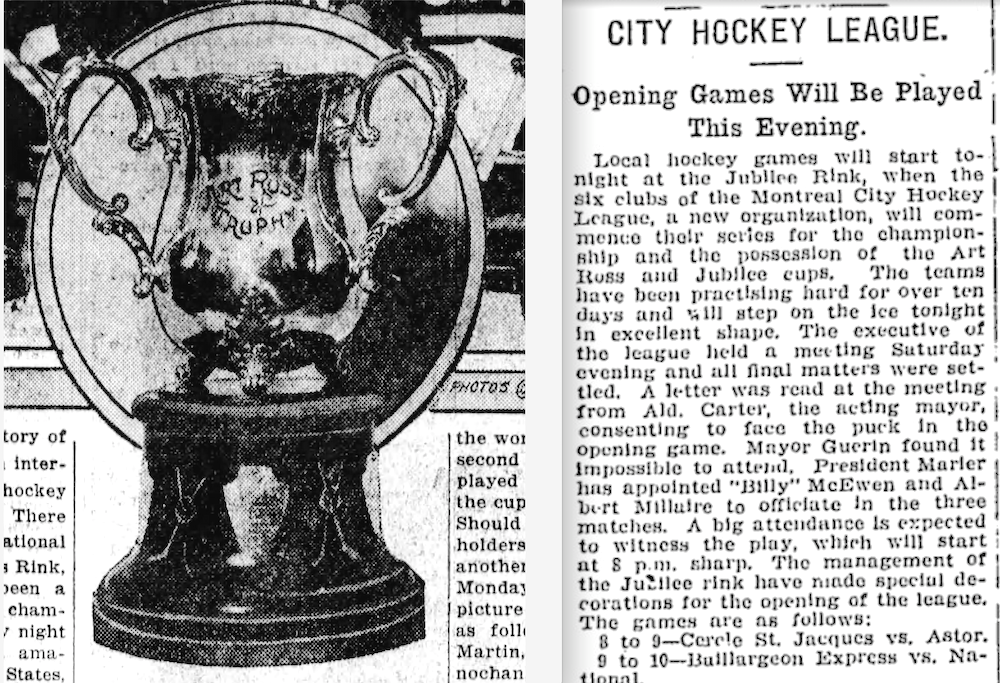
Ross Cup
This is the original Art Ross Trophy, purchased by Art Ross in 1910 for competition in the Montreal City Hockey League. A few years later, it became an international amateur award. Although the engraving clearly says Art Ross Trophy, this old mug is usually referred to as the Art Ross Cup.

Stieb and Henke

A week from today will mark the 25th anniversary of the first (and so far only) no-hitter in Blue Jays history. Dave Stieb blanked the Indians for a 3-0 victory in Cleveland on September 2, 1990. Sportsnet marks the anniversary this Sunday with Dave Stieb: Almost Perfect. I’m sure it will be good, as all their special features have been.

As anyone who knows Blue Jays history is aware, Stieb had a reputation for being prickly. In the early days, when he was so much better than most of the players around him, he often glared at teammates who made errors when he was on the mound. You still hear stories that the rest of the Jays never liked him much. I must say, though, for whatever it’s worth, he was always perfectly nice to me when I was on the ground crew.

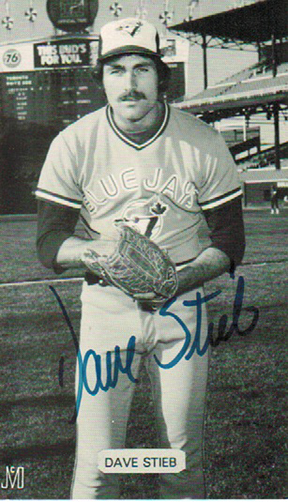
For example, my brother Jonathan had a girlfriend he wanted to impress by getting Stieb’s autograph. When I asked him if he’d sign a piece of paper for her, and he said, “don’t you think she’d like a baseball better?” He signed a ball for her, and also gave me an autographed picture. I gave the ball to Jonathan to give to the girl. I kept the picture (which I still have!) for myself.

Stieb autograph

As anyone who knows Blue Jays history is also aware, Stieb had several heart-breaking near-misses en route to finally throwing his no-hitter. The first of those came 30 years ago this week, on August 24, 1985. Facing 300-game winner Tom Seaver of the White Sox in Chicago, Stieb had a no-hitter through eight innings. He’d walked three, and only two runners had gotten as far as second base, but on the first pitch in the bottom of the ninth, Rudy Law took Stieb deep. No-hitter gone. Shutout too. Three pitches later, Bryan Little hit another home run.

Pitch counts were never reported in those days, so it’s unclear how many pitches Stieb had thrown. He told reporters his arm had begun to tighten up and that manager Bobby Cox might not have sent him out for the ninth if not for the no-hitter. Now, Cox turned to Gary Lavelle … who promptly gave up a home run to Harold Baines. After finally recording the first out, Lavelle surrendered a single to Carlton Fisk. The near-blowout was in danger of getting away, bringing Cox back to the mound.

Since the Blue Jays had started to contend in 1983 the bullpen had aways been a weakness. Now, finally, Toronto had someone to turn to when the game got tight. Only it wasn’t the person we’d all expected when the 1985 season began.

I remember exactly where I was when I heard that the Blue Jays had acquired Bill Caudill from Oakland at the Winter Meetings in December of 1984. (The deal cost Toronto Dave Collins – a player I liked a lot – and Alfredo Griffin – whom everybody liked, but, paraphrasing Sports Illustrated, “who was Alfredo Griffin to keep Tony Fernandez in the minors?” … and, by the way, when the Blue Jays first called up Fernandez in September of 1983, I was sent to the airport to pick him up! He gave me a bat as a souvenir.)

Caudill signs

Caudill’s contract was expiring when the Blue Jays acquired him, and I also remember exactly where I was in February of 1985 when I heard they’d avoided going to arbitration with him. I was thrilled. Locking up Caudill was the move that was going to put us over the top, but it went bad right from the start.

Caudill struggled in spring training, and then pitched poorly (despite picking up a pair of wins) when Toronto opened the season in Kansas City. A few days later in Baltimore, the Blue Jays were leading the Orioles 7-3 in the bottom of the eighth when Caudill entered the game with two on and nobody out. (Remember when teams used their relief aces that way?) He promptly issued a walk to load the bases, gave up a run-scoring ground out, a single to make it 7-5 … and then a monster three-run homer to Eddie Murray. Jim Acker got out of the inning, but the Blue Jays lost 8-7.

“I’m no superman,” Caudill would say as his struggles continued … but fortunately, the Blue Jays had Clark Kent waiting in reserve!

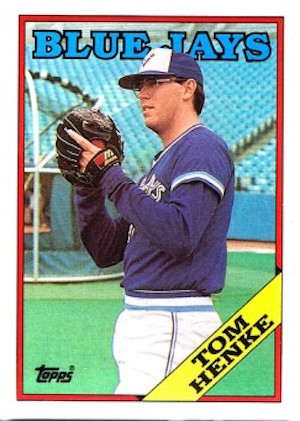
Henke

I most decidedly do not remember where I was when the Blue Jays claimed Tom Henke from the Texas Rangers in January of 1985 as compensation for losing Cliff Johnson to free agency. But as Caudill struggled, I do remember the reports on Henke in the press notes I would read in the photographers dugout where we on the ground crew watched the games. The late-blooming 27-year-old bricklayer from Taos, Missouri was putting up stunning numbers in Syracuse. By the time he got to Toronto on July 28, Henke’s Triple-A numbers read: 51.1 innings, 13 hits, 18 walks and 60 strikeouts. He had a 2-1 record with 18 saves and had surrendered only five runs (all of them earned) for an ERA of 0.88.

Henke got a nerve-wracking win in a 4-3, 10-inning victory in Baltimore in his Blue Jays debut on July 29, 1985. He picked up a more efficient win two days later. His first save came at home versus Texas on August 2. Bill Caudill earned a sloppy save the following night, but it was the last one he got in 1985. Tom Henke ruled the back of the bullpen now, and it turned the franchise around. Henke got the final two outs to save Stieb’s near no-hitter 30 years ago this week, and kept on racking up saves until the Blue Jays were World Series champions in 1992.

One Book to Guide Them

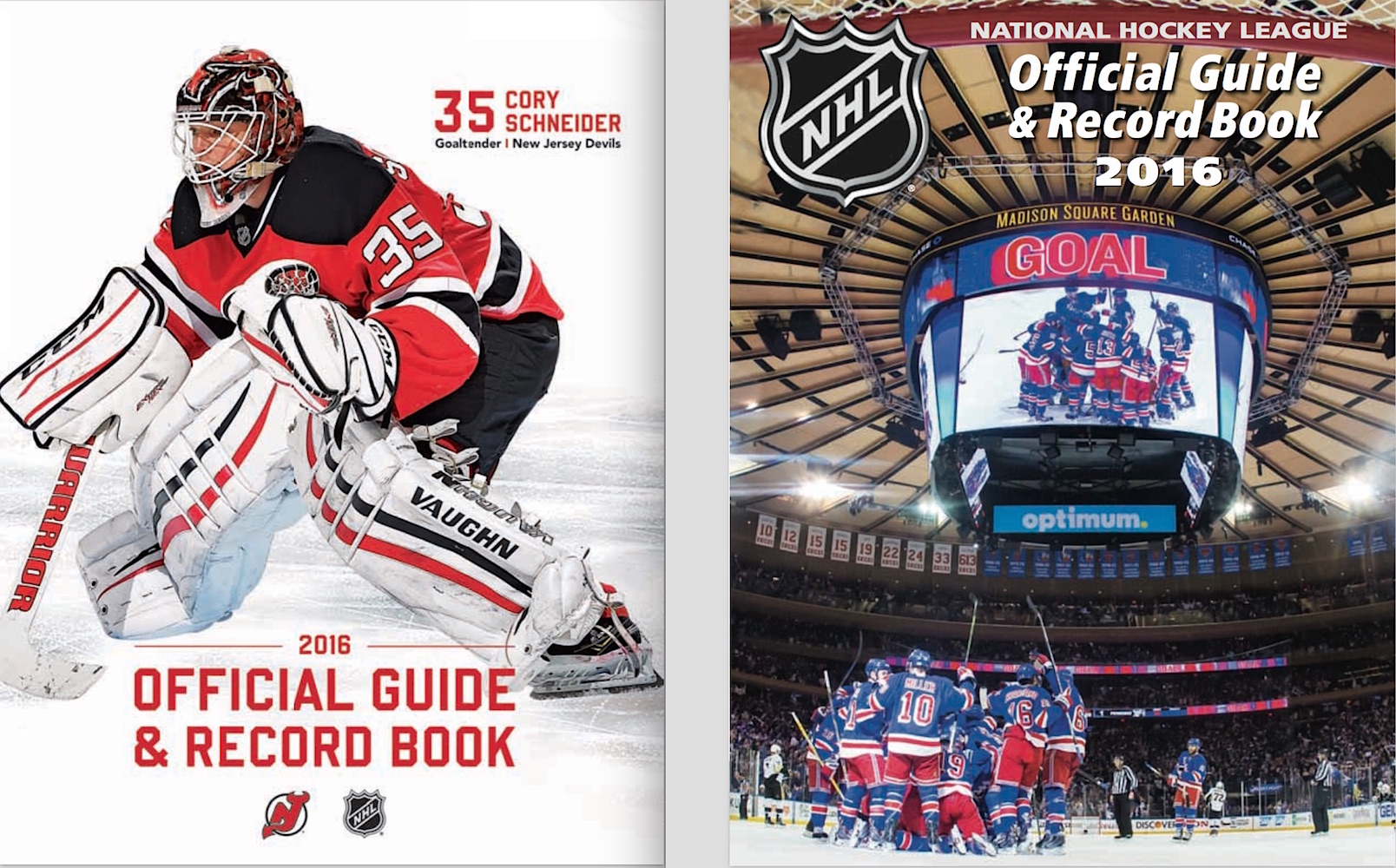
The NHL Official Guide & Record Book was completed this week and sent to the printer. This will be the 84th edition of a book that dates back to the 1932-33 season. Milt Dunnell, the dean of Canadian sportswriters who died at the age of 102 in 2008, used to send a note to Dan Diamond every year saying something along the lines of, “Jim Hendy could never have guessed what his little pocket guide would become.”

Jim Hendy worked on what he called The Hockey Guide until 1951, after which he turned over the book to the NHL. Through expansion after 1967 and right into the 1980s, the book maintained its “pocket” format, although as the NHL grew from six to 21 teams it was split into two books: a Guide and a Register. In 1984, Dan Diamond proposed a reorganization and redesign that saw the NHL Official Guide & Record Book remodelled into magazine-sized pages including photographs for the first time. Dan’s first Guide was 352 pages. Over the years, it’s grown to 672 pages!

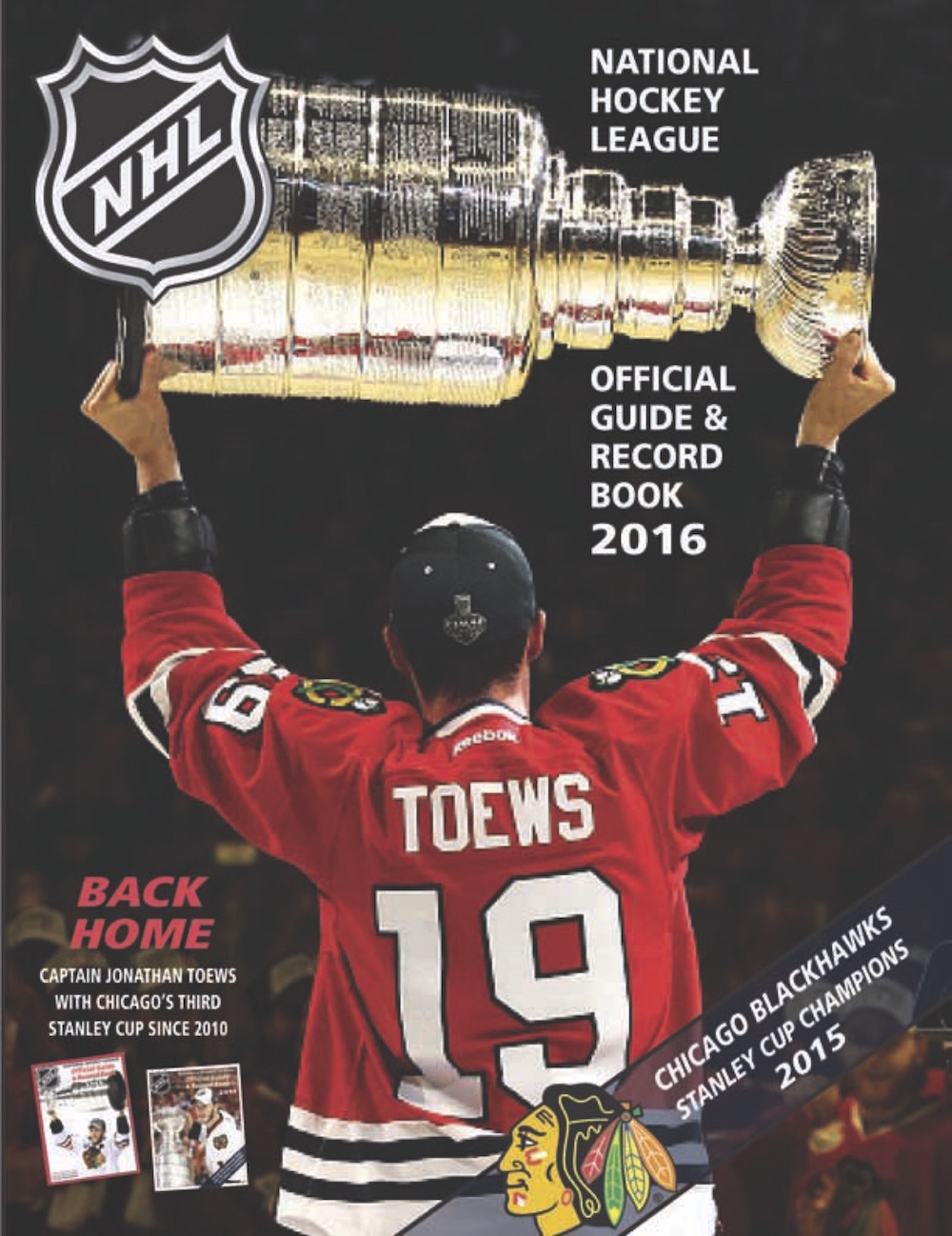
Guide Cover
The National Cover

No matter what the size, Dan Diamond & Associates takes its mandate of being the NHL’s Official Guide very seriously. A tremendous amount of care and attention goes into being accurate. Obviously, the NHL Communications department aids greatly in this, but you can help too. Every year, a note in the Guide states: “We appreciate comments and clarifications from our readers” and that, “Your involvement makes a better book.”

This year, we corrected a decades-old error in Alec Connell’s record from 1927-28 for the Longest Shutout Sequence By a Goaltender based on an article Don Weekes wrote last fall for The Hockey News and brought to our attention. (And, yes, we go with Alec. Although Connell’s given name was Alexander and many call him Alex, Alec does seem to be what he went by himself for most of his life.)

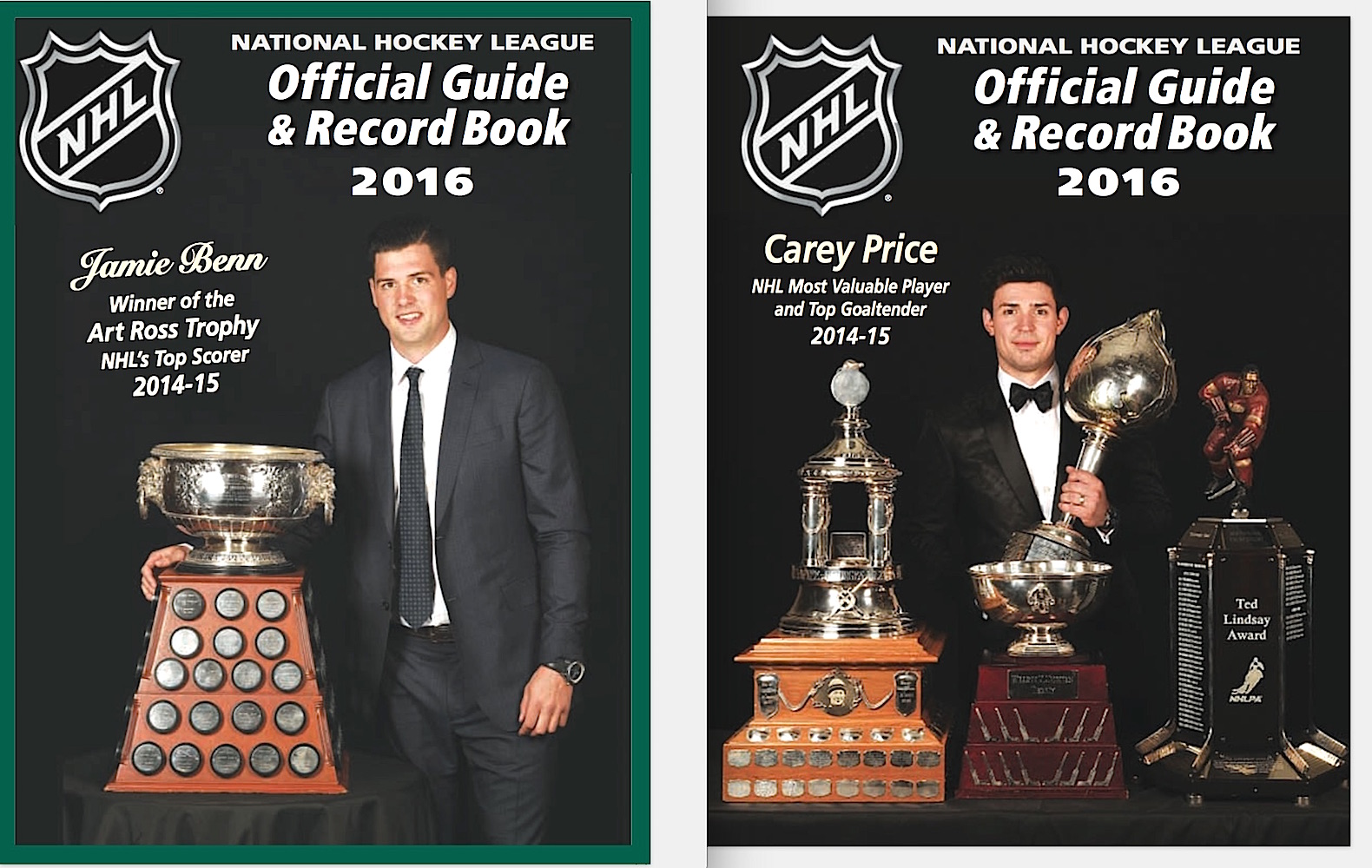
Dallas Montreal
Dallas and Montreal custom covers

I’ve been working with Dan Diamond & Associates since the summer of 1996. Among the many jobs I do, it’s been my responsibility for the last decade or so to assemble statistical panels for newly drafted North American players that will appear in the Guide’s Prospect Register for the very first time. As often as possible, we like to include a line of statistics from a player’s last year of minor/youth hockey before he moved up to Junior A or college. There are many web sites that aid the cause these days, though I always like to double-check (and often triple-check) what’s on any stats-specific site against what’s on a league or a team’s web site. Every summer, there are numbers that don’t match or can’t be found, and can only be resolved by contacting a team, or a coach, or a parent directly.

It’s always fun talking to a proud coach or parent in the weeks after a young player has been selected in the NHL Draft. This past spring (even before the NHL Draft was held), I had the opportunity to “talk” via email with Connor McDavid’s father to try and clarify his son’s statistics from his last year of midget hockey with the Toronto Marlboros of the GTHL.

Devils Rangers
Devils and Rangers custom covers

I had noticed that while every stats site seemed to have the same amazing totals for McDavid’s spectacular 2011-12 season (88 games, 79 goals, 130 assists, 209 points), none of the sites that broke down his numbers into season games, playoff games and tournament games showed the same results. A big deal? Not really. But I thought that if Connor McDavid was going to be the next great NHL superstar everyone believes he will be, it would be nice to get it right! Turns out, Connor’s father felt the same way.

I contacted the Marlboros (who, I know, from past years, do not officially keep statistics for their players) and they put me in touch with Brian McDavid, who had tracked all of his sons stats that season. “Please don’t lump me into the ‘crazy hockey dad’ category for doing this,” he wrote, “but I felt Connor had a chance to be a significant player in the game in the future and … that his season would be lost from a statistical view if I didn’t do it myself.” He sent me an Excel sheet showing Connor’s performance game-by-game, not only for the Marlboros that season but also for his team at the PEAC School for Elite Athletes in North York (a Toronto suburb).

Colorado Calgary
Colorado and Calgary custom covers

So, while we can’t match the up-to-the-minute aspect of the many sports web sites out there these days, you’ll be hard pressed to find any one site on the Internet that can give you all the information as neatly and concisely as that contained in the NHL Official Guide & Record Book … and I dare say you’ll have an even harder time finding one that does so with such attention to detail.

This year’s Guide will be in bookstores in early September. Or you can order it online right now at the dda.nhl eBay site.

Rhapsody in Blue Jay

I’ll admit it. I’ve been pretty pessimistic when it comes to the Blue Jays over say, the last 22 years. Can you blame me? But, to my credit (or maybe not), I’ve never bailed on them. Now that I live in Owen Sound, I don’t get to see them live nearly as much as I used to, but I keep watching on television night after night after night. I haven’t always been sure why I do. Sometimes, it felt like a strange kind of loyalty to my younger self.

Still, I kept watching. But any time I was foolish enough to even let myself start to believe for a short time, they’d break my heart. Now? I’m pumped! This past weekend in New York was amazing. And – even though it’s August and not September – it got me thinking back to the pennant race of 1985 … the first time Toronto won the American League East.

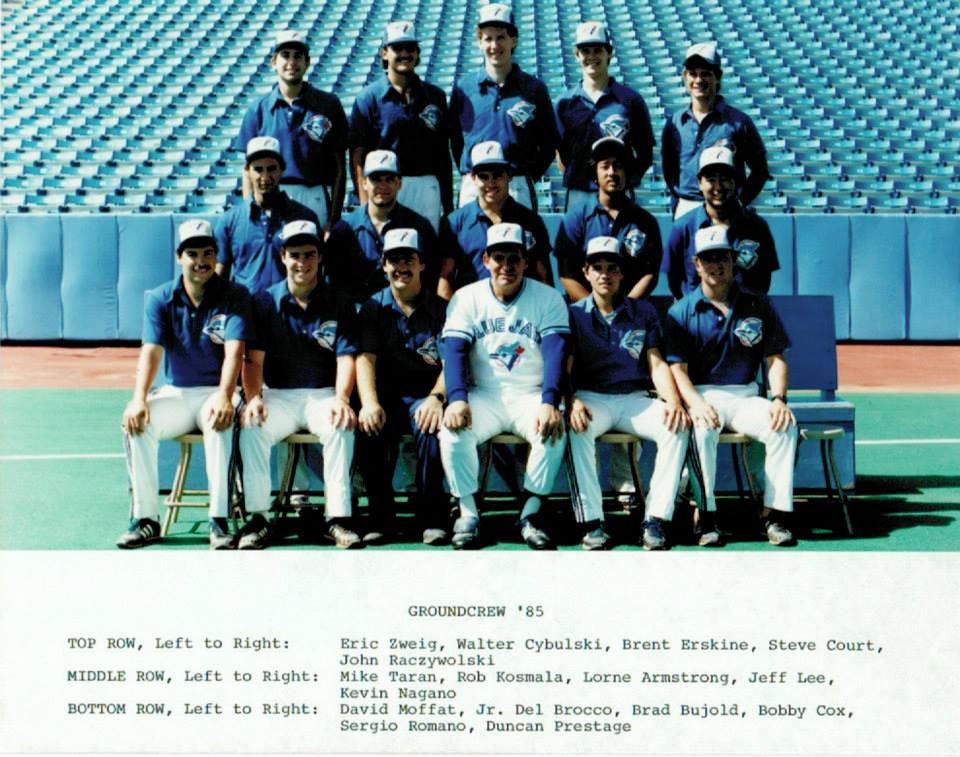
As many of you know, my family lived and died with this team in those days. (OK, we still do!) We still have the season tickets we’ve had since the moment they went on sale prior to the first season in 1977. I grew up with this team and it was a blast! In 1985, I was in my fifth and final year on the Blue Jays ground crew as the team made the journey from worst to first.

Jay Crew

On August 4, 1985, the Blue Jays were 67-39. They were 9 1/2 games up on the Yankees in the American League East. Over the next five weeks, the Jays went 21-12. The Yankees went 29-6. They had two seven-game winning streaks and an 11-game streak during that stretch. Every night, it seemed, they were trailing, only to rattle off a big inning late in the game to pull out a victory. It was testing my faith.

There was an old security guard who worked in the Blue Jays bullpen in those days. I’m very sorry I can’t remember his name. I loved talking with him. As a boy in 1930s, he’d lived in New York and worked at the Polo Grounds. As an old man (in the days long before the Internet), he carried papers in his pocket on which he tracked all of baseball’s all-time leaders and which current players were gaining on them.

I remember walking out to the bullpen one day and admitting to him how nervous I was getting. Dennis Lamp (who went 11-0 in relief that year) glared at me. People may remember a picture of him in the clubhouse after the Jays clinched, pointing to a sign he’d made that said something along the lines of, “People counted this team out, but we never heard the bell.” I’ve never told anyone this before, but I sort of felt he was talking to me. But that’s getting a little ahead of the story…

When the Blue Jays headed into New York to begin a four-game series on September 12, their once-big lead was down to 2 1/2 games. That Thursday night, the Jays were leading 4-1 through six innings. But as they had done for weeks, the Yankees rallied in the seventh. Two brutal errors by Tony Fernandez led to six runs on just three hits. The Yankees won the game 7-5.

Amazingly, the Blue Jays bounced back. They won the next three in a row, and stretched their lead back to 4 1/2 games. Though things got nervously tight again over the next couple of weeks, Toronto clinched the AL East Division on October 5, 1985, with a 5-1 victory over the Yankees.

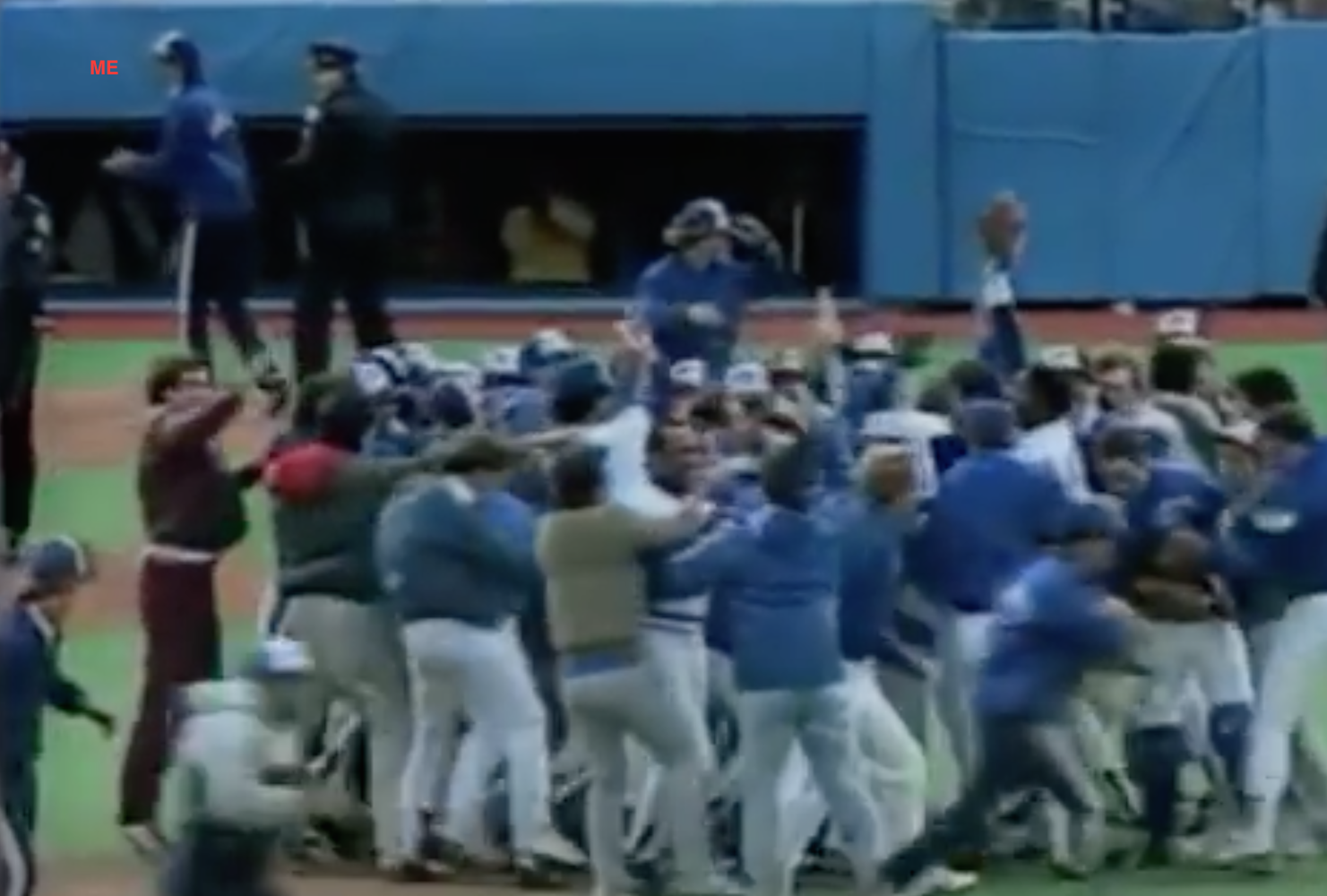
I was right there on the field a few seconds later, assigned the job of protecting home plate in case any excited fans wanted to dig it up as a souvenir. In some of the film footage (unfortunately, not the TV footage you can find on YouTube) you can clearly see me running onto the field, hugging a fellow ground crew member, and then turning to face the stands, where my brother Jonathan had been sitting, and waiting for him to race onto the field to leap into my arms.

Jays 85

The World Series wins were great. My wife Barbara and I often remember the nervous feeling in our stomaches as Game Six in 1992 went into extra innings, and I remember wading through a room full of people after the game, struggling to reach and embrace my brother David. But for me, 1985 will always be special. It staggers me to think it was 30 years ago…

Chasing Art Ross

As many of you know, my newest book will be out this fall. It’s a biography of hockey legend Art Ross. Early last month, I wrote the following email:

Art Ross Title

From: Eric Zweig
Subject: Biography of Art Ross
Date: June 8, 2015 at 12:06 PM EDT
To: Bryan Trottier

Dear Mr. Trottier,

My name is Eric Zweig. For nearly 20 years, I have worked with the small publishing company that creates the NHL Official Guide & Record Book. I am also the author of more than 20 books about hockey and hockey history for both children and adults. You and I met several years ago in Kenora during the 100th anniversary celebration of the Kenora Thistles’ 1907 Stanley Cup championship. I spoke at the dinner about Art Ross’s contributions to the team.

This fall, I have a book coming out with Dundurn Press in Toronto that will be the first full-scale biography of Art Ross. In order to generate publicity for the book, several Canadian hockey writers have agreed to read advanced copies and (hopefully!) offer positive comments. Scotty Bowman and Harry Sinden have also agreed to do this. I am hopeful that you, as a past winner of the Art Ross Trophy, might be willing to provide a brief, written, comment about the experience of winning the Art Ross Trophy.

Thank you, and I look forward to hearing from you.

To be honest, I wasn’t sure he would even receive the message. I certainly didn’t expect he’d remember me, and could easily imagine an email from an unknown address going directly to spam, or being deleted without a second thought. But to my delight, barely an hour later, I received the following response. I thought it was pretty amazing, and with Bryan Trottier’s permission, I share it with you now:

Trottier Art Ross

From: Bryan Trottier
Subject: Re: Biography of Art Ross
Date: June 8, 2015 at 1:14 PM EDT
To: Eric Zweig

Hi Eric

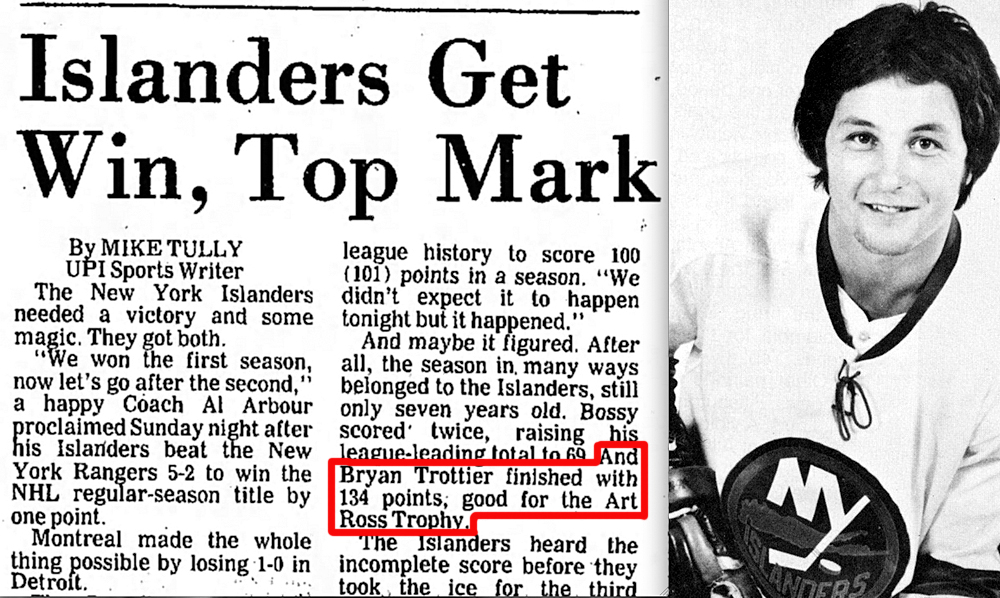
Winning the Art Ross Trophy was an interesting quest and achievement. The 1978-79 season was a strong year for our team [the New York Islanders]. Our line was having a terrific offensive year and Mike Bossy was on a tear scoring goals. We rode the wave and were too young and dumb to recognize any pressures. We were just doing something we loved to do.

I do remember feeling a bit selfish, which was uncomfortable, but as the season was winding down, I started to recognize how my teammates and Al [Arbour, our coach] were rooting for me. Everyone was making it almost a team mission. This I loved most! “Lets help Trotts win it.” I needed the support and talents of teammates… Clark Gillies, Mike Bossy, Denis Potvin were huge talents, [John] Tonelli, [Bob] Bourne, etc. I needed quality ice time from the head coach. [Al’s] combination of line mates and power-play groups — double shifting was helpful. I also needed the selflessness of some of the other center men sharing their ice time.

I believe Guy Lafleur and I were tied going into the last game of the season. I was in New York versus the Rangers and he was in Detroit facing the Red Wings, who were having another trying season. I thought, “Uh oh…” And Marcel Dionne had just had a five-point night to catch us as well, I think. I ended up scoring a goal and assist while Jim Rutherford shut out the Canadiens. I remember watching the out-of-town scoreboard and being amazed at what Detroit was doing. I came to the bench a couple times and Al asked if I could go again. “Wow, he’s really giving me every chance possible,” I thought, and Mike Kaszycki and Wayne Merrick were telling me to take their next shift. Wow, forever grateful to two great, selfless teammates. Dave Lewis, Ed Westfall, Bob Nystrom were all urging and prodding. “You may never get another whack at this kid,” so “go for it!” was their message.

I don’t believe I ever made a public declaration that I wanted to win the Ross, and I think Al Arbour and [GM] Bill Torrey liked that I was a bit reserved and guarded as to my comments or answers to the press when asked about the race. But it was there and I did give it my very best as I didn’t want to waste the opportunity afforded me by fate, teammates and coach/management. I do remember the Long Island fans loving it as the fan mail was full of well wishers, and I remember Mike Bossy being as proud as a brother when the season ended. “Feels good, huh?” he said. To which I said, “Thanks, Boss!” Enough said. We both knew what the other was thinking. “Couldn’t have done it with out ya!”

A few years ago, I was at an alumni event and a random hockey fan came up to me and told me that I was one of three players in the history of the game to win the Art Ross, the Hart, the Calder, the Conn Smythe, plus the Stanley Cup at least twice. I wouldn’t be in this group if not for Jim Rutherford and a 1979 Islanders team that pushed, supported, encouraged and motivated me.

I wish I knew more about Mr. Ross as a player, coach, manager, innovator, etc. Your research and creative writing will be of great interest. It will be an honor to read the book.

Bryan Trottier

Visions of the Future

At the end of October, shortly after the World Series, I wrote a piece about Lester Patrick’s hockey vision for baseball’s future. With the All-Star Game tonight, we’ll check in on Frank Patrick’s thoughts on how to improve baseball. Frank is widely considered to have been the more inventive of the two Patrick brothers when it came to modern hockey rules, but his future vision for baseball didn’t pan out as well as Lester’s.

In his column in the Boston Globe on August 5,1953, Victor O. Jones recalled the days of 1934 to 1936, when Frank had served as coach of the Bruins during the depths of the Great Depression.

Bruins 1934-35
The 1934-35 Boston Bruins. Frank Patrick is seated third from the right.
Creator: Leslie Jones, 1886-1967 (photographer).
Publisher: Boston Public Library, Print Department BPL 08_06_011885
Leslie Jones-The Camera Man

He thought baseball could attract more interest if it marked the field a little more elaborately,” Jones recalled. “He want to lay down chalk lines dividing left, center and right field and also proposed that circular lines be drawn at every 100 foot radius from home plate. Frank got this idea from listening to a radio broadcast of a game. He thought if the announcer could say: ‘He hit that one beyond the 300 foot circle,’ the fans would get a better idea of just how far the batter hit the ball.”

Not much of a concern once television replaced radio, but Jones writes of another Frank Patrick brainchild that was much more visionary. “Soon after he came up with another idea – a covered building large enough to play football games inside it, with moveable sections of stands which could be rolled around to provide, from day to day, a field of play for any kind of sport from football and polo to swimming and boxing.”

FP Baseball

Jones wrote that “Frank Patrick went so far as to get an engineer to draw plans for such a stucture,” and that his domed stadium was “entirely possible from the engineering point of view.” Jones notes, however, that this was during the Depression and that “money was scarce.” Still: “Don’t be surprised someday, though, if you see such a structure.”

Interestingly, in his 1980 biography of the clan entitled The Patricks: Hockey’s Royal Family, Eric Whitehead writes that plans for Frank’s dome were drawn up around 1947 or 1948. He applied for copyrights in Ottawa and Washington, but couldn’t find any financial backers. On this one, he was truly ahead of his time.

Frank Patrick died on June 29, 1960. Ground was broken for construction of the Houston Astrodome on January 3, 1962. These days, few true domed stadiums remain, but you’d have to think that Frank would be impressed with the evolution of retractable roof stadiums since the SkyDome opened in 1989.


(NOTE: The front row in the top picture is comprised entirely by future members of the Hockey Hall of Fame. Who can name them all in addition to Frank Patrick?)

Hod Stuart Was Here

On June 23, 1907, Hod Stuart died at the height of his hockey career. He was 28 years old. Some of you reading this will recognize his name right away. Others won’t. But 108 years ago today, news of his death would have been like hearing that Sidney Crosby or Jonathan Toews had just been killed.

Hod Stuart was a defensemen (a cover point in his day), so a better comparison might be made to Drew Doughty, P.K. Subban, or Erik Karlsson, one of whom will win the Norris Trophy tomorrow as this past season’s best NHL defender. Given his status as the game’s highest-paid player, perhaps Stuart was most like Nashville’s Shea Weber – although during the 1906-07 season when hockey players were first allowed to earn salaries in Canada, you’d have to add a lot more zeroes before Stuart’s salary (which was somewhere between $1,200 and $1,500) matched the $14 million Weber makes.

Dead

William Hodgson Stuart, the son of William Stuart and Rachel Hodgson, was born in Ottawa on February 20, 1879. His father was a well-respected contractor and the captain of the Ottawa Capitals lacrosse team. Young Hod played football and hockey in Ottawa at the end of the 1890s, but moved to Quebec City in 1900 on a contracting job for his father. He played hockey there too, and met his future wife, Marguerite Cecilia Loughlin, whom he married in 1901. By 1907, they had two young children.

Hod Stuart had yet to emerge as a hockey star while playing in Ottawa and Quebec, but did so quickly after 1902 when he began to play in the United States – where players were already allowed to earn a salary. Canadian fans needed convincing when Stuart left Pittsburgh in late December of 1906 to play for the Montreal Wanderers, but his play was outstanding and the press reports were just as glowing. Late in his life, Art Ross would say that Hod Stuart was the only defenseman he’d ever seen that was in a class with Eddie Shore.

Despite what many sources say, Stuart was not yet with the Wanderers when they defeated a team from New Glasgow, Nova Scotia in a preseason Stanley Cup challenge at the end of December. He joined the team in time for its first regular-season game on January 2, 1907 and starred in the Wanderers’ Stanley Cup series with the Kenora Thistles two weeks later. The Thistles won, but the Wanderers bounced back to finish their 10-game season with a perfect 10-0 record and Stuart was a big part of their winning back the Cup in a rematch in Kenora at the end of March.

After the hockey season, Stuart returned to Ottawa but was soon at work for his father’s construction company overseeing a building project in Belleville, Ontario. On a leisurely Sunday, he spent the morning canoeing with friends. In the heat of the day around 3 o’clock, they returned to the waterfront. Hod was a strong swimmer, and he jumped in from the Grand Junction dock to cool off, swimming about a quarter-mile to a nearby lighthouse.

Memorial
Hod Stuart’s wife and daughters, circa 1910, courtesy of johnnysgirl668 on Ancestry.com

There was a small platform around the lighthouse, about six or eight feet above the water, and those watching from the dock saw Stuart climb up and rest for a few minutes before diving in again. He didn’t re-surface. Unaware of how shallow it was in certain places around the lighthouse, Stuart struck his head on a jagged rock just two feet below the waterline. He suffered a fractured skull and a broken neck, and was said to have died instantly. On January 2, 1908, the Wanderers defeated a team of all-stars in the Hod Stuart Memorial Game, which raised just over $2,000 for Stuart’s wife and daughters. In 1945, he was among the first inductees into the Hockey Hall of Fame.

The story of Hod Stuart’s death is what I intended to write about today, but in researching his life I came across something pretty amazing. In the spring of 1897, when he was just 18 years old, Stuart left Ottawa with another local boy, sponsored by a group that included Hod’s father, to seek his fortune in the Klondike, where gold had been discovered during the summer of 1896.

As I wrote last week about the Spanish-American War, the Klondike Gold Rush is among my many wide-but-not-deep historical interests, and in a letter written to his father on May 31, 1897 (as reported in the Ottawa Journal on July 27), Hod rhymes off many familiar names:

Klondike

We left Dyea, an Indian village, Sunday…. We towed all the stuff up the river seven miles and then packed it to Sheep’s Camp…. A beautiful time we had I can tell you, climbing hills with fifty pounds on our backs…. We left Sheep’s Camp next morning at four o’clock, and reached the summit at half-past seven…. The Chilkat Pass [note: though the Chilkat Pass was a route to the Klondike, this is likely a misspelling of the more famous Chilkoot Pass, which was just beyond Sheep Camp] is not a pass at all, but a climb right over the mountains…. It was an awful climb – an angle of about fifty-five degrees. We could keep our hands touching the trail all the way up. It was blowing and snowing…

Another letter, written on June 28, appears in the Journal on October 12, but there’s not much news after that. However, on April 7, 1898, the Journal notes that Hod was among the first Ottawa parties in the gold fields, and that his father “has learned from time to time that his son has been doing well.” Astoundingly, William Stuart had left for the Klondike the night before, having contracted to build the Bank of Commerce building in Dawson City. By September of 1898, father and son were back in Ottawa. Hod failed to seek his fortune in gold, but soon found fame as an athlete.

Football
Pulford is Hockey Hall of Famer Harvey Pulford, although this clip refers to Hod Stuart’s senior football debut with the Ottawa Rough Riders on Thursday, November 24, 1898.